Both the Bible and the Qur’an condemn idolatry, not artistic storytelling.
Islamic history itself contains many depictions of humans and even images of Muhammad.
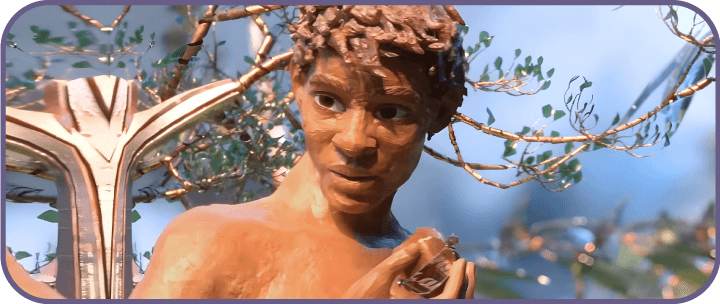
In The Legacy of Adam, such imagery is symbolic and not meant to portray God literally.
Some Sunni scholars since the 9th century have interpreted certain hadith as banning artistic depictions of living beings. However, the Qur’an itself does not explicitly forbid figurative art. What it clearly condemns—like the Bible—is idolatry, the worship of images.
Historical evidence shows that figurative art has existed throughout Islamic civilization. Umayyad palaces were decorated with frescoes of humans and animals, and Abbasid art included figurative ceramics, metalwork, and carvings. In the 13th century, Muslim artists even produced illustrated manuscripts showing scenes from the life of Muhammad.
Descriptions in religious texts also naturally create images in the mind. The Qur’an itself describes God using expressions such as “hands,” which Muslim scholars traditionally understand as symbolic language, not literal physical descriptions.
In the same way, the visual portrayal of God in The Legacy of Adam is not meant as a literal depiction. It is a storytelling device intended to help audiences understand the narrative, not an object of worship.
For these reasons, many scholars argue that the real issue addressed in both the Bible and the Qur’an is idolatry, not the artistic representation of people or symbolic depictions used in teaching or storytelling.
Sunni scholars since the 9th century have interpreted some hadith as implying a general ban on art depicting living beings (figurative art). However, many artistic representations of living beings are found in Islamic history, including pictures of humans and animals that adorned palaces of the Umayyad era, and paintings of Mohammad by Muslim artists in the 13th century. Besides, written descriptions of humans or God’s “hands” in the Qur’an inevitably produce figurative images in the minds of readers. Like the Bible, rather than condemning figurative art, the Qur’an condemns treating figurative art as an idol.
Like the Bible, the Qur’an condemns idolatry, but not the artistic depiction of human figures. As Malise Ruthven observes: “There is no explicit ban on figurative art in the Qur’an, but popular Muslim tradition became strongly iconophobic . . .”1 The hadith against figurative art were (along with all hadith) written down more than a century after Mohammad’s death, and are tied to particular events in such a way that they need interpreting in order to be applied in any general manner. From the 9th century onward, Sunni exegetes increasingly saw in them categorical prohibitions against the representation of living beings, but different branches of Islam disagree on this subject: “Aniconism is common among fundamentalist Sunni sects . . . and less prevalent among liberal movements within Islam. Shia and mystical orders also have less stringent views on aniconism.”2
Many artistic representations of living beings are found throughout Islamic history:
Frescos and reliefs of humans and animals adorned palaces of the Umayyad era . . . The ‘Abbasid Palaces at Samarra also contained figurative imagery. Ceramics, metal ware, and objects in ivory, rock crystal, and other media also bore figural imagery in the medieval era.3
In the 13th century, miniatures of Muhammad were commissioned from Muslim artists by rich patrons: “they show almost every episode of Muhammad’s life as recounted in the Qur’an and other texts, from birth to death and ascension into heaven.”4
In Islamic literature, Muhammad’s appearance is described in the traditions about his life and deeds known as Sirah Rasul Allah. Literary descriptions of humans in the Qur’an inevitably result in imaginative depictions of humans in the minds of readers. John Kaltner and Younus Mizr note that:
The reference of divine hands, as well as other anthropomorphisms that are used to describe God in the Qur’an, have been discussed frequently by Muslim commentators, and it is generally held that they are not meant to be taken literally.5
Likewise, the visual depiction of God in The Legacy of Adam is not meant to be taken literally.
Malise Ruthven, Islam: A Very Short Introduction (Oxford, 2012), 43.
“Aniconism in Islam” https://en.wikipedia.org/wiki/Aniconism_in_Islam.
“Aniconism in Islam” https://en.wikipedia.org/wiki/Aniconism_in_Islam.
Emma Graham-Harrison, “Drawing the prophet: Islam’s hidden history of Muhammad images”, The Guardian, 10th Jan 2015, www.theguardian.com/world/2015/jan/10/drawing-prophet-islam-muhammad-images.
John Kaltner & Younus Mizra, The Bible and the Qur’an: Biblical Figures in the Islamic Tradition (London: Bloomsbury T&T Clark, 2018), 16.
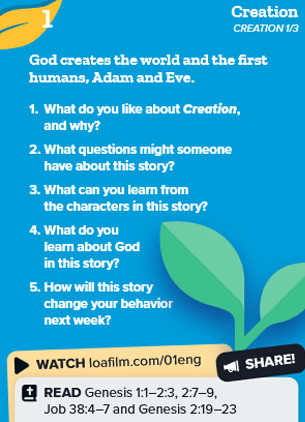
No, episode 1 does not deny God as Creator of everything.
It combines Genesis 1 and 2 using artistic storytelling.
Eden is shown as part of the Earth, not separate from creation.
Episode 1 does not deny that God is “Creator of the heavens and the earth.” Instead, it presents an artistic synthesis of the two creation accounts found in Genesis 1 and 2.
In Genesis 1:1–2:3, God creates the entire cosmos, “the heavens and the earth”, including humanity as male and female in His image. Then, in Genesis 2:4–24, the focus narrows: God forms a specific man (Adam), plants a garden in Eden, and places him there.
These are not necessarily contradictory accounts but can be understood as two perspectives:
– Genesis 1 gives a broad, cosmic overview of creation.
– Genesis 2 zooms in on a particular location and moment within that creation.
Episode 1 reflects this by portraying Eden and the Garden as specific places within the already created world, not separate creations. The sequence is adjusted slightly for storytelling clarity, which is what is meant by “artistic license.”
There are also different interpretations of how these chapters relate:
Some see them as overlapping descriptions of the same events, while others see Genesis 2 as a continuation after Genesis 1.
In either case, the core claim remains intact: God is the Creator of everything, and Eden is part of that creation.
Episode 1 takes some “artistic license” in portraying the creation. In Genesis 1:1-2:3 God creates “the heavens and the earth,” including mankind “in his own image . . . male and female . . .” (Genesis 1:27.) Genesis 2:4-24 describes God forming “the man of dust” before planting “a garden in Eden, in the east” where “he put the man whom he had formed.” (Genesis 2:8.) In the original Genesis account, Eden and the Garden are clearly parts of the Earth.
Episode 1 is an artistic representation of material from the first two sections of the Old Testament book of Genesis. As such, it takes some “artistic license.” Chapter 1:1-2:3 is about God creating “the heavens and the earth”, including His creation of “man”, i.e. mankind, “in his own image . . . male and female he created them.” (Genesis 1:27.) Chapter 2:4-24 is about God forming “the man of dust” before He planted “a garden in Eden, in the east” where “he put the man whom he had formed.” (Genesis 2:8.) It is clear that Eden and the Garden are specific parts of the Earth. Indeed:
The Persian Gulf Oasis seems to match the description of the Garden of Eden in Genesis. Till about twelve to ten thousand years ago, the seas were hundreds of feet lower. Surprisingly evocative of the Genesis account of the Garden, the Persian Gulf was dry land, irrigated by four rivers, without rain, but with fresh water springing up out of the ground. As seas rose globally, the Persian Gulf was submerged under the ocean . . .6
Some people think these two stories in Genesis offer different perspectives on the same events, such that that Adam and Eve either are, or are a part of, the humanity created by God in Genesis 1:27. Other people think Genesis 2:4-24 follows on in historical sequence from Genesis 1:1-2:3, in which case Adam and Eve are particular people created by God after His creation of humanity in general, an interpretive option excluded by Surah’s 4:1 and 7:11-27 of the Qur’an.
S. Joshua Swamidass, The Genealogical Adam & Eve: The Surprising Science Of Universal Ancestry (Downers Grove, IL: IVP Academic, 2019), 167.
The “six days” are often understood symbolically or as long periods, not literal 24-hour days.
Both the Bible and the Qur’an allow for a structured or gradual creation.
Episode 1 reflects this by showing creation as a process.
Episode 1 follows Genesis 1 and 2, presenting creation in an artistic and visual way, including processes like growth and development over time. This can seem longer than “six days,” but that depends on how those “days” are understood.
Both the Bible and the Qur’an mention creation in six days (e.g., Surah 11:7, 50:38), but many scholars do not interpret these as literal 24-hour periods. Instead, the “days” are often seen as a literary structure, a way of organizing God’s creative work, or as longer epochs or ages.
Even within Islamic scholarship, the Arabic word yawm (day) can refer to more than a single day, sometimes meaning an extended period of time. The Qur’an itself suggests that creation unfolds in stages (e.g., Surah 71:13–17), which aligns with a more gradual process.
Episode 1 reflects this broader understanding by showing creation dynamically, with growth and development, rather than compressing everything into six literal days.
So rather than contradicting the idea of “six days,” the episode adopts a widely accepted interpretation that sees those “days” as symbolic or expansive, allowing for a more natural depiction of creation unfolding.
Episode 1 is an artistic representation of material in Genesis 1 and 2. The Qur’an gets its description of God creating “in six days” (Surah 11:7 & 50:38) from Genesis 1:1-2:3. While some people interpret this passage literalistically, most people recognize it isn’t meant to be read this way, and that the “days” of creation should be understood as a literary framing device and/or an analogy for God’s creative activity, or as representing extended periods of time.
Episode 1 presents an artistic representation of material taken from the first two sections of Genesis (i.e. Genesis 1:1-2:3 and Genesis 2:4 ff.), with a focus on the material in the second section. The Qur’an gets its description of God creating “in six days” (Surah 11:7 & 50:38) from Genesis 1:1-2:3. While some people interpret Genesis 1:1-2:3 in a literalistic manner that reads the six days as consecutive 24-hour time periods, most people recognize that it isn’t meant to be read in a literalistic way, and that the “days” of creation should be understood as a literary framing device and/or as an analogy for God’s creative activity, or as representing extended periods of time. Indeed, theologian Matthew Bennett observes that:
Many contemporary scholars of Islam contend that the Arabic word for day (yom) can refer to a literal twenty-four-hour period or a much larger time more aptly translated as “age.” Furthermore, Qur’an 71:13–17 indicates that God’s created world has undergone a gradual process of development . . .7
Matthew Bennett, 40 Questions About Islam (Grand Rapids, MI: Kregel Academic, 2020), 121.
“God’s image” does not mean physical likeness, but a special role and dignity.
It points to humans representing God and caring for creation.
This is similar to the Qur’an’s idea of humans as God’s stewards (caliphs).
When Genesis says that God will “make man in our image,” it is not referring to physical appearance, since God is not a material being. Instead, it points to a unique status and role given to humans.
In the Bible, being made in God’s image means that humans are created to represent God, reflect aspects of His character, and exercise responsibility over creation. It gives humans a distinctive dignity and purpose compared to the rest of creation.
Although the Qur’an does not use the phrase “image of God,” it expresses a related idea by describing humans as God’s caliphs (khalifa) on earth (Surah 2:30). This term implies stewardship, responsibility, and representation on behalf of the Creator.
However, there is a difference in emphasis. The biblical concept suggests that humans have an intrinsic identity tied to God’s image, giving them deep, inherent value. In contrast, the Qur’anic language tends to emphasize humanity’s role as servants entrusted with a task.
So, in Episode 1, the phrase “in our image” reflects this biblical idea: humans are not just created beings, but representatives of God’s authority and care within creation, expressed through storytelling rather than literal form.
The Biblical language about man being created in God’s “image” doesn’t mean we literally look like God, but is an even more exalted version of the Qur’an’s description of humans as God’s caliph on earth [Surah 2:30].
Although the Qur’an doesn’t use the figurative language of humans being created in God’s “image” (which does not mean being made to physically resemble God, because God is a spiritual being, but which means that God entrusts humans with the responsibility of stewardship), it does use a somewhat similar concept. As Chawkat Moucarry observes:
The creation of human beings in the image of God is not a concept found in the Qur’an. The Qur’an does, however, describe humanity as God’s caliph on earth ([Surah] 2:30). The Arabic word khalifa is used to refer to the men who succeeded Muhammad at the head of the Muslim nation. When it is applied to people in general, it indicates that the Creator has entrusted us with the responsibility of representation and of stewardship (cf. [Surah] 38:26).8
That said, Andy Bannister explains that: “For the Qur’an, humans are valuable and important, but just slaves of Allah. For the Bible, humans are far more than that: they are image bearers, people with intrinsic and fundamental value and dignity because of their very nature.”9
Chawkat Moucarry, The Prophet and the Messiah (Downers Grove, IL: IVP, 2001), 86.
Andy Bannister, Do Muslims And Christians Worship The Same God? (IVP, 2021), 86.
Episode 1 follows the Genesis account, where Eve is created from Adam.
Both the Bible and Islamic tradition affirm that she comes from him.
The “rib” may be symbolic, pointing to unity, not a literal procedure.
Episode 1 follows the Genesis narrative, where Adam is created first and Eve is later formed from him. This sequence is not unique to the Bible; the Qur’an also states that humanity was created from a single person, and that his wife was created from him (Surah 4:1).
Although the Qur’an does not explain how Eve was created, many Islamic commentators and hadith traditions describe her as being formed from Adam, often mentioning a “rib.” This shows a shared underlying idea: humanity begins from a unified origin.
The biblical text in Genesis 2:21 is often translated as “rib,” but the original Hebrew word can also mean “side.” In other parts of the Old Testament, it is used for sides of structures or landscapes, not anatomy. This has led some scholars to argue that the passage is not describing a literal surgical act.
Additionally, the “deep sleep” mentioned in the text is often associated elsewhere with visions or divine revelation, suggesting that Adam may be receiving insight into the nature of human relationship rather than undergoing a physical operation.
In this reading, the creation of Eve from Adam’s “side” communicates a deeper meaning: man and woman share the same essence and are designed for unity and partnership.
The Qur’an interprets and retells the original Biblical story about Adam in a way that fits its own theology.
As Andy Bannister comments: “Whenever the Qur’an retells biblical stories and traditions, it adjusts and adapts them, reshaping them to fit its own theology and agenda.”10 According to Surah 4:1, God “created you from one person, and created from him his wife, and scattered from the two of them many men and women.”11 In other words, the Qur’an is clear that God created Hawwã (i.e. Eve) from Adam. Moreover, as John Kaltner and Younus Mizra point out: “while the Qu’ran does not detail how Eve/Hawwã’ was created, many commentators narrate that she was created from Adam’s rib.”12 There is a hadith in which Mohammed says: “Treat women kindly. Woman has been created from a rib and the most bent part of the rib is the uppermost. If you try to turn it straight, you will break it.”13 However, this doesn’t appear to be a statement about Eve’s material origins, but a metaphor warning against a husband trying to reshape the character of his wife.
Some people think Genesis 2:21’s depiction of God creating Eve from one of Adam’s “ribs” whilst he sleeps is intended as a literal description of events. Other people think it is intended figuratively. Either way, the traditional reference to “one of his ribs” is probably the result of poor translation, as when the Hebrew word translated as “ribs” in Genesis 2:21 is used elsewhere in the Old Testament, it “is not as an anatomical term in any other passage.”14 In these other passages, the word refers to planks or beams, to this or that “side” of an architectural plan, or to the other “side” of a hill (2 Samuel 16:13). Hence Genesis 2:21 should probably be translated: “So the LORD God caused a deep sleep to fall upon the man, and while he slept took one of his sides and closed up its place with flesh.” Furthermore, when the phrase “deep sleep” is used in other Old Testament passages, including later in the book of Genesis (i.e. Genesis 15:12-16), when a person has a vision from God (see also Daniel 7:1 & 8:18). Hence theologian John Walton argues from an examination of the Hebrew text that:
Adam’s sleep has prepared him for a visionary experience rather than a surgical procedure. The description of himself being cut in half and the woman being built from the other half (Gen. 2:21-22) would refer not to something he physically experienced but to something that he saw in a vision. It would therefore not describe a material event but would give him an understanding of an important reality, which he expresses eloquently in Genesis 2:23.15
Andy Bannister, Do Muslims And Christians Worship The Same God? (IVP, 2021), 83.
Gordan D. Nickel & A.J. Droge (trans), The Qur’an With Christian Commentary: A Guide to Understanding the Scripture of Islam (Grand Rapids, MI: Zondervan Academic, 2020), 107.
John Kaltner & Younus Mizra, The Bible and the Qur’an: Biblical Figures in the Islamic Tradition (London: Bloomsbury T&T Clark, 2018), 43.
“Was Eve Created from Adam’s Spare Rib?”, https://aboutislam.net/counseling/ask-about-islam/eve-adams-spare-rib/.
John H. Walton, The Lost World Of Adam And Eve (Downers Grove, IL: IVP Academic, 2015), 78.
John H. Walton, The Lost World Of Adam And Eve (Downers Grove, IL: IVP Academic, 2015), 80.
Peter S. Williams, “The Beginnings of History: Evidence from Genesis to Joseph.” (2025)
YouTube Playlist, “Genesis.”
http://www.youtube.com/playlist?list=PLQhh3qcwVEWhQcmE4OsKJWhtnzA65up7t
YouTube Playlist, “Human Origins.”
http://www.youtube.com/playlist?list=PLQhh3qcwVEWggUTIWUFS7jpMSdPFKyVUw
YouTube Playlist, “Islam.”
http://www.youtube.com/playlist?list=PLQhh3qcwVEWjhD84EB0jEG5PswCOcDsmJ
Emma Graham-Harrison, “Drawing the Prophet: Islam’s hidden history of Muhammad images.” The Guardian, 10th Jan 2015,
http://www.theguardian.com/world/2015/jan/10/drawing-prophet-islam-muhammad-images
Gerhard F. Hasel, “The Meaning of “Let Us” in Genesis 1:26.”
https://digitalcommons.andrews.edu/cgi/viewcontent.cgi?article=1307&context=auss
Conrad Hyers, “The Narrative Form of Genesis 1: Cosmogonic, Yes; Scientific, No.”
www.asa3.org/ASA/PSCF/1984/JASA12-84Hyers.htmlLinks to an external site
Douglas Jacoby, “How Long are the “Days” of Genesis 1?”
http://www.douglasjacoby.com/qa-1502-long-days-genesis-1/Links to an external site
Amna Khalid, “Most of All, I am Offended as a Muslim.” (29th Dec, 2022)
https://banished.substack.com/p/most-of-all-i-am-offended-as-a-muslim
Paul Marston, “Understanding the Biblical Creation Passages.”
http://www.lifesway.net/understanding_the_biblical_creation_passages.htmlLinks to an external site.
Todd Patterson, “How Can the Creation Account in Genesis 1 be Both History and Literature?”
http://www.toddjana.com/how-can-the-creation-account-in-genesis-1-be-both-history-and-literature/
Andy Bannister. Do Muslims And Christians Worship The Same God? (IVP, 2021)
Matthew Barrett, et al. Four Views On The Historical Adam (Zondervan, 2013)
J. Daryl Charles. ed. Reading Genesis 1-2: An Evangelical Conversation(Hendrickson, 2013)
C. John Collins. Science and Faith: Friends or Foes? (Crossway, 2003)
William Lane Craig. In Quest of the Historical Adam: A Biblical and Scientific Exploration (Eerdmans, 2021)
Ann Gauger, et al. Science and Human Origins (Discovery Institute, 2012)
John Garvey. The Generations of Heaven and Earth: Adam, the Ancient World, and Biblical Theology (Cascade, 2020)
Kenneth D. Keathley, ed. Perspectives On The Historical Adam And Eve: Four Views (Lifeway, 2024)
John Lennox. Seven Days That Divide The World: The Beginning According to Genesis and Science. 10th Anniversary edition (Zondervan, 2021)
Andrew Ter Ern Loke. The Origin of Humanity and Evolution: Science and Scripture in Conversation (T&T Clark, 2023)
S. Joshua Swamidass. The Genealogical Adam & Eve: The Surprising Science Of Universal Ancestry (IVP Academic, 2019)
John H. Walton. The Lost World Of Adam And Eve (IVP Academic, 2015)
John H. Walton. Genesis: The NIV Application Commentary (Zondervan, 2001)