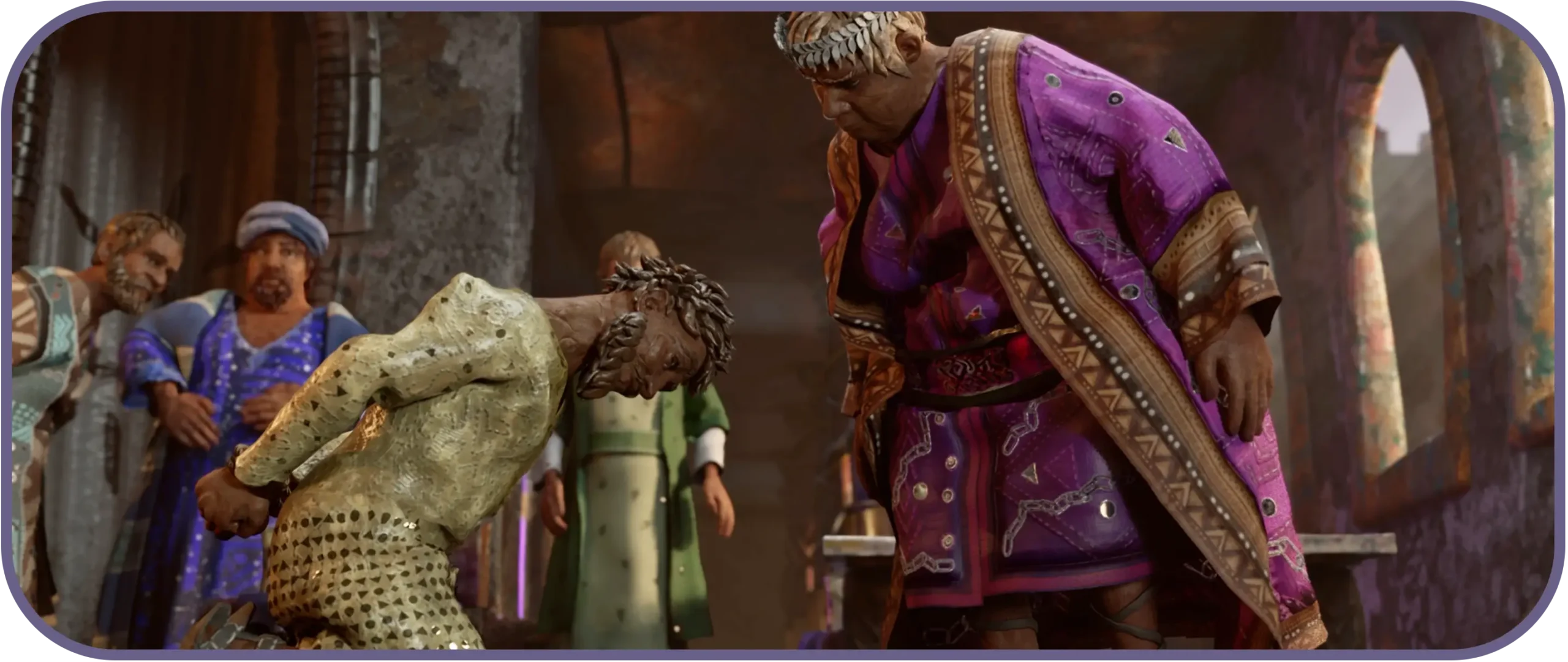
It is Joseph Caiaphas, the High Priest at the time.
He led the Jewish council that questioned Jesus.
He is confirmed by historical and archaeological evidence
The High Priest is Joseph Caiaphas, he served roughly AD 18–36.
That places him exactly at the time of Jesus.
He appears in multiple Gospel accounts.
Especially during Jesus’ trial and he presides over the Sanhedrin. This was the highest Jewish council, his role is both religious and political.
He operates under Roman authority, so his position is sensitive.
Outside the Bible, he is mentioned by Josephus and this confirms he is a real historical figure along with archaeological finds.
In 1990, an ossuary was discovered that bears the inscription:
“Joseph son of Caiaphas.”
Dated to the 1st century. This likely refers to the same person.
Other family-related ossuaries have also been found.
This is Joseph Caiaphas, who was the Jewish High Priest from AD 18-36.
Caiaphas was the Jewish high priest at the time of Jesus’s death. He plays a prominent role in the Gospels, during the interrogation and trial of Jesus before the Sanhedrin, the Jewish council. The Jewish historian Josephus tells us that he was high priest from AD 18 to 36. Archaeologist David E. graves notes that “While the Bible only speaks of him as Caiaphas (Matt 26: 3, 57; Luke 3: 2; John 11: 49; 18: 13, 14, 24, 28; Acts 4: 6), Josephus mentions his full name as “Joseph Caiaphas” (A. J. 18.35; 18.95).”[705]
In 1990, workers widening a road to the south of Jerusalem discovered a large, ancient burial cave. Twelve ossuaries (or bone boxes) were discovered, one of which was highly decorated and containing the bones of a 60 year old man. Many scholars believe them to be the bones of Caiaphas. On the side and back of the ossuary is the inscription: “Yosef bar Caifa,” which means “Joseph, son of Caiaphas.” As Graves reports:
From the intact tombs, coins and the style of writing, the box was reliably dated to the first century AD . . . On both ends of the box, the Aramaic inscription read: “Qafa” and “Yosef Bar Kayafa” (“Caiaphas,” “Joseph, son of Caiaphas”) and dates to AD 36–37. Several scholars argue that this is the Caiaphas of the NT and Josephus . . .[706]
Fig. The Caiaphas ossuary. Credit: BRBurton. For a video of his ossuary, see: Zahi Shaked. “Ossuary of the high priest Joseph Caiaphas from the time of Jesus, Israel Museum, Jerusalem.” https://www.youtube.com/watch?v=0bHTcFe5Gyk&list=PLQhh3qcwVEWjh9aRRWF1kYZIVCPc5iCcw&index=30

Six years before the 1990 discovery, another ossuary was acquired by the Israel Antiquities Authority, bearing the inscription, “Yehohanah, daughter of Yehohanan, son of Theophilus the high priest.” Theophilus was the brother-in-law of Caiaphas and succeeded him as high priest in AD 37.
In June 2011, another ossuary came to light relating to the family of Caiaphas. The Israel Antiquities Authority announced the recovery of a looted ossuary bearing the inscription: “Miriam, daughter of Yeshua, son of Qayapha, priest of Ma’aziah, from Beth ‘Imri.” As Theologian Craig A Evans observes: “If the name of this priest is vocalized ‘Qayapha (instead of Qopha or Qupha), then we could have a match with Caiaphas. Indeed, we may have the ossuary of the granddaughter of the high priest who condemned Jesus.”[707]
David E. Graves, The Archaeology of the New Testament: 75 Discoveries That Support the Reliability of the Bible: B&W (Biblical Archaeology Book 3), 2024. Kindle edition, 191.
David E. Graves, The Archaeology of the New Testament: 75 Discoveries That Support the Reliability of the Bible: B&W (Biblical Archaeology Book 3), 2024. Kindle edition, 190.
Craig A Evans, Jesus and His World: The Archaeological Evidence. London: SPCK, 2012, 101.
Jesus stays silent to fulfill prophecy.
He does not try to defend himself.
His silence shows acceptance, not weakness.
The Gospel writers present Jesus’ behavior in light of Isaiah 53, where the suffering servant is described as one who is oppressed and afflicted, yet does not open his mouth, like a lamb led to the slaughter.
By remaining silent, Jesus aligns himself with this prophetic pattern, signaling that his suffering is not accidental but anticipated within the scriptural framework.
At the same time, the narrative context makes it clear that the trial is not a genuine search for truth, but a process with a predetermined outcome.
Jesus’ silence therefore reflects an awareness of the situation, rather than a failure to engage with it.
More importantly, his mission does not involve preserving his own life through argument or resistance. This gives his silence a distinct character: it is not resignation under pressure, but controlled restraint in line with a larger purpose.
In this way, silence becomes a form of communication. It signals that the events unfolding are not derailing his mission, but are in fact part of it.
Rather than attempting to overturn the process, Jesus allows it to proceed, thereby embodying the role of one who suffers unjustly yet willingly.
In line with messianic prophecy, Jesus doesn’t try to save himself from the false accusations of the Jewish leaders.
In the messianic prophecy of Isaiah 53, we read that the suffering servant of God “was oppressed, and he was afflicted, yet he opened not his mouth; like a lamb that is led to the slaughter, and like a sheep that before its shearers is silent, so he opened not his mouth.” (Isaiah 53:7, ESV.) As the Joseph Benson wrote in his 1857 commentary on the Old and New Testaments, Jesus “neither murmured against God for giving him up to suffer for other men’s sins, nor reviled men for punishing him without cause, nor used apologies or endeavours to save his own life . . .”[708] As Legacy of Adam producer Roger Gihlemoen explains:
Jesus does not defend himself because the outcome of the accusations has already been decided. The silence echoes an ancient prophecy that described the servant of God as being silent like a lamb led to slaughter. By remaining silent, Jesus shows that he willingly accepts what must happen and fulfills what was spoken long before.
Benson Commentary, https://biblehub.com/commentaries/benson/isaiah/53.htm.
Because Jesus is making an explicit divine claim.
He identifies himself with Daniel 7 and Psalm 110.
To them, this sounds like blasphemy.
The reaction only makes sense in its Jewish context. Jesus is not making a vague statement.
He is combining two highly loaded texts.
First, Daniel 7.
The “Son of Man” comes with the clouds.
This figure receives authority, glory, and an eternal kingdom.
Second, Psalm 110:
“Sitting at the right hand of God.”
The texts implies shared authority with God.
In that context, Jesus is doing three things at once.
He identifies himself as the Messiah, he places himself in a divine role and he reverses the courtroom.
They think they are judging him.
He claims he will judge them.
Because in Jewish thought, cloud-riding and divine enthronement belong to God.
So this is not just a title claim, it is a claim to divine status and authority. That is why the reaction is immediate and the high priest tears his clothes. This is the traditional response to blasphemy.
Conclusion:
Jesus is not misunderstood here.
He is understood very clearly, and that is exactly the problem.
Jesus’s captors were angered because they recognized Jesus’s self-description as using language from the Jewish scriptures that spoke of his divine character.
Jesus’ preferred self-designation in the gospels is “Son of Man” (the title features in multiple early sources), “and this title is central for spelling out Jesus’ relation to the coming kingdom.”[709] As Michael Licona explains:
Many sceptical scholars believe that Jesus referred to Himself as the Son of Man, because it is unlikely to have been an invention of the early Church. For example, in the Gospels, “Son of Man” is Jesus’ favourite self-designation. Yet in the epistles, it is never used of Jesus. In fact, the term appears in the New Testament only 4 times outside of the Gospels and never in extra-biblical Christian writings during the first 120 years following Jesus. The point is: How likely is it that the Church originated the title Son of Man as Jesus’ favourite self-description, when the Church itself did not refer to him in this manner?[710]
Theologian Oscar Cullmann concludes that “by means of this very term Jesus spoke of his divine heavenly character . . .”[711]
Robert H. Stein, a renowned scholar of the Synoptic Gospels who is senior professor emeritus of New Testament interpretation at The Southern Baptist Theological Seminary in Louisville, Kentucky, affirms the authenticity of Jesus’ self-designation as the (not merely “a”) “Son of Man,” and notes that: “The only clear instance of this title in contemporary Judaism in the sense in which Jesus used it is found in [Daniel] 7:13.”[712] The prophet Daniel wrote:
In my vision at night I looked, and there before me was one like a son of man, coming with the clouds of heaven. He approached the Ancient of Days and was led into his presence. He was given authority, glory and sovereign power; all nations and peoples of every language worshiped him. His dominion is an everlasting dominion that will not pass away, and his kingdom is one that will never be destroyed. (Daniel 7: 13-14)
Here, God the Father (“the Ancient of Days”) receives “one like a son of man” who “was given authority, glory and sovereign power,” who is described as the appropriate recipient of worship, who has an “everlasting dominion” and a “kingdom” (i.e., the kingdom of God) that “will never be destroyed.” In the light of this prophetic background, consider the report of Jesus’s trial included within Mark’s Gospel:
They took Jesus to the high priest, and all the chief priests, the elders and the teachers of the law came together. Peter followed him at a distance, right into the courtyard of the high priest. There he sat with the guards and warmed himself at the fire. The chief priests and the whole Sanhedrin were looking for evidence against Jesus so that they could put him to death, but they did not find any. Many testified falsely against him, but their statements did not agree. Then some stood up and gave this false testimony against him: ‘We heard him say, “I will destroy this temple made with human hands and in three days will build another, not made with hands.”’ Yet even then their testimony did not agree. Then the high priest stood up before them and asked Jesus, “Are you not going to answer? What is this testimony that these men are bringing against you?” But Jesus remained silent and gave no answer. (Mark 14:53-61)
As philosopher and theologian William Lane Craig explains:
In Jewish thinking God is the one who built the temple . . . and who threatens the destruction of the temple . . . The charges brought against Jesus, that he threatened the destruction of the temple and promised to rebuild it, show that he was being charged with arrogating to himself divine roles.[713]
However, with the witnesses’ testimony failing to cohere, the trial seems to be going well for Jesus. So the high priest gambles upon a more direct approach:
Again the high priest asked him, “Are you the Messiah, the Son of the Blessed One?” “I am,” said Jesus. “And you will see the Son of Man sitting at the right hand of the Mighty One and coming on the clouds of heaven.” (Mark 14:61-62.)
Jesus’ response to the high priest is made in terms of theologically charged symbolic images:
As New Testament scholar Craig L. Evans explains:
Jesus had claimed that the day will come when Caiaphas and company will see Jesus, the “Son of Man,” seated at God’s right hand, on God’s chariot throne, thundering through heaven and coming in judgement. That a man would dare claim such a thing was indeed blasphemous.[717]
Jesus’ self-designation here coheres with “Documents like 4 Ezra and Parts of 1 Enoch, probably written in the same century in which Jesus lived, [which] clearly make the Son of Man a messianic figure.”[718] In short, Jesus deliberately incriminated himself in the council’s eyes:
The high priest tore his clothes. ‘Why do we need any more witnesses?’ he asked. ‘You have heard the blasphemy. What do you think?’ They all condemned him as worthy of death. (Mark 14:63-64)
As Overman explains, “In Jewish tradition the high priest was to tear his garments if he ever heard blasphemy.”[719] In other words, with his reply to the high priest:
Jesus affirms that he is the Messiah, the Son of God, and the coming Son of Man. He compounds his crime by adding that he is to be seated at God’s right hand, a claim that is truly blasphemous in Jewish ears. The trial scene beautifully illustrates how in Jesus’ self-understanding all the diverse claims blend together, thereby taking on connotations that outstrip any single term taken out of context.[720]
People sometimes wonder what the source could have been for this conversation between Jesus and the high priest, but several relevant sources were available to the gospel writers. Since the trial was “probably carried out at Herod’s palace,”[721] Luke’s mention that one of the women who supported Jesus financially was Joanna, the wife of Herod’s steward (see Luke 8:3 & 24:10), has an obvious relevance. Moreover, “The texts say that the ‘whole’ council was gathered. This would have included Joseph of Arimathea and Nicodemus. They could easily have given eyewitness testimony to what happened.”[722] Then again, “Some court records were public, and therefore available to those willing to do some research (such as Luke: See Luke 1:1-4).”[723] Finally, it should be remembered that John the apostle was known personally to the High Priest (see John 18:15).
Michael Licona, “Jesus – the Son of Man?” https://www.bethinking.org/jesus/jesus-the-son-of-man.
Quoted by Terry L. Miethe and Gary R. Habermas, Why Believe? College Press, 1993, 278 & 280.
Robert H. Stein, “Criteria for the Gospel’s Authenticity.” In Contending With Christianity’s Critics: Answering New Atheists & Other Objectors, edited by Paul Copan and William Lane Craig. Nashville, Tennessee: B&H Academic, 2009, 95.
William Lane Craig, Reasonable Faith: Christian Truth and Apologetics, third edition. Wheaton, Illinois: Crossway, 2008, 307.
Rob Bowman and J. Ed Komoszewski, Putting Jesus In His Place: The Case for the Deity of Christ. Grand Rapids, Michigan: Kregel, 2007, 244.
Komoszowski, J. Ed et al. Reinventing Jesus: How Contemporary Skeptics Miss The Real Jesus And Mislead Popular Culture. Grand Rapids, Michigan: Kregel, 2006, 179.
Komoszowski, J. Ed et al. Reinventing Jesus: How Contemporary Skeptics Miss The Real Jesus And Mislead Popular Culture. Grand Rapids, Michigan: Kregel, 2006, 179.
Craig A. Evans, “The Jesus of History and the Christ of Faith: Toward Jewish-Christian Dialogue.” In Who Was Jesus? A Jewish-Christian Dialogue. Paul Copan and Craig A. Evans, ed’s. WJK, 2001, 66.
Michael Bird in How Did Christianity Begin? A believer and non-believer examine the evidence. London: SPCK, 2008, 27.
Dean L. Overman, A Case for the Divinity of Jesus: Examining the Earliest Evidence. Plymouth: Rowman & Littlefield, 2009, 59.
William Lane Craig, Reasonable Faith: Christian Truth and Apologetics, third edition. Wheaton, Illinois: Crossway, 2008, 317.
Archaeological Study Bible: An Illustrated Walk Through Biblical History and Culture. Grand Rapids: MI: Zondervan, 2005, 1714.
Josh McDowell and Don Wilson, He Walked Among Us: Evidence for the Historical Jesus. Carlisle: Alpha, 2000, 334.
D. A. Carson, The Gospel According to John. Grand Rapids, Eerdmans, 1991, 587.
Yes, Pontius Pilate was a real historical figure.
He is confirmed by multiple ancient writers and archaeology.
He served as Roman governor during Jesus’ time.
Pontius Pilate is one of the better-attested figures in the New Testament when it comes to external historical confirmation, since he appears not only in the Gospels but also in multiple independent sources from the first and second centuries.
He served as Roman prefect of Judea from approximately AD 26 to 36, placing him precisely within the timeframe of Jesus’ public ministry and execution.
Jewish sources such as Josephus describe Pilate as the governor appointed by Emperor Tiberius, and explicitly mention his role in condemning Jesus to crucifixion, while the Roman historian Tacitus independently confirms that “Christus” was executed under Pontius Pilate during Tiberius’ reign.
In addition to these literary references, there is also archaeological evidence that directly names him, which is relatively rare for figures mentioned in the New Testament.
The most important find is the so-called Pilate Stone, discovered in Caesarea in 1961, which contains a partially preserved Latin inscription referring to “[Pont]ius Pilatus” and identifying him as prefect of Judea.
This inscription is especially significant because it is contemporary with Pilate’s lifetime and aligns closely with what we know from written sources about his title and position.
The fact that Caesarea was the administrative capital of Judea further strengthens the identification, since it would have been the natural location for a Roman governor’s official inscriptions.
Additional references from writers such as Philo of Alexandria also describe Pilate’s governance, often portraying him as a harsh and inflexible ruler, which fits the general picture emerging from both Jewish and Roman accounts.
Taken together, these sources provide a consistent and mutually reinforcing picture of Pilate as a historical Roman official with real political authority in Judea..
Pontius Pilate was a real historical figure who is known to us from multiple literary and archaeological sources.
Pontius Pilate was the Roman Prefect of Judea from 26-36 AD. As archaeologist Bryan Windle reports:
Numerous ancient texts provide information about him, including the New Testament gospels, [Jewish philosopher] Philo’s On the Embassy to Gaius, [Jewish historian] Josephus’ Antiquities of the Jews and The Jewish Wars, as well as The Annals, by [Roman historian] Tacitus. . . . Josephus, says that Pilate was “sent by Tiberius as prefect to Judaea” and that he condemned Jesus “to the cross.” The Roman historian, Tacitus, records how “Christus . . . suffered the extreme penalty during the reign of Tiberius at the hands of . . . Pontius Pilatus.”[724]
A partially damaged limestone block bearing an inscription that mentions the Pontius Pilate was discovered in June 1961 by Italian archaeologist Maria Teresa Fortuna Canivet.
This inscribed stone block was found during excavations of the coastal city of Caesarea, which was the capital of Judaea Province during the time Pilate was Roman governor. The artefact is a fragment of a dedicatory inscription, possibly from a temple or other building constructed in the 1st century AD and dedicated to the Roman Emperor Tiberius. The stone had then been reused in the 4th century as a building block for a set of stairs in a structure erected behind the stage house of the Herodian era theatre. The extant and legible inscription on this block reads as follows:
S TIBERIEUM
IUS PILATUS
ECTUS IUDA
In translation from Latin to English, with conjectured elements in brackets, the inscription reads:
. . . [this] Tiberieum
. . . [Pont]ius Pilate
. . . prefect of Judea
. . . has dedicated [this][725]
The artefact is significant because it is an archaeological find of an authentic 1st-century Roman inscription mentioning the name “[Pon]tius Pilatus.” This inscription is contemporary to Pilate’s lifetime, and fits with what is known of his career as reported in literary sources. As archaeologist David E. Graves comments, “The mention of Pilate with Tiberius (42 BC– 37 AD) puts Pontius Pilate in the same time period as Jesus . . .”[726]
Fig. The Pontius Pilate Stone.[727] For video of this inscription, see: Gospel and Spade, “The Pontius Pilate Inscription: Evidence for the Roman Governor of Judea.” https://www.youtube.com/watch?v=xYpF2zD9oAs

Writing in Biblical Archaeological Review, Nathan Steinmeyer comments:
the historical evidence for a Roman prefect by the name of Pontius Pilate is substantial. Beyond New Testament references (and the above mentioned Pilate Stone), Pilate is known through the work of the Jewish philosopher Philo of Alexandria (Embassy to Gaius 304–305), the writings of the Jewish historian Josephus (Jewish Wars 2.169–177), as well as many second-century texts.[728]
Bryan Windle. “Pontius Pilate: An Archaeological Biography.” https://biblearchaeologyreport.com/2019/10/11/pontius-pilate-an-archaeological-biography/.
“Pilate stone.” https://en.wikipedia.org/wiki/Pilate_stone.
Graves, David E. The Archaeology of the New Testament: 75 Discoveries That Support the Reliability of the Bible: B&W (Biblical Archaeology Book 3), 2024. Kindle edition, 177.
Nathan Steinmeyer, “Pontius Pilate’s Ring Reexamined.” (BAR, April 24, 2023) https://www.biblicalarchaeology.org/daily/ancient-cultures/ancient-israel/pontius-pilates-ring-reexamined/.
The crowd is influenced by the chief priests.
Barabbas represents a familiar, political solution.
Jesus represents something they do not understand.
The decision to release Barabbas instead of Jesus is not best explained as a spontaneous, grassroots preference for violence, but rather as the result of influence and expectation operating together within a volatile setting.
The Gospel accounts explicitly note that the chief priests and leaders stirred up the crowd to ask for Barabbas, which suggests that the choice was at least partially shaped, if not orchestrated, by those with authority and persuasive power.
At the same time, Barabbas himself represents a type of figure that would have made immediate sense to many people living under Roman occupation, since he was associated with rebellion and had taken part in violent resistance against Rome.
The crowds choose Barabbas to be released because they are persuaded to do so by the chief priests.
Barabbas (i.e., “son of Abba”) was an insurrectionist who had killed someone during a riot in Jerusalem. The bandits/insurrectionists crucified alongside Jesus had probably been involved in the same riot.[729] Theologian Eckhard J. Schnabel observes that “The Gospel writer do not say that the crowd asked for Barabbas because they were champions of his cause. Rather, they wanted Barabbas released because they were incited by the chef priests to do so (Matt 27:20, Mark 15:11.).”[730] Legacy of Adam producer Roger Gihlemoen explains:
Barabbas is a violent rebel who tries to free Israel from Roman rule. He represents a solution people can understand and support. Jesus speaks about a different kind of kingdom—one that is spiritual, not political. The episode shows that people often choose what feels practical and familiar, even if it is violent, rather than a truth that challenges their expectations.
See Eckhard J. Schnabel, Jesus In Jerusalem: The Last Days. Grand Rapids, MI: Eerdmans, 2018, 98.
See Eckhard J. Schnabel, Jesus In Jerusalem: The Last Days. Grand Rapids, MI: Eerdmans, 2018, 99.
Pilate knows Jesus is innocent but prioritizes political stability.
He gives in to pressure from the crowd and leaders.
Washing his hands is symbolic, but does not remove responsibility.
As a Roman prefect, Pilate’s primary responsibility was not abstract justice, but maintaining order in a volatile province, and the situation described in the Gospels shows a rapidly escalating crowd that could easily turn into unrest or even rebellion.
In this context, the pressure exerted by the chief priests and the crowd becomes decisive, since any disturbance during a major festival like Passover would have posed a serious threat to his position and could have led to consequences from Rome.
Although Pilate attempts to navigate the situation by offering alternatives, such as releasing Jesus under customary practices, these efforts fail to resolve the tension, leaving him with a choice between enforcing his judgment or preserving public order.
He ultimately chooses the latter, allowing the execution to proceed despite his stated conclusion that Jesus has committed no crime.
The act of washing his hands draws on a known Jewish symbolic gesture used to declare innocence, and in performing it publicly, Pilate attempts to shift responsibility onto the crowd and their leaders.
Pilate sees Jesus as innocent before Roman law, but he also sees it is expedient for him to allow the Jews to have their way with Jesus. Pilate tries to deny his responsibility for what happens next.
Matthew 27:24 reports that
When Pilate saw that he was getting nowhere, but that instead an uproar was starting, he took water and washed his hands in front of the crowd. “I am innocent of this man’s blood,” he said. “It is your responsibility!” (NIV.)
Theologian Albert Barnes (1798–1870) comments:
The Jews were accustomed to wash their hands when they wished to show that they were innocent of a crime committed by others. See Deuteronomy 21:6; Psalm 26:6. Pilate, in doing this, meant to denote that they were guilty of his death, but that he was innocent. But the mere washing of his hands did not free him from guilt. He was “bound” as a magistrate to free an innocent man; and whatever might be the clamour of the Jews, “he” was guilty at the bar of God for suffering the holy Saviour to be led to execution, in order to gratify the malice of enraged priests and the clamors of a tumultuous populace.[731]
As Legacy of Adam producer Roger Gihlemoen explains: “Pilate sees that Jesus has committed no crime. However, he fears unrest and pressure from the crowd and religious leaders.” Having given in to the mob, “Pilate tries to remove himself from responsibility. The episode shows that symbolic gestures cannot erase real choices. Even when Pilate claims innocence, he still allows injustice to happen.”
Barnes Notes’ on the Bible, Matthew 7, https://biblehub.com/commentaries/barnes/matthew/27.htm
Jesus means Pilate’s authority is not ultimate.
It exists because God allows it.
Pilate acts freely, but within a larger framework.
Jesus tells Pilate that his authority is not ultimate. Any power Pilate has exists only because God allows it for a greater purpose.
This does not remove Pilate’s responsibility, since he still makes a genuine choice, but it does place that choice within a broader framework in which human authority is derivative rather than absolute, all power is given from God.
Pilate only has the freedom and power to act as he does because God permits him that freedom and power.
As Legacy of Adam producer Roger Gihlemoen explains:
Jesus tells Pilate that his authority is not ultimate. Any power Pilate has exists only because God allows it for a greater purpose. The episode shows that Pilate is not truly in control—he is part of a larger plan unfolding beyond his understanding. Without God’s permission, Pilate would have no power at all.
Jesus’ humiliation is not prevented because it is part of his mission.
Even within Islamic sources, prophets are not fully shielded from suffering.
In Christianity, his suffering reveals, rather than diminishes, his authority.
The idea that God must protect His messengers from all forms of humiliation in the Qur’an, is not as consistent as it is sometimes presented, even within Islamic sources, where prophets are in fact shown experiencing both moral struggle and public hardship.
The Qur’an itself records figures such as Adam, Moses, and Abraham acknowledging fault or seeking forgiveness, while Muhammad is repeatedly instructed to ask for forgiveness, which suggests that prophetic status does not exclude human limitation or vulnerability.
In addition, Islamic tradition preserves accounts of prophets, including Muhammad, being mocked, rejected, physically harmed, and publicly humiliated, most notably in events such as Ta’if and various battles, which indicates that suffering is not incompatible with being chosen by God.
Even in some classical tafsir traditions concerning Jesus, there are descriptions of him being opposed, seized, or mistreated prior to later events, which further complicates the idea of total protection from humiliation.
Taken together, this broader pattern suggests that divine approval is not demonstrated by the absence of suffering, but can coexist with rejection, injustice, and apparent defeat.
Within the Christian framework, this pattern reaches its fullest expression in Jesus, who does not merely endure suffering as an unavoidable consequence of his mission, but actively embraces it as central to that mission.
This is where the logic shifts, since the humiliation of Jesus is not something that needs to be explained away, but something that is presented as meaningful in itself.
The concept of incarnation implies that God does not remain distant from human suffering, but enters into it, which reframes humiliation from being a contradiction of divine authority into being a vehicle through which that authority is revealed.
Rather than asserting power through force, avoidance, or visible protection, Jesus’ path emphasizes endurance, obedience, and self-giving, which stands in contrast to more conventional expectations of how divine authority should manifest.
The resurrection, in turn, functions as the vindication of this path, indicating that the suffering is neither final nor decisive, but part of a larger movement toward restoration.
A common claim is that God would not allow a true prophet to experience humiliation. However, the Qur’an and Hadith themselves present a more complex picture.
Several prophets are shown acknowledging fault or seeking forgiveness: Adam admits wrongdoing (7:23), Moses confesses his sin after killing a man (28:15–16), and Abraham asks for forgiveness (26:82). Even Muhammad is instructed multiple times to seek forgiveness (e.g., 47:19; 48:2). This suggests that prophetic dignity in Islam does not mean a complete absence of human weakness or public hardship.
Likewise, prophets are not consistently shielded from physical humiliation. Islamic tradition records that Muhammad was mocked, stoned, and driven out of Ta’if, and seriously injured in battle. If suffering and humiliation were incompatible with prophethood, these events would be difficult to explain.
Even in discussions about Jesus, some classical tafsir traditions (Ibn Kathir) still describe him being seized, mocked, or mistreated prior to that event. This indicates that the idea of total protection from humiliation is not uniformly applied, even within Islamic sources.
Taken together, the argument that God must prevent all forms of humiliation for His prophets is not consistently supported by the Qur’an or Hadith. Rather, the pattern seems to be that prophets may endure suffering, opposition, and even apparent disgrace, without this diminishing their status before God.
This is precisely where Jesus stands apart. He is not merely a prophet preserved from suffering, but one who willingly enters into it. As fully God and fully man, he experiences the full weight of human pain, rejection, and injustice. As theologians like Athanasius and later John Stott have emphasized, the incarnation means that God does not remain distant from human suffering, but takes it upon Himself. The humiliation of Jesus is therefore not a contradiction of his authority, but the very means through which it is revealed.
As the suffering servant of prophecy, Jesus allows himself to be humiliated; but he is ultimately vindicated by his resurrection.
Muslims believe that prophets are protected from ultimate humiliation, not that they never suffer humiliation. As Ahmed Hammuda acknowledges,
Insulting God and His Prophets is not an invention of the contemporary world. For eons [people] have levelled abuse at the Divine and His notable representatives on Earth, not least of all at the Prophets of God.[732]
Although Jesus willingly suffered humiliation, he was ultimately vindicated by his resurrection from the dead. Legacy of Adam producer Roger Gihlemoen comments:
In this episode, Jesus is humiliated and mistreated. Christianity presents this not as God abandoning Jesus, but as Jesus willingly stepping into injustice. His authority is not protected by power, but revealed through endurance and obedience.
As Christian apologist David Wood observes, “The gospel does not point to a prophet who advanced his cause through force, privilege, or coercion, but to a Savior who conquered through humility, suffering, and self-sacrifice.”[733]
Ahmed Hammuda, “How Allah Dealt With Those Who Insulted His Prophet.” https://www.islam21c.com/theology/how-allah-dealt-with-those-who-insulted-his-prophet/.
David Wood, Why Christians Should Understand Islam: A Critical Examination of Beliefs, History, and Truth Claims. Kindle, 2025, 43.
Zahi Shaked. “Ossuary of the high priest Joseph Caiaphas from the time of Jesus, Israel Museum, Jerusalem.” https://www.youtube.com/watch?v=0bHTcFe5Gyk&list=PLQhh3qcwVEWjh9aRRWF1kYZIVCPc5iCcw&index=30
YouTube Playlist, “Pontius Pilate.” https://www.youtube.com/playlist?list=PLQhh3qcwVEWj06pSR-O1zeRUDyvT25B3b
“What trials did Jesus face before His crucifixion?” https://www.gotquestions.org/trials-of-Jesus.html
“Who killed Jesus?” https://zondervanacademic.com/blog/who-killed-jesus-the-historical-context-of-jesus-crucifixion
J. P. Holding, “On the Trial of Jesus.” https://tektonics.org/gk/jesustrial.php
Austen, Michael W. Humility: Rediscovering the Way of Love and Life in Christ. Grand Rapids, MI: Eerdmans, 2024.