People expected a political, conquering Messiah.
They focused on victory passages and ignored suffering ones.
This led to widespread misunderstanding of Jesus.
The Old Testament presents two main Messiah “profiles.”
These were both present in the texts.
But in the 1st century, context mattered. Israel was under Roman occupation. So expectations became political. People wanted liberation and national restoration. This shaped how prophecies were read. Victory texts were emphasized. Suffering texts were minimized or reinterpreted.
Some Jewish traditions solved this by proposing: two different Messiahs. The New Testament takes another route. One Messiah, but two comings. First: suffering, redemption, sacrifice. Second: judgment, victory, restoration.
Even Jesus’ disciples struggled with this. They expected power, not crucifixion. That’s why they didn’t understand his predictions. So the misunderstanding is not random. It’s a selective reading shaped by political pressure.
Conclusion: They had the right texts, but the wrong expectations about timing and method.
Under the pressure of Roman occupation, 1st century Jews, including Jesus’s disciples, were focused upon some of the prophetic data about the Messiah in the Jewish scriptures at the expense of the rest.
As the narrator says in this episode, Jesus “is the heir to the throne of King David, fulfilment of the promise to Abraham, and the promised Messiah.” However, as the first century Gospels of the New Testament make clear, people often misunderstood Jesus’s teaching and his intentions because they had their own preconceived ideas about how the Messiah should behave. As Rich Robinson observes, in the Jewish Old Testament scriptures:
Sometimes the prophets describe a humble man, rejected by his own people and suffering quietly, yet whose death has salutary effects for the spiritual health of the Jewish people. Isaiah 52:13–53:12 is the most prominent such passage. Another portrayal comes from Zechariah 9:9, where the “king”—understood to be the Messiah—comes into town riding on a donkey, showing his humility. But at other times, the prophets describe a victorious warrior-king who brings justice to a world transformed. . . . Isaiah 11:1–9 is one such example.[646]
How are these two strands of prophecy to be understood? Robinson explains that
several streams of rabbinic tradition have interpreted these prophetic portraits as describing two different messiahs. . . . modern Judaism tends to toss out the portrait of the suffering Messiah and keep only the portrait of the warrior . . . . But the Jewish writers of the New Testament accepted both options in a different way. Rather than opting for two Messiahs, they saw a picture of a single Messiah who appears twice on the stage of Jewish—and human—history.[647]
Jesus’s disciples came to see Jesus as the one and only Messiah who was discussed by both strands of Old Testament prophecy, a Messiah whose first coming was focused on his role as a servant-king suffering for the salvation of Jews and Gentiles alike, and thereby establishing the kingdom of God in their midst, and whose future “second coming” would initiate God’s end-time victory over sin and establish the culmination of God’s kingdom-rule in the “new heavens and earth” (see Isaiah 65:17; Isaiah 66:22 ; Romans 8:21; 2 Peter 3:13; Revelation 21:1).
However, under the pressure of Roman occupation, 1st century Jews were understandably focused upon some of the scriptural data about the Messiah at the expense of the rest:
One of the most significant misunderstandings among the disciples was regarding the nature of the Kingdom of God. The disciples, like many Jews of their time, anticipated a political and earthly kingdom that would overthrow Roman rule and restore Israel’s national sovereignty [see, for example, Mark 10:37-45].[648]
As a bystander says in this episode: “Perhaps he is the king who will beat the Romans?” This misunderstanding was held by Jesus’ own disciples at first. As John the disciple says in this episode: “We can change things; we can finally get a good king.” This is why
the crowds hailed Jesus as the “King of Israel” (John 12:13), laying palm branches before Him in a gesture of honor and expectation of deliverance. However, Jesus entered Jerusalem on a donkey, fulfilling Zechariah 9:9 and symbolizing a mission of peace rather than military conquest. The crowd’s acclamation was sincere but based on a misunderstanding of the nature of His kingship.[649]
Since they sharing the same misunderstanding as the crowd,
The disciples frequently failed to understand Jesus’ predictions about His death and resurrection. In Mark 9:31-32, Jesus tells them, “The Son of Man is going to be delivered into the hands of men. They will kill Him, and after three days He will rise.” Yet, the disciples did not comprehend this, and “they were afraid to ask Him about it.” Their misunderstanding is further highlighted in John 20:9, where it is noted that “they still did not understand from Scripture that Jesus had to rise from the dead.”[650]
Rich Robinson, “Can Jesus Be Messiah if He Didn’t Bring Peace?” https://jewsforjesus.org/answers/jesus-cant-be-the-messiah-he-didnt-bring-peace.
Rich Robinson, “Can Jesus Be Messiah if He Didn’t Bring Peace?” https://jewsforjesus.org/answers/jesus-cant-be-the-messiah-he-didnt-bring-peace.
“Son of Man” means both human and divine authority.
Jesus uses it to point to Daniel 7’s heavenly ruler.
It reveals his identity while correcting wrong expectations about the Messiah.
“Son of Man” has two layers in Jewish context.
First, it simply means “human being.” It’s used widely in the Old Testament, especially in Ezekiel. So on the surface, it sounds humble. But there is a second, much deeper meaning.
In Daniel 7, “one like a son of man” comes with the clouds. He is given eternal authority, kingdom, and worship. This is not just a human figure. He shares in God’s rule and authority.
Many Jewish interpreters before Jesus saw this as the Messiah. So when Jesus uses this title about himself, he is doing something very deliberate. He combines humility and divine authority in one phrase. He can speak indirectly about his identity, while still making a strong claim.
This becomes clear in moments like Mark 14:62. There, he links himself directly to Daniel 7. That’s why the high priest reacts strongly.
Jesus also uses the title in unexpected ways. He speaks of suffering, rejection, and death. This clashes with common expectations.
So the title works on two fronts: it reveals who he is, and corrects what people thought the Messiah would be.
Jesus uses the “Son of Man” phrase to link himself with a significant figure in a vision recorded by the Old Testament prophet Daniel.
In this episode, Jesus’s disciple Peter asks, “Son of Man? What does he mean?” In the Gospels, Jesus frequently refers to himself as “ho huis tou anthrōpou,” which is typically translated “the Son of Man.” Most interpreters “think that this Greek phrase translates an Aramaic phrase like bar nash, which may be translated as ‘a son of man.’”[651] As Benjamin E. Reynolds explains:
Throughout Israel’s Scriptures, similar phrases are used to speak of human beings (e.g., Gen 11:5; Deut 32:8; Ps 8:4; Eccl 1:13). The plural phrase “sons of men/man” is one of the most common uses, and God calls Ezekiel a “son of man” over ninety times (e.g., Ezek 2:1). Yet, nowhere in the Hebrew Scriptures do we have an example of “son of man” used as a self-reference.[652]
By using “son of man” as a self-reference, Jesus used this Old Testament phrase in a unique way. While the phrase “son of man” is often used in the Old Testament, and in other Jewish writings, “to refer to a human being or a mere mortal (Num. 23:19, Job 25:6, Psalms 8:4, Sirach 17:30),”[653] including prophets such as Ezekiel and Daniel, it is also used by these prophets to refer to a figure they see in visions of heaven. For example, the prophet Daniel reports:
I saw in the night visions,
and behold, with the clouds of heaven
there came one like a son of man,
and he came to the Ancient of Days
and was presented before him.
And to him was given dominion
and glory and a kingdom,
that all peoples, nations, and languages
should serve him
[the Hebrew term translated as ‘serve’ can also be translated as ‘worship’];
his dominion is an everlasting dominion,
which shall not pass away,
and his kingdom one
that shall not be destroyed. (Daniel 7:13-14, ESV.)
Traditional Jewish interpreters considered this passage to be messianic:
The identification of the Son of Man with the Messiah is evident in every Jewish commentary on this chapter. Even the earliest Jewish interpreters concede that the Son of Man is King Messiah . . . . Rabbinic sages identified him with Messiah [Sanhedrin 98a; Numbers Rabbah 13:14], and . . . Rashi notes that the “one like a man” coming is King Messiah. . . . Rashi says this man is also Israel . . . . insofar as he is the unified head of the nation; hence why he is contrasted against the Gentile kings who represent their own nations in the form of beasts.[654]
Moreover,
The three Jewish apocalypses known to interpret this passage all present the son of man figure as a royal or messianic figure who will judge the wicked and redeem the righteous (see Parables of Enoch 46-48, Parables of Enoch 62; 4 Ezra 13; and 2 Bar 29-30; 2 Bar 70-74). This Jewish apocalyptic interpretation suggests that Jesus used the phrase to identify himself as the “one like a son of man” from Daniel, that is, “the Son of Man.”[655]
The prophet Ezekiel also had visions of the heavenly throne, and in his visions the throne was occupied by a “figure like that of a man” (Ezekiel 1:26, 8:2). Daniel Boyarn, professor of Talmudic culture at UC Berkeley, notes that Ezekiel’s phrase is a Hebrew equivalent of the Aramaic used in Daniel 7:13. As Nick Meader, principal research associate at Newcastle University, observes:
This is significant because Ezekiel 1:28 then confirmed “This was the appearance of the likeness of the glory of the Lord. When I saw it, I fell facedown…” The one like a man bears the likeness of the glory of the Lord . . .[656]
Furthermore, when Daniel speaks of the “one like a son of man” coming “with the clouds of heaven,” the latter phrase is also one commonly used in the Hebrew Bible. According to Boyarin, this Hebrew phrase is used 70 times (for example, in Deuteronomy 33:26–27), and in every other instance, it refers to God.[657] Hence, when Jesus used Daniel’s language about the “son of man” in self-reference, and especially when he told the Jewish leaders that they would “see the Son of Man sitting at the right hand of the Mighty One and coming on the clouds of heaven” (Mark 14:62), he was portraying himself not merely as a human Messiah, but as the heavenly one to whom God the Father gives
dominion and glory and a kingdom, that all peoples, nations, and languages should serve [or “worship”] him; his dominion is an everlasting dominion, which shall not pass away, and his kingdom one that shall not be destroyed (Daniel 7:13-14, ESV).
This is the one of whom the prophet Isaiah said:
to us a child is born, to us a son is given; and the government shall be upon his shoulder, and his name shall be called Wonderful Counselor, Mighty God, Everlasting Father, Prince of Peace. Of the increase of his government and of peace there will be no end, on the throne of David and over his kingdom, to establish it and to uphold it with justice and with righteousness from this time forth and forevermore. The zeal of the LORD of hosts will do this. (Isaiah 9:6-7)
As Meader argues,
Even before the time of Jesus . . . many followers of Judaism considered the Son of Man to be divine. A “second power” who sits on a throne next to the Ancient of Days. These earlier followers had good reason to conclude this from the text of Daniel 7. So it is no surprise that the high priest cried “blasphemy!” when Jesus defines himself as the Son of Man [since] he is claiming to be the Messiah, both fully human and fully divine, who will rule alongside the Ancient Days for all eternity.[658]
That this was Jesus’s intent is underlined by the fact that he repeatedly used the “son of man” self-designation “to illustrate he has divine prerogatives, including the authority to forgive sins (Mark 2:10), suspend the Sabbath (Mark 2:28), judge men (John 5:27), and even provide eternal life . . . (John 6:53-54).”[659] As theologian Oscar Cullmann concludes, by his use of the “son of man” phrase, “Jesus spoke of his divine heavenly character . . .”[660]
Rylie Fine lays out how Jesus’ language built upon but stretched the messianic expectations of his contemporaries:
When Jesus referred to himself as the Son of Man, he claimed to be the Messiah and King of the world. . . . In the words of Jesus, we see echoes of the imagery from Daniel’s vision. Passages like Matthew 26:64 and Mark 16:26 describe Jesus, the Son of Man, coming gloriously on the clouds of heaven at his second coming. There will be no question when the Son of Man comes again; it will be as obvious as lightning in the sky (Matthew 24:27, Luke 17:24). When he returns, he will judge the righteous and the unrighteous. At that time, the righteous will inherit the kingdom of God (Matthew 16:27; Matthew 25:31-36).
But not all of what Jesus said about being the Son of Man fulfilled the Jew’s expectations. As mentioned above, the Jews believed the Son of Man represented the Messiah, but they did not believe the Messiah was divine. So when Jesus came claiming that he, as the Son of Man, was the Lord of the Sabbath (Matthew 12:8) and had the authority to forgive sins (Mk 2:10), it did not sit well, particularly with the religious leaders.
Another way Jesus reversed their expectations was by coming first to suffer and die. Using the Son of Man title, Jesus predicted that he would be arrested by the chief priests and scribes, beaten and crucified, and then rise from the dead (Luke 17:24-25, Matthew 17:22-23; Matthew 20:18-19). These predictions went entirely against the general expectation that the Messiah would be a glorious military leader who would defeat Rome . . . .[661]
Hence,
Jesus used the title Son of Man to communicate an important truth about himself. At the same time, he used it to correct the misconceptions surrounding him. By calling himself the Son of Man, Jesus indicated to listeners that he was the Messiah they had been seeking. However, by using it in conjunction with statements about his humility as well as his deity, he completely shattered and reshaped the preconceived notions of who he was and what he had come to do.[662]
Benjamin E. Reynolds, “The Son of Man.” https://www.bibleodyssey.org/articles/the-son-of-man/#google_vignette.
Benjamin E. Reynolds, “The Son of Man.” https://www.bibleodyssey.org/articles/the-son-of-man/#google_vignette.
Tom Nash, “Biblical Meaning of ‘Son of Man’.” https://www.catholic.com/qa/biblical-meaning-of-son-of-man.
Gloria Veritatis, “How Jesus Christ Fulfills the Prophecy in Daniel 7.” https://medium.com/@Gloria.Veritatis/how-jesus-christ-fulfills-the-prophecy-in-daniel-7-b63d30cd77c4.
Benjamin E. Reynolds, “The Son of Man.” https://www.bibleodyssey.org/articles/the-son-of-man/#google_vignette.
Nick Meader, “Daniel 7: Is the Son of Man Divine, Human, or Both?” https://medium.com/interfaith-now/daniel-7-is-the-son-of-man-divine-human-or-both-27708b23d89c.
Nick Meader, “Daniel 7: Is the Son of Man Divine, Human, or Both?” https://medium.com/interfaith-now/daniel-7-is-the-son-of-man-divine-human-or-both-27708b23d89c.
Nick Meader, “Daniel 7, Jesus, and the Son of Man.” https://medium.com/interfaith-now/daniel-7-is-the-son-of-man-divine-human-or-both-27708b23d89c.
https://medium.com/interfaith-now/daniel-7-is-the-son-of-man-divine-human-or-both-27708b23d89c.
Tom Nash, “Biblical Meaning of ‘Son of Man’.” https://www.catholic.com/qa/biblical-meaning-of-son-of-man.
Oscar Cullmann, quoted by Terry L. Miethe and Gary R. Habermas, Why Believe? College Press, 1993, 278 & 280.
Rylie Fine, “Why Did Jesus Say He Was the Son of Man?” https://www.christianity.com/wiki/christian-terms/why-did-jesus-call-himself-the-son-of-man.html.
Rylie Fine, “Why Did Jesus Say He Was the Son of Man?” https://www.christianity.com/wiki/christian-terms/why-did-jesus-call-himself-the-son-of-man.html.
Jesus rode a donkey to deliberately fulfill Zechariah 9:9.
It signaled humility and peace, not military conquest.
He presented himself as king, but not the kind people expected.
In the ancient world, kings didn’t always ride war horses. A horse signaled war and conquest. A donkey signaled peace and legitimacy.
In Israel’s own tradition, kings like Solomon rode donkeys. Zechariah 9:9 explicitly says: the king will come “humble and riding on a donkey.” By doing this, Jesus publicly claims: “I am that king.” But he defines kingship differently.
The donkey is not a weakness. It’s a deliberate redefinition of what kind of king he is.
By riding into Jerusalem on a donkey, Jesus fulfills the prophecy of Zechariah 9:9, and indicates that he is a humble Messiah.
Riding on a donkey doesn’t seem very kingly, but according to the Jewish prophet Zechariah, the Messiah would enter Jerusalem on a donkey (Zechariah 9:9). By entering Jerusalem on a donkey, Jesus was fulfilling this prophecy:
the crowds hailed Jesus as the “King of Israel” (John 12:13), laying palm branches before Him in a gesture of honor and expectation of deliverance. However, Jesus entered Jerusalem on a donkey, fulfilling Zechariah 9:9 and symbolizing a mission of peace rather than military conquest. The crowd’s acclamation was sincere but based on a misunderstanding of the nature of His kingship.[663]
Palm branches were used to celebrate kings and victories.
The crowd treated Jesus like a conquering Messiah.
But they misunderstood the kind of king he actually was.
Palm branches had strong symbolic meaning in the ancient world. They were associated with victory, celebration, and kingship. In Greek culture, victors in games received palm branches. In Jewish context, they had even deeper meaning.
During the Maccabean revolt, Judas Maccabeus was welcomed with palm branches. That event represented national liberation. A foreign power defeated. So by Jesus’ time, palm branches had political weight. They symbolized hope for freedom from oppression.
When the crowd waves palms, they are making a statement. Not just celebration, but expectation. They shout “King of Israel.” This is loaded language. It implies a coming overthrow of Rome. So their actions are not neutral. They are proclaiming Jesus as a national liberator.
But Jesus rides a donkey. Not a war horse. So you get a clash of expectations. The crowd celebrates a conqueror. Jesus presents himself as a peaceful king.
Waving palm branches was a traditional way to celebrate kings in the ancient world.
The Gospel according to John specifies that the branches used by the crowd in welcoming Jesus into Jerusalem were palm branches:
The next day the large crowd that had come to the feast heard that Jesus was coming to Jerusalem. So they took branches of palm trees and went out to meet him, crying out, “Hosanna! Blessed is he who comes in the name of the Lord, even the King of Israel!” (John 12:12-13)
As Steve Shirley observes,
history tells us that waving palm branches was done to celebrate kings and conquerors. We also know that in Greek athletic competitions, victors were often given a palm branch, which they would wave to celebrate their “victory.”[664]
Moreover, the events of what Christians now call “Palm Sunday” contains echoes of events in the Maccabean revolt of 167–160 BC, and in particular of Jerusalem’s reception of Judas Maccabeus, the Jewish priest who led that revolt:
This was, and is, one of the key events in Jewish history. Fighting a war to regain Jerusalem from the Seleucid Empire, who had conquered it, and had desecrated God’s Temple, the forces of Judas Maccabeus prevailed in 164 B.C. (The war to regain more Jewish territory continued for a few more years, with Judas Maccabeus being killed near the end.) In the [Jewish] book of Maccabees . . . we see Judas Maccabeus being celebrated “with praise and palm branches” by the Jews as he entered Jerusalem . . .[665]
Maccabee reportedly entered Jerusalem “with thanksgiving, and branches of palm trees, and with harps, and cymbals . . . and songs, because there was destroyed a great enemy out of Israel” (1 Mac. 13:49-51). It is against this historical background that
the crowds hailed Jesus as the “King of Israel” (John 12:13), laying palm branches before Him in a gesture of honor and expectation of deliverance. However, Jesus entered Jerusalem on a donkey, fulfilling Zechariah 9:9 and symbolizing a mission of peace rather than military conquest. The crowd’s acclamation was sincere but based on a misunderstanding of the nature of His kingship.[666]
Shane Rosenthal points out that
According to Josephus, the Roman forces eventually cut down all the trees in Jerusalem and the surrounding suburbs during the Jewish War . . . which perhaps explains why there aren’t as many date palms in or around Jerusalem at the present day. But when Vespasian ultimately conquered the Jewish capital, he minted his famous “Judea Capta” coin commemorating his victory, and as you can see in the image below, one side of this coin features the image of—you guessed it—a palm tree.[667]
Fig. “Judea Capta” sestertius coin of Vespasian, struck in AD 71 to celebrate victory over the Jewish Revolt. The inscription on the reverse says: IVDEA CAPTA, “Judaea conquered.”[668]

Steve Shirley, “Why did the Jews wave palm branches when Jesus entered Jerusalem?” https://jesusalive.cc/palm-branches-waved-for-jesus/#:~:text=Today%2C%20many%20Christians%20celebrate%20this,therefore%20they%20turned%20on%20Him.
Steve Shirley, “Why did the Jews wave palm branches when Jesus entered Jerusalem?” https://jesusalive.cc/palm-branches-waved-for-jesus/#:~:text=Today%2C%20many%20Christians%20celebrate%20this,therefore%20they%20turned%20on%20Him.
Shane Rosenthal, “Did Palm Trees Grow in Jerusalem at the Time of Jesus?” https://www.humbleskeptic.com/p/did-palm-trees-grow-in-jerusalem.
See Wikipedia, “Judaea Capta coinage.” https://en.wikipedia.org/wiki/Judaea_Capta_coinage, https://en.wikipedia.org/wiki/File:Sestertius_-_Vespasiano_-_Iudaea_Capta-RIC_0424.jpg.
Jesus is angry because the Temple is corrupt and misused.
It excludes non-Jews and exploits worshippers financially.
He also challenges the whole system as no longer fulfilling its purpose.
Jesus’ reaction in the Temple is multi-layered.
First, there is corruption. Money changers and sellers were exploiting pilgrims. People had to use a specific currency. This opened the door for unfair exchange rates.
Second, there is exclusion. This happens in the Court of the Gentiles. It was the only place non-Jews could worship. Yet it had been turned into a marketplace. So access to God was being blocked. This directly contradicts Isaiah’s vision. A house of prayer for all nations.
Third, there is political distortion. The Temple had become tied to nationalism and power. Not just worship, but identity and control.
Fourth, there is symbolic judgment. Jesus is not just cleansing, he is confronting the system itself. His actions echo prophetic tradition. Like earlier reforming kings and prophets.
Jesus is not losing control. He is making a deliberate, prophetic statement about corruption, exclusion, and coming judgment.
Jesus is angry at a number of things, including financial corruption and how non-Jews are being excluded from the area of the Temple meant to allow them access.
Jesus’s provocative actions in Jerusalem’s Temple had several different motivations. For one thing, there was his critique of how non-Jews were being excluded from the Temple:
Jesus’ action tool place in the Court of the Gentiles (recently developed by Herod’s builders). Isaiah’s vision of the Temple as a “place of prayer for all nations” (Isaiah 56:7) . . . was being flouted by the money-changers using the Gentiles court as a place for their dealings. It was the only place the Gentiles could worship the God of Israel, it was a scandal that it had been turned into a place of trade . . . This was a comparatively recent innovation, instigated some twenty years earlier by Caiaphas the high priest; but this abuse of the Gentile’s court had to stop: Israel’s God, Jesus was insisting, was to be accessible to all.[669]
Then again, there was the financial (and spiritual) corruption indicated by Jesus’s accusation that the Temple had become “a den of robbers” (Mark 11:17, Matthew 21:13; Luke 19:46).[670] As Peter Walker comments,
Worshippers were required to pay for their sacrificial animals in a unique currency (the “Tyrian shekel”). There was plenty of room for corruption here, with the charge of high exchange rates.[671]
Moreover,
there was a political dimension. The Temple was increasingly becoming the symbolic focus for a hot-headed Jewish nationalism . . . . The place of divine worship was not to be desecrated by becoming no more than a political pawn.[672]
Finally, in temporarily suspending the functioning of the Temple, Jesus was highlighting how he saw himself as the fulfilment of the purposes of God that were symbolized by the Temple.[673]
In the Gospel of John, Jesus dramatically intervenes in the Temple before he begins his public ministry in Galilee (John 2:13–22, 3:24 & 4:3; cf. Mark 1:14). However, the only such event reported in the Synoptic Gospels – an event about which John remains silent – takes place at the end of Jesus’ ministry (e.g., Mark 11:15–18). Ancient authors would sometimes select and arrange material thematically or topically rather than chronologically, so some Christians conclude that John has moved Jesus’ actions in the Temple from the last week of his life to the beginning of his account, for theological reasons. However, as theologian Allan Chapple points out,
The differences between the accounts are considerable, and can be summarized as follows. The actions Jesus took
It therefore seems that Jesus probably intervened in the Temple, in somewhat different ways, both at the beginning and at the end of his ministry.[675]
There is a theological symbolism of Jesus’s double intervention at the Temple that reflects the Old Testament’s instructions for dealing with housing that has a fungal infection, which is metaphorically called “leprosy” (the biblical term for a broad class of human skin diseases). In Leviticus 14, God tells Moses and Aaron that when there is
a case of leprous disease in a house in the land of your possession, then he who owns the house shall come and tell the priest, “There seems to me to be some case of disease in my house.” Then the priest shall command that they empty the house before the priest goes to examine the disease, lest all that is in the house be declared unclean. And afterward the priest shall go in to see the house. And he shall examine the disease. And if the disease is in the walls of the house with greenish or reddish spots, and if it appears to be deeper than the surface, then the priest shall go out of the house to the door of the house and shut up the house seven days. And the priest shall come again on the seventh day, and look. . . (Leviticus 14:34–39a, ESV).[676]
If the fungal outbreak had spread, the priest would order the affected fabric stripped out and safely disposed of, and the house would then be repaired.[677] However, should the “infection” re-appear again after this initial “treatment,” the law required the house to be torn down and re-built:
If the disease breaks out again in the house, after he has taken out the stones and scraped the house and plastered it, then the priest shall go and look. And if the disease has spread in the house, it is a persistent leprous disease in the house; it is unclean. And he shall break down the house, its stones and timber and all the plaster of the house, and he shall carry them out of the city to an unclean place. (Leviticus 14:43-65, ESV).
In an echo of this Levitical procedure, Jesus visited the Temple in Jerusalem early in his ministry, as reported by John:
The Passover of the Jews was at hand, and Jesus went up to Jerusalem. In the temple he found those who were selling oxen and sheep and pigeons, and the money-changers sitting there. And making a whip of cords, he drove them all out of the temple, with the sheep and oxen. And he poured out the coins of the money-changers and overturned their tables. And he told those who sold the pigeons, “Take these things away; do not make my Father’s house a house of trade.” His disciples remembered that it was written, “Zeal for your house will consume me.” So the Jews said to him, “What sign do you show us for doing these things?” Jesus answered them, “Destroy this temple, and in three days I will raise it up.” The Jews then said, “It has taken forty-six years to build this temple [Or This temple was built forty-six years ago], and will you raise it up in three days?” But he was speaking about the temple of his body. When therefore he was raised from the dead, his disciples remembered that he had said this, and they believed the Scripture and the word that Jesus had spoken. (John 2:13–22).
During this first “inspection” Jesus identified that the temple was infected by sin, and symbolically purged it (a kingly action in the reforming tradition of kings Hezekiah and Josiah in the Old Testament[678]). Then, analogous to the way in which the law required an infected house be re-inspected to see if the “leprosy” was gone, Jesus performed a second priestly inspection of the Temple in the week before his death:
And he entered the temple and began to drive out those who sold and those who bought in the temple, and he overturned the tables of the money-changers and the seats of those who sold pigeons. And he would not allow anyone to carry anything through the temple. And he was teaching them and saying to them, “Is it not written, ‘My house shall be called a house of prayer for all the nations’? But you have made it a den of robbers.” And the chief priests and the scribes heard it and were seeking a way to destroy him, for they feared him, because all the crowd was astonished at his teaching. (Mark 11:15 b–18, ESV).
In this second “inspection,” Jesus saw that the “infection” was persistent. Consequently, he prophesied the destruction of this unclean “house of God” (e.g., Mark 13:1–2), a prophecy that was fulfilled in AD 70 when the Romans literally tore down the Temple and threw its stones off the temple mount.
The new Temple would be Jesus’s own resurrected human body (see John 2:21, Mark 14:58 & Matthew 26:61) and the community of Christ’ followers, a community the apostle Paul called “the body of Christ” (e.g., 1 Corinthians 6:15, Ephesians 4:12). As Paul wrote to the first century church in Corinth: “Don’t you realize that all of you together are the temple of God and that the Spirit of God lives in you? . . . . All of you together are Christ’s body, and each of you is a part of it.” (1 Corinthians 3:16 & 12:27 NLT).
Peter Walker, In the Steps of Jesus, Second Edition. Oxford: Lion Scholar, 2009, 189-190.
See Craig Evans, “Why Jesus Overturned Temple Tables.” https://www.youtube.com/watch?v=CWIr5_MTXTc.
Peter Walker, In the Steps of Jesus, Second Edition. Oxford: Lion Scholar, 2009, 190.
Peter Walker, In the Steps of Jesus, Second Edition. Oxford: Lion Scholar, 2009, 190.
See N. T. Wright, “What is the significance of Jesus cleansing the Temple?” https://www.youtube.com/watch?v=U1rTG9MMWN4.
Allan Chapple, “Jesus’ Intervention In The Temple: One Or Twice?” JETS 58/3 (2015) 545–69, https://etsjets.org/wp-content/uploads/2015/09/files_JETS-PDFs_58_58-3_JETS_58-3_545-69_Chapple.pdf, 549-550.
See InspiringPhilosophy, “When Did Jesus Cleanse the Temple? Supposed Contradiction #35.” https://www.youtube.com/watch?v=-MzlpqcxTzE.
As an article biblehub.com observes: “Ancient Israelite houses were built of sun-dried mudbrick, fieldstone, or hewn limestone coated with lime plaster. Archaeological digs at Jericho, Hazor, and Tell Beit Mirsim reveal thick plaster layers that readily trapped moisture, a perfect medium for fungal colonies. Spores of Aspergillus, Penicillium, and Stachybotrys have been recovered from plaster fragments stored in the Rockefeller Museum, Jerusalem. Modern mycologists note these molds emit mycotoxins capable of respiratory damage—an empirical confirmation of the Mosaic concern for public health millennia before germ theory.” - https://biblehub.com/q/Mold_s_role_in_Leviticus_14_35.htm. A related article notes: “Excavations at Tel Beersheba, Lachish (Level III), Hazor, Shiloh, and Megiddo show walls of soft limestone blocks coated with lime or clay plaster—an ideal substrate for hygroscopic salts and microorganism colonies. (Y. Aharoni, “Arad and Lachish,” 1975; Y. Yadin, “Hazor, The Rediscovery,” 1975). Repairs visible in these walls frequently involve entire stones removed and replaced with fresh blocks differing in tooling or size—field-evidence for the very practice Leviticus mandates. Refuse mounds just outside city limits at Tell en-Naṣbeh, Lachish, and the City of David contain mixed limestone, plaster flakes, and soil rich in nitrates—compatible with discarded, moisture-laden building debris (E. Mazar, “Excavations in the City of David,” 2010).” - https://biblehub.com/q/Evidence_for_Leviticus_14_40_practices.htm. In cases where the repaired house was pronounced clean, “the priest performed the same twin-bird rite used for healed lepers (14:49-53). One bird was slain over fresh water; the living bird, cedar wood, scarlet yarn, and hyssop were dipped in the blood-water mixture and the house was seven-times sprinkled. The live bird then flew free ‘outside the city,’ signifying atonement accomplished and impurity removed. Blood, water, wood, scarlet, and hyssop prefigure the cross (John 19:29), the water and blood from Christ’s side (John 19:34), and the scarlet thread of redemption [Joshua 2:18].” - https://biblehub.com/q/Mold_s_role_in_Leviticus_14_35.htm.
Although Leviticus 14:40 only mentions “stones,” this is representative, rather than exhaustive, and doesn’t exclude mud bricks, which were actually more common as a building material.
Brad Orr, “Cleansing the Temple - Then and Now.” https://www.shadyoaks.org/blog/cleansing-the-temple-then-and-now.
It was a Roman silver coin called a denarius.
It bore the image of the emperor.
Jesus used it to expose their hypocrisy and make a deeper point.
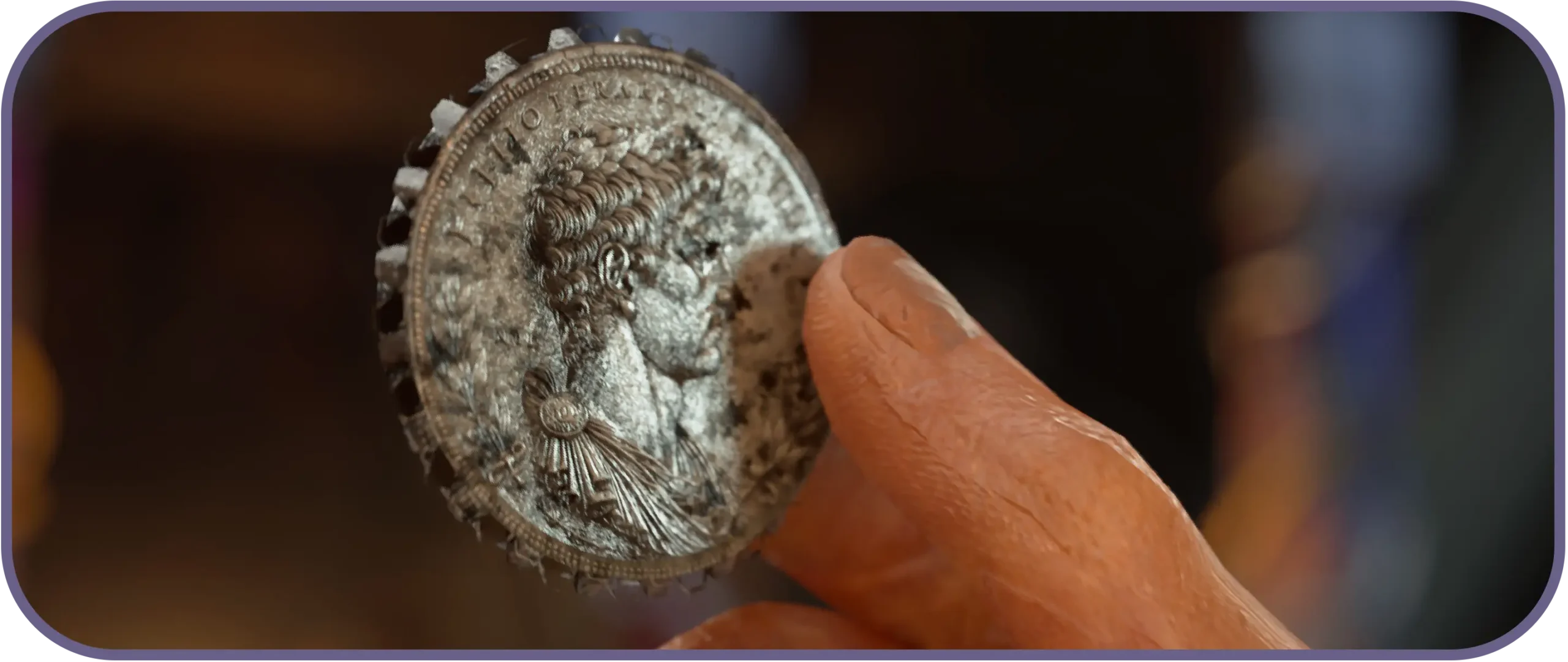
The coin in question is a Roman denarius. It was the standard daily wage for a worker. This coin typically carried the image of the emperor, along with an inscription affirming his authority. That detail is crucial.
Jesus asks: “Whose image is on the coin?” They answer: Caesar’s. This exposes something. They are already using Roman currency. So they are already participating in the system.
Their question is a trap. If Jesus rejects the tax, he looks rebellious. If he accepts it, he looks disloyal to Israel.
Jesus avoids the trap. He says: “Give to Caesar what is Caesar’s.” Meaning: the structures of the present world order, including its economic systems, belong to a fallen human domain, not to God’s ultimate kingdom. But he adds: “Give to God what is God’s.” That shifts the discussion. Humans bear God’s image. So ultimate allegiance belongs to God.
Conclusion: The coin is not just a prop. It exposes hypocrisy and reframes authority at a deeper level.
Jesus’s makes his point in response to his opponents by bringing their attention to the imagery on a silver denarius.
Jesus’ opponent flattered Jesus by saying that “You treat all men equal and teach the way of God in accordance with the truth.” Their question, which was designed to get Jesus into trouble, assumed that the real Messiah would side with Jews over against Gentiles, especially a Gentile such as the Roman Emperor. However, the Messiah is the fulfilment of the Old Testament promise to Abraham that God would bless all the nations through his seed. We know that
A number of coins were in circulation in Judea at the time of Jesus Christ. The standard unit of Roman currency was the silver denarius (Drachma in Greek units). A denarius is suppose to be equivalent to the daily wage of a labourer.[679]
As theologian Albert Barnes (1798-1870) commented:
The tribute for the temple service was paid in the Jewish shekel; that for the Roman government in foreign coin. Their having that coin about them, and using it, was proof that they themselves held it lawful to pay the tribute; and their pretensions, therefore, were mere hypocrisy.[680]
Fig. Example of a 1st century Roman denarius coin, bearing the words “Caesar Augustus Tiberius , son of the Divine Augustus” around the image of his head (14 – 37 AD).[681]

Craig A. Evans, “Why Jesus Overturned Temple Tables.” https://www.youtube.com/watch?v=CWIr5_MTXTc
InspiringPhilosophy, “When Did Jesus Cleanse the Temple? Supposed Contradiction #35.” https://www.youtube.com/watch?v=-MzlpqcxTzE
Peter S. Williams, “Archaeological Evidence for Jesus” (FOCLOnline, 2025), https://www.youtube.com/watch?v=ESOpqrxsBzU&t=6s
YouTube playlist, “The Islamic Dilemma.” YouTube playlist. https://www.youtube.com/playlist?list=PLQhh3qcwVEWiY5DeYrxP-uTnxrQjjWboV
———. “Textual Reliability of the New Testament.” YouTube playlist. https://www.youtube.com/playlist?list=PLQhh3qcwVEWhx61s1CiNf9_CATxat5bn8
———. “The Reliability of the New Testament.” YouTube playlist. www.youtube.com/playlist?list=PLQhh3qcwVEWj04HUH7t9yqIiFKKuAkjh_
———. “Christianity and Archaeology.” YouTube playlist. https://www.youtube.com/playlist?list=PLQhh3qcwVEWjh9aRRWF1kYZIVCPc5iCcw
———. “The Historical Jesus.” YouTube playlist. https://www.youtube.com/playlist?list=PLQhh3qcwVEWg0CpSQPAr5cy_lnXpeQMNk
———. “Who Wrote the NT Gospels?” YouTube playlist. https://www.youtube.com/playlist?list=PLQhh3qcwVEWg2vHjaH7hwE3BdtZao15CS
N. T. Wright, “What is the significance of Jesus cleansing the Temple?” https://www.youtube.com/watch?v=U1rTG9MMWN4
Biblehub, “Did Jesus ride one or two animals?” https://biblehub.com/q/did_jesus_ride_one_or_two_animals.htm
Allan Chapple, “Jesus’ Intervention In The Temple: One Or Twice?” JETS 58/3 (2015) 545–69, https://etsjets.org/wp-content/uploads/2015/09/files_JETS-PDFs_58_58-3_JETS_58-3_545-69_Chapple.pdf
Gary R. Habermas. “Recent Perspectives on the Reliability of the Gospels.” https://www.equip.org/articles/recent-perspectives-on-the-reliability-of-the-gospels/
———. “Why I Believe the New Testament Is Historically Reliable.” https://www.monergism.com/thethreshold/sdg/Why%20I%20Believe%20the%20New%20Testament%20 is%20Historically%20Reliable%281%29.pdf
Eric Lyons, “Chronology and the Cleansing of the Temple.” https://apologeticspress.org/chronology-and-the-cleansing-of-the-temple-660/
J. P Moreland. “The Historicity of the New Testament.” https://www.bethinking.org/is-the-bible-reliable/the-historicity-of-the-new-testament
Randy Newman. “Did Jesus Fulfil Old Testament Prophecies of a Coming Messiah?” https://www.cslewisinstitute.org/resources/did-jesus-fulfill-old-testament-prophecies-of-a-coming-messiah/#:~:text=On%20the%20surface%2C%20some%20of,messiah%20who%20atones%20for%20sins.&text=These%20make%20up%20just%20a,do%20both—reign%20and%20suffer?
Benjamin E. Reynolds, “The Son of Man.” https://www.bibleodyssey.org/articles/the-son-of-man/#google_vignette
Rich Robinson, “Can Jesus Be Messiah if He Didn’t Bring Peace?” https://jewsforjesus.org/answers/jesus-cant-be-the-messiah-he-didnt-bring-peace
Keith Small. “The Textual Histories of the Qur'an and New Testament.” https://www.bethinking.org/islam/textual-histories-of-Qur’an-and-nt
Got Questions, “How many times did Jesus cleanse the temple?” https://www.gotquestions.org/temple-cleanse.html
Sam Shamoun, “The Qur’an and the Holy Trinity.” http://answering-islam.org.uk/Shamoun/Qur’an_trinity.htm
Peter S. Williams. “Understanding The Trinity.” https://www.peterswilliams.com/wp-content/uploads/2016/02/Trinity.pdf
Michael W. Austen. Humility: Rediscovering the Way of Love and Life in Christ. Grand Rapids, MI: Eerdmans, 2024.
Richard Bauckham. Jesus: A Very Short Introduction. Oxford: Oxford University Press, 2011.
John Dickson. Is Jesus History? Epsom: Good Book, 2019.
Charles E. Hill. Who Chose the Books of the New Testament? Bellingham, WA: Lexham, 2022.
Walter C. Kaiser Jr. The Messiah in the Old Testament. Grand Rapids: Zondervan, 1995.
Lydia McGrew. Hidden in Plain View: Undesigned Coincidences in the Gospels and Acts. Tampa, FL: DeWard, 2017.
William D. Mounce. Why I Trust the Bible: Answers to Real Questions and Doubts People Have about the Bible. Grand Rapids, MI: Zondervan Reflective, 2021.
Gordon Nickel. The Gentle Answer to the Muslim Accusation of Biblical Falsification. Bruton Gate, 2016.
Stanley E. Porter. How We Got the New Testament: Text, Transmission, Translation. Grand Rapids, MI: Baker Academic, 2013.
Douglas D. Scott. Is Jesus of Nazareth the Predicted Messiah? A Historical-Evidential Approach to Specific Old Testament Messianic Prophecies and Their New Testament Fulfilments. Eugene, OR: Wipf & Stock, 2019.
Dan Wickwire. Has the Bible Been Changed?: The Reliability of the Scriptures According to Jewish, Christian, and Islam. Aneko, 2016.
Peter J. Williams. Can We Trust the Gospels? Wheaton, IL: Crossway, 2018.
Peter S. Williams, Behold the Man: Essays on the Historical Jesus. Eugene, OR: Wipf and Stock, 2024.
———. Getting at Jesus: A Comprehensive Critique of Neo-Atheist Nonsense About the Jesus of History. Eugene, OR: Wipf and Stock, 2019.
———. Digging for Evidence. Christian Evidence Society. https://christianevidence.org/booklet/digging_for_evidence/