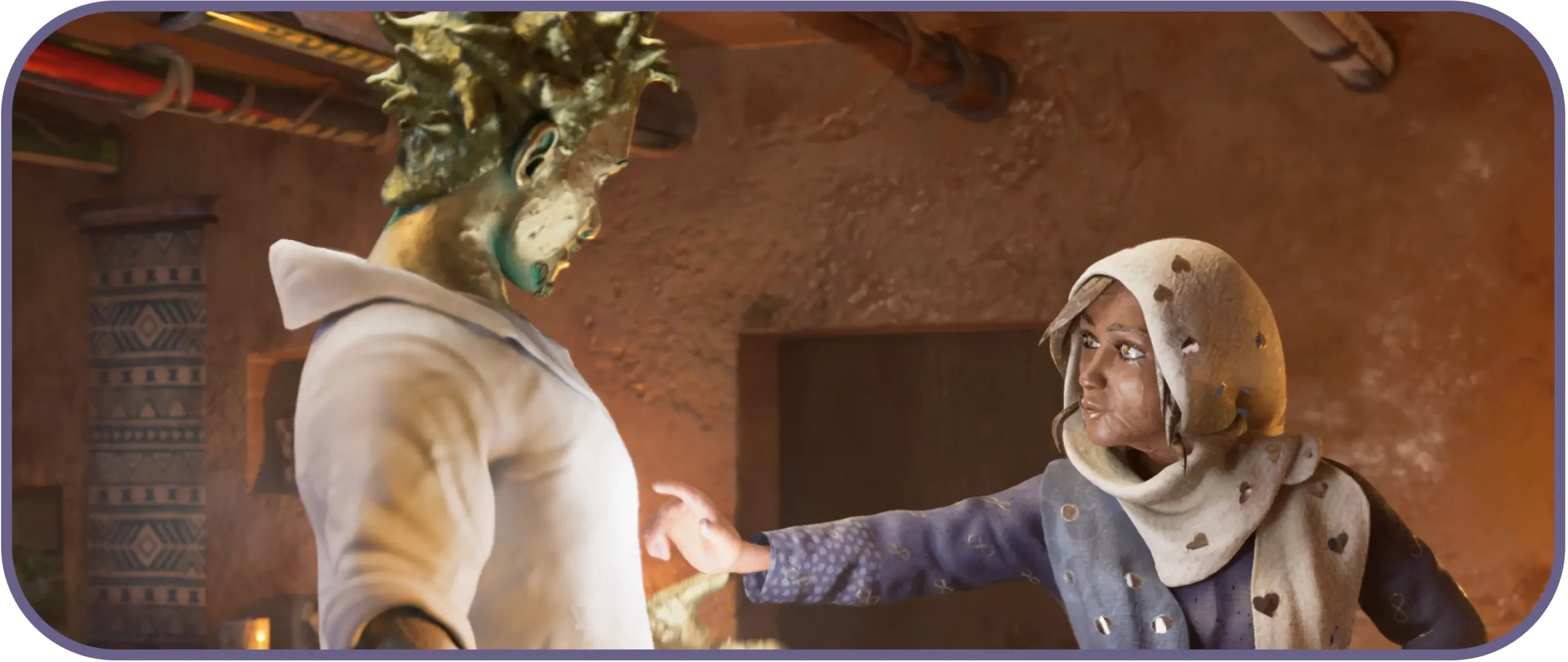
A thousand years have passed between episode 15 and 16. The transition is from David’s rule to the Roman leadership of Israel.
The story jumps nearly 1,000 years, from the 10th century BC to the 1st century BC. After David and Solomon, Israel splits into two kingdoms, Israel and Judah. Both kingdoms are eventually conquered, with Judah falling to Babylon. This leads to the Jewish exile. Persia later allows the Jews to return and rebuild Jerusalem and the temple. Greek and then Roman rule follow, increasing expectation of a coming Messiah.
Between episode fifteen and episode sixteen we jump forward almost a thousand years, from the 10th century BC to the 1st century BC.
After David, and his son King Solomon, the kingdom of Israel was split into the twin kingdoms of Israel in the north and Judah in the south, a situation that led to the eventual conquest of both kingdoms. Jerusalem in Judah was the last city to fall to the Babylonians, leading to the era known as the “Jewish exile.” Later, Babylon was itself conquered by the Persian Empire, which allowed the Jews to return to Judea, renovate Jerusalem and rebuild its temple. After this, Judea came under Greek influence, resulting in the “Maccabean revolt” against Greek rulership, before Judea fell under a Roman rulership that fermented Jewish expectations of God’s prophesied messiah from the line of David.[441]
On the history between David and the birth of Jesus see, Peter S. Williams, “United and Divided: Israel’s Kingdom from Judges to Exile.” (2025) https://www.youtube.com/watch?v=0r7f5SzreTI&t=7s; Anthony J. Tomasino, Judaism Before Jesus: The Events & Ideas That Shaped the New Testament World (IVP, 2003).
“The Word” (logos) in John refers to a divine person who was with God and is God.
It describes Jesus as pre-existent and active in creation.
This Word then became human in Jesus.
In John’s Gospel, Jesus is described as “the Word” (Greek: logos).
This term carries both Jewish and Greek background meaning.
John 1 presents the Word as existing “in the beginning.”
This places the Word before creation, not as part of it.
The Word is also described as being “with God.”
This implies a personal relationship, not just an abstract force.
At the same time, “the Word was God.”
This describes the nature of the Word as fully divine.
Importantly, John maintains a distinction between God and the Word.
They are not the same person, but share the same divine nature.
The Word is also the agent of creation.
“All things were made through him.”
This places the Word on the creator side of reality.
Then comes the key claim in John 1:14.
“The Word became flesh and dwelt among us.”
This identifies Jesus as the incarnation of the Logos.
So Jesus is not just a prophet or messenger.
He is presented as pre-existent, divine, and active in creation.
The Qur’an also calls Jesus a “Word from God.”
But it does not explain this concept in detail.
John, however, gives a developed theological framework.
In summary, “the Word” means that Jesus is God’s self-expression,
personally present, divine in nature, and incarnate in human form.
John’s gospel uses the Greek term logos to describe Jesus as a person that existed in close relationship “with” God “in the beginning,” a person “through” whom creation was accomplished, a person who thus exists on the Divine side of the fundamental Jewish distinction between God and the creation, but who nevertheless “became flesh and dwelt among us” as Jesus of Nazareth, “full of grace and truth.”
Sura 3:45 of the Qur’an reads:
˹Remember˺ when the angels proclaimed, “O Mary! Allah gives you good news of a Word from Him, his name will be the Messiah, Jesus, son of Mary; honoured in this world and the Hereafter, and he will be one of those nearest ˹to Allah˺.[442]
However, the Qur’an gives no context for understanding what is meant by calling Jesus kalimatim-minhu, a “Word from Him” (that is, from God).[443] This episode begins by quoting the first and third verses of what is know as the fourth gospel (which is traditionally known as “the gospel according to John,” often referred to simply as “John”), one of four first-century biographies of Jesus in the “New Testament” section of the Christian Bible[444]:
In the beginning was the Word, and the Word was with God, and the Word was God. He was in the beginning with God. All things were made through him, and without him was not any thing made that was made. (John 1:1-3, ESV.)
The Greek term translated here as the capitalised “Word” is “logos.” In Greek philosophy logos was “the wisdom behind the creation of the world and everything in it . . .”[445] For example, according to the ancient Greek “Stoic” philosophy that stemmed from Zeno of Citium (circa. 300 BC) “the seminal reason (logos spermatikos) is the cosmic source of order . . . . Logos also has another aspect: it is what enables us to apprehend the principles and forms, i.e. it is an aspect of our own reasoning.”[446] However, the term had been adopted by Jewish thinkers (such as the Jewish philosopher Philo of Alexandrea), and one cannot assume that every use of the term means exactly the same thing. Moreover, classicist F.F. Bruce has a point when he proposes that “It is not in Greek philosophical usage . . . that the background of John’s thought and language should be sought . . . . but in Hebrew revelation.”[447]
According to John, the logos existed “in the beginning” and “with God” (the Greek term here pros – with/towards - can suggest a personal relationship). Moreover, creation was accomplished “through” the logos. Therefore, when John goes on to say “and the Word was God” (i.e., “kai theos en ho logos”), he does not mean to say that the Word is one and the same as, or identical to, the God that the logos was “with” in the beginning, the God who created “through” the logos. As F. F. Bruce explains, “Had theos as well as logos been preceded by the article [ho] the meaning would have been that the Word was completely identical with God, which is impossible if the Word was also ‘with God.’”[448] Rather, when John affirms “and the Word was God” (i.e., “kai theos en ho logos”), the Greek term theos (i.e., God/Divine) is without the article, and so “is predicative and describes the nature of the Word.”[449] To translate “kai theos en ho logos” as “and the logos was Divine” would fit with both John’s careful distinction between “God” and “the logos” that was “with God” in the beginning and his assertions that “All things were made through” the logos, who was “with” God “in the beginning” (a reference to the creation narrative in Genesis 1:1), statements that place the logos on the uncreated side of the fundamental Jewish distinction between God as creator and the created cosmos. This demonstrates that the logos is not being presented by John as “a god” on a par with Greek or Roman “gods,” but as Divine in a robust sense that is nonetheless meant to be consistent with Jewish monotheism. To quote theologians Andreas J. Köstenberger and Alexander Stewart: “There are two persons, the Word and God, who are both God (Greek theos; i.e., they are both divine), yet these two persons are one God.”[450] As theologian Colin G. Kruse observes:
Relationship implies different persons, and this moves us away from unitarianism (one God, one person) towards trinitarianism (one God, three persons – Father, Son [=the Word] and the Spirit. As the fourth gospel unfolds it becomes clear that this is what is intended.[451]
The divine logos is “God the Son,” the “second” person of the one Trinitarian God. He was “with” God the Father “in the beginning,” and took on a human nature in the person of Jesus. As theologians Daniel Sakitey and Ernest van Eck observe: “It is this logos which in John’s interpretation existed before creation . . . that assumed flesh . . . and whose glory John and his colleague disciples beheld and proclaimed.”[452]
“The Uniqueness and Titles of Jesus in Islam. C. The Titles Word And Spirit Of God.” https://www.answering-islam.org/Gilchrist/Vol2/5c.html
For a discussion of the dating, authorship, and historical credentials of the fourth gospel, see Craig L. Blomberg, The Historical Reliability of John's Gospel. Apollos, 2015; Lydia McGrew, The Eye of the Beholder: The Gospel of John as Historical Reportage. Tampa, FL: DeWard, 2021; Peter S. Williams, Behold the Man: Essays on the Historical Jesus. Eugene, OR: Wipf and Stock, 2024.
Daniel Sakitey and Ernest van Eck, “The logos Christology in the fourth gospel (Jn 1:1-5, 14): A soteriological response to an Ewe cosmic prayer.” Herv. teol. stud. vol.79 n.4, Pretoria 2023, https://scielo.org.za/scielo.php?script=sci_arttext&pid=S0259-94222023000400020#:~:text=Christology%20of%20the%20logos%20in,emphasised%20in%20John%201:2.
F. F. Bruce, The Gospel of John: Introduction, Exposition, and Notes. Grand Rapids, MI: Eerdmans, 1983, 29.
F. F. Bruce, The Gospel of John: Introduction, Exposition, and Notes. Grand Rapids, MI: Eerdmans, 1983, 31.
C. K. Barnett, The Gospel According to St John. SPCK, 1978, 156, quoted by Colin G. Kruse, Tyndale New Testament Commentaries: John. Nottingham: IVP Academic, 2003, 63.
Andreas J. Köstenberger and Alexander Stewart, The First Days of Jesus: The Story of the Incarnation. Wheaton, IL: Crossway, 2015. [Kindle Android version], 177.
Colin G. Kruse, Tyndale New Testament Commentaries: John (Nottingham: IVP Academic, 2003), 64. See Peter S. Williams, “Understanding The Trinity” https://www.peterswilliams.com/wp-content/uploads/2016/02/Trinity.pdf.
Daniel Sakitey and Ernest van Eck, “The logos Christology in the fourth gospel (Jn 1:1-5, 14): A soteriological response to an Ewe cosmic prayer.” Herv. teol. stud. vol.79 n.4, Pretoria 2023, https://scielo.org.za/scielo.php?script=sci_arttext&pid=S0259-94222023000400020#:~:text=Christology%20of%20the%20logos%20in,emphasised%20in%20John%201:2.
Yes, the New Testament text is highly reliable compared to other ancient works.
It is supported by a large number of early manuscripts.
Textual criticism shows that most differences are minor and do not affect core teachings.
The New Testament is one of the best-attested texts from antiquity.
There are over 5,000 Greek manuscripts and many thousands more in other languages. Some fragments date very close to the time of the original writings. For example, Papyrus P52 is often dated to around AD 100–125.This means the gap between original writing and surviving copies is relatively small.
By comparison, most ancient works survive in far fewer copies. They also have much larger time gaps, often over 1,000 years.
Textual criticism compares all available manuscripts. This allows scholars to reconstruct the original text with high confidence.
Most variations between manuscripts are minor. They involve spelling, word order, or small copying differences. Very few affect meaning, and none change core Christian doctrines.
The idea that the Bible text was widely corrupted is not supported by evidence. Early manuscripts existed long before Islam. These manuscripts match later copies closely. This makes a large-scale alteration across regions unlikely.
The transmission of the New Testament was decentralized. Texts spread across many communities, making coordinated changes difficult.
In summary, the New Testament text is considered highly reliable. It reflects the original writings with a strong degree of accuracy.
The contemporary critical text of New Testament that forms the translation basis of modern editions of the New Testament is a highly accurate reproduction of the original, first century text.
Because the Qur’an affirms that the Christian scriptures (i.e., the Bible, made up of the so-called “Old Testament” scriptures and the “New Testament” scriptures, including the four New Testament Gospels) are revelations from Allah, and because the Christian scriptures contain many things that contradict the Qur’an, Muslims commonly deduce from their assumption that the Qur’an is the word of Allah that the text of the Bible must have somehow been corrupted. However, as Daniel Wickwire points out,
The Qur’an does not speak of any corruption the text of the Bible (Tahrif bil Lafız) but it does speak of a verbal distortion of its meaning (Tahrif bil Mana). . . . Al-i İmran 3:78 – And there is a party of them who distort the Scriptures with their tongues, that you may think that what they say is from the Scripture, when it is not from the Scripture. And they say: “It is from Allah,” when it is not from Allah, and they speak a lie concerning Allah knowingly.[453]
The charge that some people “distort the Scriptures with their tongues” assumes the undistorted reliability of the Scriptures they distort. As Muslim scholar Abdullah Saeed confirms, “In no verse in the Qur’ān is there a denigrating remark about the scriptures of the Jews and Christians. Instead, there is respect and reverence. Any disparaging remarks were about the People of the Book, individuals or groups, and their actions.”[454] The Qur’an says that the Christian Bible is the written word of Allah:
It is important here to note with Gordon Nickel that
One of the key points of confusion between Christians and Muslims when they discuss the “Gospel” and its contents is that many Muslims have a false idea of what the Gospel is. In order to clear up this confusion, one should know what the “Gospel” meant to people in the Middle East during the six centuries between . . . Jesus and the origins of Islam. The Gospel means the “good news” of salvation through the death and resurrection of Jesus. The term for Gospel in the original Greek New Testament is euaggelion. At first, euaggelion meant the reward given to the messenger who brought good news. Later, the term came to be used for the good news itself. . . . Eventually, the word euaggelion came to be applied to a written text. . . . However, Christians used the word “Gospel” in the singular well into the third century. . . . relatively soon after the completion of the four Gospel accounts in the first century A.D., they were bound into a single book that circulated among the early Christian communities.[458]
Hence,
Even when euaggelion came to be applied to a written text, the word continued to be employed in the singular. . . . The usage bespeaks the conviction that the gospel was identical with the teaching of the Lord. This usage is reflected in the formulaic expression, “the Lord says in the gospel” (e.g., 2 Clem. 8:5), but it is also reflected in the titles of the Gospels. The earliest parchment codices of the New Testament, namely, the fourth-century Sinaiticus and Vaticanus codices, entitled the Gospels “according to Matthew,” “according to Mark,” and so on. This manner of providing each of the written gospels with a title suggests that euaggelion applied to the whole collection of the four canonical gospels.[459]
So, “the Gospel” that the Qur’an references alongside the Torah as prior divine revelation is the singular “gospel” recounted in the fourfold gospel according to Matthew, according to Mark, according to Luke, and according to John.
The Qur’an also says that Allah’s words cannot be changed:
Therefore, to claim that the text of the Christian Bible available to us today is a corrupted text that does not accurately represent the original, is to contradict the Qur’an.
In any case, if the text of the bible is supposed to have been changed, when is this supposed to have happened? On the one hand “The Bible could not have been changed before the time of Muhammad, because Muhammad himself accepted the Bible as the valid Word of God.”[462] On the other hand, “The Bible could not have been changed after the time of Muhammad, because pre-Islamic Bibles say exactly the same things as those after Muhammad.”[463] We know this because “scholars are now able to study 206 Greek and forty-four Latin New Testament manuscripts that predate the seventh century.”[464] Moreover, as Gordon Nickel comments, “The Gospel has been translated into many languages. If one or two language groups had changed their translations, how would the same changes have appeared in translations of other language groups far away? Instead, there is uniformity.”[465] Here is a list showing the number of available manuscripts of translations of the gospels into other languages, all dating from before the rise of Islam:
The modern, “critical text” of the New Testament thus comes to us through about 23,980 manuscripts, including some 10,000 Latin manuscripts, 975 Coptic manuscripts, 350 Syriac manuscripts, and 5,700 Greek manuscripts[467] which include “135 papyri, 283 majuscules, 2,860 minuscules, and 2,422 lectionary (i.e. the New Testament text is divided into separate pericopes) manuscripts.”[468]
Theologians Andreas J. Köstenberger, Darrell L. Bock, and Joshua D. Chatraw jointly point out that: “in almost every case even the most widely accepted works from ancient philosophers and historians are considered verifiable with only a small handful of available sources to vouch for them.”[469] Indeed, according to Norman L. Geisler and Frank Turek, many ancient works survive “on fewer than a dozen manuscripts [and the average is about twenty manuscripts], yet few historians question the historicity of the events those works describe.”[470] The text of the Qur’an, as a point of comparison, reaches us through just 800 or so manuscripts.[471] Homer’s ca. eighth-century BC Iliad provides the closest comparison to the New Testament on this score, with recent discoveries pushing the number of manuscripts from the oft-quoted 643 up to about 1900.[472] Classical literature can only offer a very rough point of comparison here, as unlike NT scholars, who count every manuscript, classicists don’t count any manuscript that’s clearly copied from another member of the same textual family tree. Nevertheless, the point stands that “there are a good number of manuscripts that attest to the text of the NT compared to classical authors.”[473] If one were to be sceptical about the text of the New Testament on the basis of the number of manuscripts available to inform the contemporary text-critical edition available to us today, consistency would demand that one would have to dismiss both the Iliad and the Qur’an on the same grounds!
Of course, the New Testament manuscripts are spread across a wide range of dates, from the second to the sixteenth century (with numbers dropping off after the fifteenth-century invention of the printing press). However, as Don Stewart and Joseph M. Holden observe, the text of the entire New Testament is accounted for in manuscripts that date “from within 300 years of the original writing [i.e., in the mid-late 1st century AD].”[474] This means that the entire New Testament is accounted for in manuscripts that predate the traditional lifetime of Muhammad.
Significant early manuscript witnesses to the New Testament text include:
There are several NT Gospel manuscript fragments from within the time period of 50 to 200 years of the autograph. Whole pages of the NT Gospels appear in the manuscript tradition within about 100 to 150 years of the autographs. Indeed, “paleographers have documented at least 120 Greek manuscripts that date to within three centuries of the original composition of the New Testament.”[478] Since we know “a manuscript could survive [in use for] 150 to 200 years as a norm,”[479] some of these could be first generation copies of the autographs!
Consider the temporal gap between the original autographs and the earliest surviving complete manuscript in the following representative cases from ancient literature:
Fig. Temporal Gap until Our Earliest Complete Manuscript of Ancient Literature.[480]
|
Ancient Literature |
Temporal Gap Until Our Earliest Complete Manuscript |
|
Homer’s Iliad (epic poem from the 8th century BC) |
c. 1800 years. |
|
Roman Poet Gaius Valerius Catullus |
c. 1,500 years. |
|
The plays of Sophocles |
c. 1,500 years. |
|
The works of Aristotle |
c. 1,400 years. |
|
The histories of Herodotus |
c. 1,350 years. |
|
The works of Plato |
c. 1,300 years. |
|
Thucydides’s History of the Peloponnesian War |
c. 1,300 years. |
|
The plays of Aristophanes |
c. 1,200 years. |
|
Josephus’ Jewish War |
c. 900 years. |
|
The poetry of Horace |
c. 900 years. |
|
The histories of Suetonius |
c. 800 years. |
|
The surviving books of the Annals of Tacitus |
c. 800 years. |
|
The writings of Pliny the Younger |
c. 750 years. |
|
Pliny the Elder’s Historia Naturalis |
c. 400 years. |
|
Gaius’s Institutes of Roman Law |
c. 300 years. |
Note that whereas Homer’s Iliad was the closest classical textual comparison to the NT in terms of the sheer number of available manuscripts, it fares poorly in terms of this “time gap” metric. David Cloud reports that “the oldest entire manuscripts of Homer’s writings are from the 10th and 11th centuries AD, at least 1,800 years later.”[481] Moreover, according to Lynnette Wofford: “Our earliest extant papyrus fragments of the Iliad are from the Ptolemaic period (fourth and third century BC) and thus reflect some degree of editorial intervention by Alexandrian scholars.”[482] If one were to insist on scepticism about the text of the New testament on the grounds of the temporal gap between the autographs and the earliest complete manuscript, consistency would basically require one to shut down every university department of classics!
The following figure compares the gap between the autograph and the earliest extant complete manuscript copies for both the NT Gospels and a dozen representative ancient literary examples:
Fig. Temporal Gap between Autographs and Earliest Extant Complete Copies.

As Norman L. Geisler and Peter Bocchino note: “The average time span between the original and earliest [complete] copy of the other ancient texts [those outside the New Testament] is over 1,000 years.”[483]
The oldest known complete manuscript of the Qur’an is the Topkapi Qur’an,[484] which dates form the mid-eight century AD, which is around 220 years after the period of time in which Muslims traditionally believe the Qur’an was revealed to Mohammad (from 610 AD until 632 AD). That’s a time-gap roughly comparable with that between the mid-to-late first century Gospels and Codex Vaticanus (circa. AD 325–350).
The oldest known partial manuscript of the Qur’an “is the Birmingham Qur’ān, consisting of two parchment leaves containing Surahs 18 to 20.”[485] Radiocarbon dating of the animal-skin parchment on which the text is written places it “in the period between 568 and 645 with 95.4% probability.”[486] That doesn’t mean that the text on the parchment dates to the same era, since blank parchments were often stored for years after they were produced. Indeed, the Birmingham Qur’an has chapter separators and dotted verse endings, features that were introduced to the Qur’an after the traditional lifetime of Mohammad:
Adnan Al-Sharif, who is the dean of libraries at Umm Al-Qura University, said there were many observations which cast doubt on the claims that the Birmingham manuscript was the oldest copy of the Qur’an. “One of these is the red-color separation between the Bismillah and the two Surahs of Mariam and Taha. It was not customary during the Prophet’s time to separate between the Surahs. . .” . . . . Abdullah Al-Sharif, a historian, said the coloring and the dotting were not known at the time of the Prophet (pbuh) or the rightly-guided caliphs. “They belong to the Umayyad era between Hijra years 41-132 . . . [i.e., circa. 661-750 AD]”[487]
In other words, the text in the Birmingham Qur’an’s probably dates from somewhere between 30 to 170 years after the time in which Muslims traditionally believe the Qur’an was revealed to Mohammad (i.e., from 610 AD until 632 AD). That places these two leaves anything from between some 30 to 120 years after the first Caliph (Abu Bakr, who reigned 632–634 AD) is traditionally said to have ordered the initial collection of the various written pieces of the Qur’an into one book. It also places them some 10 to 100 years after “the Qur’an in its codified form was [supposedly] established under the third Caliph, Uthman, around 650.”[488]
It is worth pointing out that “the tradition of the collection under ʿUthmān first appeared in writing around 200 years after the event it purports to describe.”[489] It is now clear that the “codified” text-form of the Qur’ān could not have been established under ʿUthmān, because when he lived Arabic was a so-called “defective script,” that is “it had no way of recording vowels and only a very limited supply of consonantal symbols.”[490] As Nickel explains:
the earliest Qur’an manuscripts show what scholars have described as a “consonantal skeleton,” in which the shapes of consonants are given, but the diacritic dots that identify the consonants are either missing or inconsistently supplied. In addition, there are no short vowels or pronunciation marks such as hamza in the earliest manuscripts, and some manuscripts also lack the long vowel alif. . . . between the earliest manuscripts of the Qur’an and the fully-pointed text Muslims use today, a great number of diacritic dots, vowel marks, and other marks presently part of the text needed to be added. The fully-pointed and vocalized Qur’an most Muslims use today is therefore not the same as the text first written down. It is, in fact, one edited version of the earliest manuscripts, dotted and vocalized in order to preserve one particular reading.[491]
Indeed, quotations from the Qur’ān “in a letter that claims to have been written around 700 A.D. by Ḥasan al-Baṣrī (d. 728). . . suggest that the text of the Qur’an was not yet as firmly fixed in the decades after ʿUthmān as it came to be later.”[492] (By contrast, the text of the New Testament, including its gospels, does not show any such trajectory of textual changes between its earlier and later manuscripts.) Today, most Islamologists view ʿUthmān is the “conventional” name for “the official version imposed by the Umayyad caliph ʿAbd al-Malik.”[493] As Stephen Shoemaker reports, “[t]he reign of ʿAbd al-Malik has emerged as a period in which the Qur’ān’s final collection and standardization seems highly likely.”[494] Born in in Medina in 646/647 AD, ʿAbd al-Malik was the fifth caliph of the Umayyad Arab dynasty centred in Damascus, ruling 685–705 AD, when he died.[495]
Whether the text of the Qur’an was codified under ʿUthmān or ʿAbd al-Malik, as textual critic Keith E. Small argues, the fact that a particular text-form of the Qur’an was established by a top-down process means that
the available sources do not provide the necessary information for reconstructing the original text of the Qur’an from the time of Muhammad. . . . the history of the transmission of the text of the Qur’an is at least as much a testimony to the destruction of the Qur’an material as it is to its preservation. It is also testimony to the fact that there never was one original text of the Qur’an. . . . Instead of the pure autographic text-forms being preserved, what has been preserved and transmitted for the Qur’an is a text-form that was chosen from amidst a group of others, and has been improved upon in order to make it conform to a desired ideal. . . . what cannot be determined are the Autographic text-forms of what the earliest Muslims considered to be the full corpus of revelations given through Muhammad and left at his death or the Authoritative text-forms of his Companions. Instead, a strongly edited version of one corpus has been preserved and transmitted, made between twenty and one hundred years after Muhammad’s death.[496]
As theologian Andrew D. Edwards comments:
Muslims often claim . . . that the Qur’an is the same today as it was in Muhammad’s time, letter for letter, without alteration. The popular assertion is that not even a dot has changed in the Qur’an for over fourteen centuries. This claim is repeated in Islamic apologetics as one of the great proofs of the Qur’an’s divine origin. However, this position does not withstand historical scrutiny. Numerous early Qur’anic manuscripts, as well as Islamic sources themselves, show the presence of textual variations, lost verses, and differing recitations. The very need for Uthman [or ʿAbd al-Malik] to impose a single recension of the Qur’an and burn the others demonstrates that variations existed from the very beginning.[497]
Moreover, as Gordon Nickell explains:
today’s “standard” text of the Qur’an is actually only one of fourteen variant readings that traditional Muslim scholars accepted as authentic during the medieval period of Islam. The text most Muslims today regard as standard was in fact first published in Cairo on July 10, 1924. The Egyptian scholars responsible for the text chose to preserve one of the fourteen readings, known as the reading of Ḥafṣ ʿan ʿĀṣim. They did not attempt to reconstruct the ancient form of the Qur’an based on the oldest available manuscripts.[498]
By contrast with the top-down process that established the received text-form of the Qur’an, as philosopher Richard Shumack explains,
the story of how Christianity ended up with four Gospels is a story that follows the journeys of the apostles, the communities they established and the libraries that developed as these communities collected as much of the apostolic testimony they could. . . . the sheer size, complexity, and careful nature of the global network of church libraries meant it would have been virtually impossible to systematically or deliberately destroy or corrupt all the texts.[499]
Indeed, as Nickel observes,
During the first three centuries of Christianity, there was no Christian political power at work making decisions about the text of the New Testament. There was an informal process among Christian leaders of copying, circulating and accepting their authority (canonization). There are stories of anti-Christian Roman rulers destroying manuscripts of the Bible, but not of Christians destroying copies of their own scriptures. It is these manuscripts from the first three centuries that are now the most valuable for establishing the original New Testament text.[500]
This wealth of early manuscript evidence allows textual critics to reconstruct the original words of the New Testament with a very high degree of confidence. As Nickel affirms,
The manuscript history of the New Testament gives good reason for confidence that the New Testament we have today is substantially the same as the original manuscripts. The critical editions of the New Testament used by scholars and translators today are the result of painstaking and expert textual criticism that considers all of the best manuscript evidence. . . . the Gospel accounts are among the best-attested documents in antiquity. There are more early manuscripts of the New Testament writings, and in better condition, than any other first-century writing. Famous works that are widely accepted as the writings of Greek dramatists and Roman historians, for example, are much less strongly attested.[501]
Nickel goes on to compare the manuscript evidence for New Testament gospels with that for the earliest biographies about Muhammad:
the earliest biography of Islam’s messenger is the Kitāb al-maghāzī by al-Wāqidī (d. 822). This important source for the details of the life of Islam’s messenger is very poorly attested. . . . only a single complete copy of the Kitāb al-maghāzī has been discovered so far, and it “is error-ridden and a significant challenge to use.” The best-known biography of the messenger of Islam, the Sīrat al-nabawiyya by Ibn Isḥāq (d. 767), is not known to exist. This biography can only be accessed in the thoroughly edited version of Ibn Hishām, who died roughly 200 years after the messenger (d. 833).[502]
In sum, the evidence supports New Testament scholar Martin Hengel’s affirmation that “The text of the Gospels is the best transmitted in the whole of antiquity.”[503] As theologian Timothy Paul Jones explains, most of the scribal variations between ancient manuscripts of the New Testament:
stem from differences in spelling, word order, or the relationships between nouns and definite articles — variants that are easily recognizable and, in most cases, virtually unnoticeable in translations. . . . Most important, none of the differences affects any central element of the Christian faith.[504]
As theologian Mark D. Roberts writes:
the abundance of manuscripts and the antiquity of manuscripts, when run through the mill of text-critical methodology, allows us to know with a very high level of probability what the evangelists and other New Testament authors wrote.[505]
Dan Wickwire. Has the Bible Been Changed?: The Reliability of the Scriptures According to Jewish, Christian, and Islam. Aneko, 2016. [Kindle Android version], 24.
Gordon Nickel, The Gentle Answer to the Muslim Accusation of Biblical Falsification. Bruton Gate, 2016. Kindle edition, 29.
Gordon Nickel, The Gentle Answer to the Muslim Accusation of Biblical Falsification. Bruton Gate, 2016. Kindle edition, 124.
Gordon Nickel, The Gentle Answer to the Muslim Accusation of Biblical Falsification. Bruton Gate, 2016. Kindle edition, 9.
Dan Wickwire. Has the Bible Been Changed?: The Reliability of the Scriptures According to Jewish, Christian, and Isla. Aneko, 2016. [Kindle Android version], 34.
Dan Wickwire. Has the Bible Been Changed?: The Reliability of the Scriptures According to Jewish, Christian, and Isla. Aneko, 2016. [Kindle Android version], 36.
Gordon Nickel, The Gentle Answer to the Muslim Accusation of Biblical Falsification. Bruton Gate, 2016. Kindle edition, 151.
Gordon Nickel, The Gentle Answer to the Muslim Accusation of Biblical Falsification. Bruton Gate, 2016. Kindle edition, 98.
Dan Wickwire. Has the Bible Been Changed?: The Reliability of the Scriptures According to Jewish, Christian, and Isla. Aneko, 2016. [Kindle Android version], 71.
See https://greeknewtestament.net; Josh McDowell and Sean McDowell, Evidence That Demands a Verdict. Nashville: Thomas Nelson, 2017, 46–68.
Andreas J. Köstenberger, et al. Truth Matters, Confident Faith in a Confusing World. Nashville: B&H Academic, 2014, 112.
Norman L. Geisler and Frank Turek, I Don’t Have Enough Faith to Be an Atheist. Wheaton, IL: Crossway, 2004, 225.
See Clay Jones. “The Bibliographical Test Updated.” Christian Research Institute, Oct 1 2013. https://www.equip.org/articles/the-bibliographical-test-updated/; Josh McDowell and Sean McDowell, Evidence That Demands a Verdict. Nashville: Thomas Nelson, 2017, 56.
Doug Potter. “A Revised Approach to Defending New Testament Textual Reliability.” (2023), https://www.academia.edu/99525454/A_Revised_Approach_to_Defending_New_Testament_Textual_Reliability?email_work_card=view-paper, 9.
Joseph M. Holden and Don Stewart. “Were the New Testament Manuscripts Copied Accurately?” Defending Inerrancy, Aug 5, 2019, https://defendinginerrancy.com/were-nt-mss-copied-accurately/, 193.
Gordon Nickel, The Gentle Answer to the Muslim Accusation of Biblical Falsification. Bruton Gate, 2016. Kindle edition, 82.
Gordon Nickel, The Gentle Answer to the Muslim Accusation of Biblical Falsification. Bruton Gate, 2016. Kindle edition, 82.
Comfort and Barrett, The Text of the Earliest New Testament Manuscripts, 1:338. For a detailed analysis of the dating of P52, see Peter S. Williams, Behold the Man: Essays on the Historical Jesus. Eugene, OR: Wipf and Stock, 2024, Chap. Three.
Joseph M. Holden and Don Stewart, “Were the New Testament Manuscripts Copied Accurately?” Defending Inerrancy, Aug 5, 2019, https://defendinginerrancy.com/were-nt-mss-copied-accurately/, §9.
William D. Mounce, Why I Trust the Bible: Answers to Real Questions and Doubts People Have about the Bible. Grand Rapids, MI: Zondervan Reflective, 2021, 131.
Data taken from various sources including: Steven Collins, The Defendable Faith: Lessons in Christian Apologetics. Albuquerque: Trowel, 2012, 98; Andreas J. Köstenberger, et al., Truth Matters, Confident Faith in a Confusing World. Nashville: B&H Academic, 2014, 115; Josh McDowell and Sean McDowell, Evidence That Demands a Verdict. Nashville: Thomas Nelson, 2017; J. P. Moreland, Scaling the Secular City. Grand Rapids, MI: Baker, 1987, 135; Jonathan Morrow, Questioning the Bible: 11 Major Challenges to the Bible’s Authority. Chicago: Moody, 2014, 96.
David Cloud. “The Illiad vs the New Testament.” Way of Life Literature, Nov 10, 2016. https://www.wayoflife.org/reports/the-illiad-vs-the-new-testament.php, §2.
Lynnette Wofford. “When Was Homer’s Iliad Written?” https://www.enotes.com/topics/iliad/questions/when-was-homers-iliad-written-658281, §4.
Norman L. Geisler and Peter Bocchino. Unshakable Foundations: Contemporary Answers to Crucial Questions about the Christian Faith. Bloomington, MN: Bethany, 2000, 257.
University of Birmingham, “What is the Birmingham Qur'an?” https://www.birmingham.ac.uk/facilities/cadbury/birmingham-Qur’an-mingana-collection/birmingham-Qur’an/what-is
University of Birmingham, “What is the Birmingham Qur'an?” https://www.birmingham.ac.uk/facilities/cadbury/birmingham-Qur’an-mingana-collection/birmingham-Qur’an/what-is
Gordon Nickel, The Gentle Answer to the Muslim Accusation of Biblical Falsification. Bruton Gate, 2016. Kindle edition, 269.
Gordon Nickel, The Gentle Answer to the Muslim Accusation of Biblical Falsification. Bruton Gate, 2016. Kindle edition, 266.
Gordon Nickel, The Gentle Answer to the Muslim Accusation of Biblical Falsification. Bruton Gate, 2016. Kindle edition, 250 & 296.
Gordon Nickel, The Gentle Answer to the Muslim Accusation of Biblical Falsification. Bruton Gate, 2016. Kindle edition, 264.
Gordon Nickel, The Gentle Answer to the Muslim Accusation of Biblical Falsification. Bruton Gate, 2016. Kindle edition, 266.
Stephen Shoemaker, quoted by Gordon Nickel, The Gentle Answer to the Muslim Accusation of Biblical Falsification. Bruton Gate, 2016. Kindle edition, 266.
“ʿAbd al-Malik: Umayyad caliph” https://www.britannica.com/biography/Abd-al-Malik-Umayyad-caliph.
Keith E. Small, Textual Criticism and Qur’an Manuscripts. Lanham: Lexington, 2012, 178, 180, 184 & 185.
Andrew D. Edwards, “How Does the Preservation of the Qur’an Compare to the Preservation of the Bible?” https://uasvbible.org/2025/09/19/bible-vs-Qur’an-preservation/#:~:text=The%20Providential%20Contrast%20Between%20the,the%20ages%20by%20His%20providence
Gordon Nickel, The Gentle Answer to the Muslim Accusation of Biblical Falsification. Bruton Gate, 2016. Kindle edition, 195.
Richard Shumack, Jesus through Muslim Eyes. SPCK Publishing, 2020. Kindle edition, 58 & 61.
Gordon Nickel, The Gentle Answer to the Muslim Accusation of Biblical Falsification. Bruton Gate, 2016. Kindle edition, 312.
Gordon Nickel, The Gentle Answer to the Muslim Accusation of Biblical Falsification. Bruton Gate, 2016. Kindle edition, 175.
Gordon Nickel, The Gentle Answer to the Muslim Accusation of Biblical Falsification. Bruton Gate, 2016. Kindle edition, 182.
Martin Hengel, quoted by Gordon Nickel, The Gentle Answer to the Muslim Accusation of Biblical Falsification. Bruton Gate, 2016. Kindle edition, 182.
Timothy Paul Jones. Misquoting Truth: A Guide to the Fallacies of Bart Ehrman’s Misquoting Jesus. Downers Grove, IL: InterVarsity, 2007, 42, 43, and 44.
[1] Mark D. Roberts, Can We Trust the Gospels? Wheaton, IL: Crossway, 2007, 37.
Yes, there is strong evidence that the Gospels are historically reliable.
They compare well with other ancient sources in both timing and detail.
Both internal consistency and external confirmation support their credibility.
The Gospels are evaluated using the same standards as other ancient texts. By those standards, they perform relatively well.
First, they are early sources. They were written within a few decades of the events they describe. This is a short gap compared to many ancient histories.
Second, they show strong internal markers of authenticity. These include small details, incidental references, and consistent character portrayals. Features like “undesigned coincidences” suggest independent but compatible accounts.
Third, the Gospels align well with known geography and culture. Archaeology has repeatedly confirmed places, customs, and political figures mentioned. For example, Roman crucifixion practices and burial customs match the descriptions.
External sources also support key claims. Non-Christian writers like Tacitus and Josephus mention Jesus and early Christians.
The Gospels also avoid excessive idealization. They include difficult or embarrassing details about key figures.
Compared to other ancient works, they are well within accepted historical ranges. Their time gap is similar to or shorter than many accepted classical sources. This does not prove every detail, but it supports general reliability.
In summary, both internal and external evidence point to the Gospels being
credible historical testimonies about Jesus.
There is plenty of internal and external evidence showing that the New Testament gospels are historically reliable sources of testimony about Jesus.
As philosopher and theologian William Lane Craig comments:
Radical critics still get a free pass from the press today for their sensational assertions, but they are being increasingly marginalized within the academy, as scholarship has come to a new appreciation of the historical reliability of the New Testament documents.[506]
As philosopher Lydia McGrew observes, this appreciation comes from simply “holding the Gospels [and other New Testament literature] up to the standards that are applicable to other ancient works.”[507]
McGrew sorts evidence for the reliability of any source of historical testimony into two categories: internal evidence and external evidence. Applied to literature such as the New Testament Gospels, internal evidences mostly concern:
ways in which the books look truthful by corresponding to what we know about how truthful people talk and write. They include undesigned coincidences, unnecessary details, unexplained allusions, reconcilable variation, and unity of personalities.[508]
External evidences concern the use of:
information from outside the canonical books of the Bible to support factual statements made within the biblical books. These include information about geography, archaeology, customs, and rulers.[509]
The tight connection between the New Testament Gospels and their testimonial sources is confirmed by research summarized by Cambridge New Testament scholar Peter J. Williams in his book Can We Trust the Gospels? (Crossway, 2018), which documents “a plethora of ways in which the Gospel writers show that they are clearly familiar with the times, places, and customs of Jesus’ day, including the local geography.”[510] In short, the New Testament exhibits a historical verisimilitude that would in all likelihood be lacking in material written by authors informationally detached from the life and times of Jesus.
Again, the New Testament’s testimony has been the subject of extensive archaeological confirmation.[511] Archaeologists have discovered material evidence that demonstrates and/or confirms (with varying degrees of plausibility) that:
The internal and external evidence taken together indicates that the New Testament Gospels compare favourably with other ancient works of history in terms of the temporal interval between their date of publication and the events they claim to report:
Fig. Temporal Interval between Events and Reports.[513]
|
Author/ Work |
Reported Events |
Report Published |
Lapse between Events & Report |
Average Lapse |
|
Mark |
ca. AD 30–33 |
ca. AD 49 |
ca. 16–19 yrs |
ca. 17.5 yrs |
|
Luke |
ca. 6 BC–AD 33 |
ca. AD 60 |
ca. 27–66 yrs |
ca. 46.5 yrs |
|
Matthew |
ca. 6 BC–AD 33 |
ca. AD 65 |
ca. 32–71 yrs |
ca. 51.5 yrs |
|
John |
ca. AD 30–33 |
ca. AD 98 |
ca. 65–68 yrs |
ca. 66.5 yrs |
|
Pliny, Letters |
AD 97–112 |
AD 100–112 |
0–3 yrs |
1.5 yrs |
|
Thucydides, History |
431–411 BC |
410–400 BC |
0–30 yrs |
15 yrs |
|
Xenophon, Anabasis |
401–399 BC |
385–375 BC |
15–25 yrs |
20 yrs |
|
Polybius, History |
200–120 BC |
150 BC |
20–70 yrs |
45 yrs |
|
Tacitus, Annuls |
AD 14–68 |
ca. AD 100–110 |
ca. 32–96 yrs |
ca. 64 yrs |
|
Heroditus, History |
546–478 BC |
430–425 BC |
48–121 yrs |
84.5 yrs |
|
Suetonius, Lives |
50 BC–AD 95 |
ca. AD 120 |
ca. 25–170 yrs |
ca. 97.5 yrs |
|
Josephus—War |
200 BC–AD 70 |
ca. AD 80 |
ca. 10–280 yrs |
ca. 145 yrs |
|
Plutarch, Lives |
500 BC–AD 70 |
ca. AD 100 |
ca. 30–600 yrs |
ca. 315 yrs |
The average gap between a historical event and a published report of that event for the non-biblical sources listed here is about eighty-eight years. Even if we exclude Plutarch’s Lives, the average temporal gap for the remaining non-biblical texts is about fifty-nine years. The average lapse between the four Gospels and the events they report is arguably just over forty-five years. This drops to about thirty-eight years for the Synoptic Gospels, and less if we exclude Matthew and Luke’s stories about Jesus’s infancy. Indeed, one can see that even on a “liberal” dating of the canonical Gospels (which would place Mark ca. 60–75, Matthew 65–85, and Luke ca. AD 65–95[514]), they would still count as relatively “early” sources by the standards of ancient historiography.
For another point of comparison, it is worth noting that the gap between the New Testament Gospels and the events they report is much smaller than the gap between the earliest biographical accounts of Muhammad and the events of his lifetime:
the earliest biography of Islam’s messenger is the Kitāb al-maghāzī by al-Wāqidī (d. 822). This important source for the details of the life of Islam’s messenger is very poorly attested. . . . only a single complete copy of the Kitāb al-maghāzī has been discovered so far, and it “is error-ridden and a significant challenge to use.” The best-known biography of the messenger of Islam, the Sīrat al-nabawiyya by Ibn Isḥāq (d. 767), is not known to exist. This biography can only be accessed in the thoroughly edited version of Ibn Hishām, who died roughly 200 years after the messenger (d. 833).[515]
Much more could be said in defence of the historical reliability of the New Testament and its four Gospels, but in sum: “the available evidence from a variety of angles confirms the strong foundation on which we can base the general reliability of the New Testament reports of the historical Jesus.”[516] A plethora of standard tests for historical authenticity find application to the New Testament’s testimony and warrants an inference to the conclusion that this testimony is, at least generally speaking, historically reliable.
William Lane Craig, On Guard. David C. Cook, 183.
Lydia McGrew, Testimonies to the Truth. Tampa, FL: DeWard, ix.
Lydia McGrew, Testimonies to the Truth. Tampa, FL: p vii–viii. See Peter S. Williams, “Undesigned Coincidences in the Gospels” https://www.youtube.com/playlist?list=PLQhh3qcwVEWgZ_2TLqaPchdovuItTyZll (YouTube playlist).
Lydia McGrew, Testimonies to the Truth. Tampa, FL: DeWard, vii.
Justin Brierley, The Surprising Rebirth of Belief in God. Tyndale House, 2023, 117.
See Craig A. Evans, Jesus and the Remains of His Day: Studies in Jesus and the Evidence of Material Culture. Hendrickson, 2016; Craig A. Evans, Jesus and His World: The Archaeological Evidence. SPCK, 2012; Peter S. Williams, Digging for Evidence.
See Peter S. Williams, “Archaeological Evidence for Jesus” (FOCLOnline), https://www.youtube.com/watch?v=ESOpqrxsBzU&t=6s; Peter S. Williams, Behold the Man: Essays on the Historical Jesus. Eugene, OR: Wipf and Stock, 2024, 89-91; Peter S. Williams, Digging for Evidence. Christian Evidence Society, https://christianevidence.org/booklet/digging_for_evidence/.
For a justification of the Gospel dates used for the synoptic gospels in this table, see Peter S. Williams, Getting at Jesus: A Comprehensive Critique of Neo-Atheist Nonsense About the Jesus of History. Eugene, OR: Wipf and Stock, 2019. For a more recent and in-depth review of the dating the Fourth Gospel, see Chapters 2 and 3 of Peter S. Williams, Behold the Man: Essays on the Historical Jesus. Eugene, OR: Wipf and Stock, 2024.
See Mark D. Roberts, Can We Trust the Gospels? Wheaton, IL: Crossway, 2007, 58.
Gordon Nickel, The Gentle Answer to the Muslim Accusation of Biblical Falsification. Bruton Gate, 2016. Kindle edition, 182.
Gary R. Habermas, “Recent Perspectives on the Reliability of the Gospels.” https://www.garyhabermas.com/articles/crj_recentperspectives/crj_recentperspectives.htm, §13.
The nativity accounts are supported by early, independent sources in Matthew and Luke.
They show overlapping details and reflect knowledge of first-century context.
Early traditions and external references also support their historical plausibility.
The nativity story is primarily recorded in Matthew and Luke. These are early sources, likely written within a few decades of the events. Importantly, they appear to be independent accounts. Matthew presents Joseph’s perspective, while Luke presents Mary’s. Despite differences, they agree on key points. Jesus is born in Bethlehem, to Mary, under Herod, and raised in Nazareth. Such overlap across independent sources strengthens credibility.
Luke’s account in particular shows signs of eyewitness tradition. His references to Mary “treasuring these things” suggest a personal source. The language of Luke’s hymns also reflects Semitic style. This suggests earlier Hebrew or Aramaic traditions behind the text.
There are also early external confirmations. Paul (c. AD 49) refers to Jesus being “born of a woman.” Ignatius of Antioch (c. AD 108) affirms the virgin birth tradition.
The narratives also include potentially awkward details. For example, shepherds, who had low social status, are key witnesses. Such “embarrassing” elements are unlikely to be invented.
The accounts also make public, checkable claims. They reference rulers, locations, and widely witnessed events.
In summary, the nativity accounts show multiple signs of authenticity. They fit well within early tradition, independent testimony, and historical context.
Besides the internal and external evidence for the testimonial reliability of the New Testament Gospels in general, there is specific internal and external evidence for the reliability of the “nativity” story in particular.
The story of Jesus’ “nativity” is related by early sources, including the first century sources known as the gospels of Matthew and Luke, which were probably published in the late 50’s – early 60’s A.D.[517] As theologians Andreas J. Köstenberger and Alexander Stewart comment, “most likely, Luke wrote independently at roughly the same time as Matthew . . .”[518] They observe that
Matthew’s infancy narrative is told from the perspective of Joseph, Jesus’s legal adoptive father. Told from this “paternal” vantage point, they provide an account of Joseph’s character and actions. Luke’s narrative . . . provides Mary’s perspective on the events that unfolded. The different points of view may possibly reflect different sources. Perhaps Matthew interviewed or gained access to oral or written accounts through some of Joseph’s sons or close friends and relatives while Luke drew information from Mary or her relatives . . . but since two of Jesus’s half-brothers, James and Jude, were active in the leadership of the early church (especially James), it is probable that both Matthew and Luke would have had access to similar sources and accounts that could be traced back directly to Jesus’s family members and relatives. If so, Matthew and Luke each may have exercised their authorial prerogative to select particular elements in the story of Jesus’s birth that were in keeping with their larger overriding purpose for writing their respective Gospels. On the one hand, Matthew may have told the infancy narrative in his Gospel from Joseph’s perspective because the paternal viewpoint would have most interested a Jewish audience. Luke, on the other hand, may have chosen to depict the story of Jesus’s birth from his mother, Mary’s, point of view because it echoed a key theme in his Gospel, namely Jesus’s consistent concern for women and others with comparatively low status in the culture of his day.[519]
After all, Luke records
that Mary “treasured up all these things, pondering them in her heart.” This comment is repeated later in the narrative: “And his mother treasured up all these things in her heart.” Mary’s perspective pervades the infancy narrative in Luke, and these verses give a reasonable clue as to how Luke came upon this information. Mary would have remembered the details of the swaddling cloths, the manger, and the report of the shepherds, and at some point would have shared these stories with other family members and friends. In this way, Luke would have gained access to Mary’s eyewitness testimony, whether oral or written.[520]
Köstenberger and Stewart also note that
Luke’s infancy narrative, particularly the hymns or canticles, reflects Semitic Greek and may have been translated from an original Aramaic or Hebrew source. . . . First, the hymns employ Hebrew poetic parallelism and, in view of the Semitic nature of the Greek, are likely based on Hebrew originals. Second, the hymns’ poetic nature admittedly suggests that their composers did not likely create them out of nothing on the spot. Luke, however, does not claim that Mary or Zechariah produced the material completely on their own; he rather records what they said or, in the case of Zechariah, prophesied. . . . Mary and Zechariah may have used existing Jewish hymns or poems that they already knew by heart and adapted to give voice to their thoughts and emotions. The hymns are thoroughly based on Old Testament words and motifs and parallel the content of other hymns in Second Temple Jewish literature.[521]
Matthew and Luke’s narratives provide complementary information with major overlaps at key points:
Fig. Key overlaps between Matthew and Luke’s nativity narratives.[522]
|
Jesus was born in Bethlehem |
Matt 2:1 |
Luke 2:2 |
|
In time of Herod (d. 4 BC) |
Matt 2:1 |
Luke 1:5 |
|
Mother: Mary |
Matt 1:18 |
Luke 1:26 |
|
Father: Joseph (named the child) |
Matt 1:18 |
Luke 1:26 |
|
But not the biological father |
Matt 1:16, 20, 22 |
Luke 1:34; 3:23 |
|
Brought up in Nazareth in Galilee |
Matt 2:22-23 |
Luke 2:39 |
|
From the line of David |
Matt 1:1 |
Luke 1:32 |
In his letter to the Galatians, written circa AD 49, and thus before either Matthew or Luke’s gospels, the apostle Paul wrote that: “When the time had fully come God sent forth his Son, born of a woman, born under the law, to redeem those who were under the law . . .” (Galatians 4:4) This verse parallels expressions and concepts found in Luke (Luke 1:68-69, 1:32, 3:23 and 2:27 & 41), which was published around AD 60 at the earliest. Historian Paul Barnett argues that “In the light of these similarities . . . it seems probable that Paul knew of the underlying tradition about Jesus’ birth that would find more complete form in the early chapters of the Gospel of Luke.”[523]
Writing in a letter to the Ephesian Christians circa. 108 AD, Ignatius of Antioch confirms: “For our God Jesus the Christ was conceived by Mary, in God’s plan being sprung both from the seed of David and from the Holy Spirit . . ,” and he mentions “Mary’s virginity and her giving birth . . .” Ignatius was a disciple of Jesus’ apostle John, so he was in a good position to know what he was talking about.
John Redford explains that:
At one time, a very popular idea was that the Christian idea of the virgin birth arose because pagan religions themselves had notions of gods mating with humans, thus divine/human beings emerged . . . all attempts to demonstrate a direct dependence on such legends by the early Christian community . . . have failed to produce any concrete evidence for it . . . Rather than being an idea borrowed from other traditions, a birth from a virgin woman by the power alone of God’s spirit is unique to the Christian sources.[524]
In the Christian sources, Jesus is conceived by the power of the Holy Spirit, and Mary remains a virgin, which is why “the nativity” is also traditionally referred to as “the virgin birth.” As Köstenberger and Stewart comment:
Matthew’s description of the Holy Spirit’s role in Mary’s virginal conception sets the account apart from any alleged Greco-Roman parallels, since parallels from the broader pagan world all depend upon a god having sexual intercourse with a human. Matthew excludes any hint of such activity from his description of the conception. . . . The language of the Holy Spirit “overshadowing” Mary recalls God’s original creative work in Genesis 1:2, which depicts “the Spirit of God” as “hovering over the face of the waters.” The coming of Jesus into the world would mark the beginning of God’s work of new creation. The Greeks had many tales of their gods impregnating human women through intercourse, but the angel’s words dismiss any possibility of such a process — the conception was supernaturally accomplished while Mary was still a virgin. [525]
Still, even mentioning the virgin birth in Matthew and Luke’s cultural context clearly ran the risk of putting people in mind of various pagan demigods, which was not how the Gospel writers wanted people to see Jesus! Why, then, would Matthew and Luke take such a risk, unless they at least believed the story they told was true?
Another indication of historicity is the fact that the nativity story makes claims about several matters of purportedly public knowledge within about sixty-five years of when the reported events are said to have happened (and thus within the lifetime of at least some people who would have remembered the events if they did happen), which is a risky strategy if the events in question didn’t actually happen. Zechariah’s loss and regaining of speech is reported by Luke as having been witnessed by people at the Temple, by Elizabeth, and by neighbors and relatives, such that “throughout the hill country of Judea people were talking about these things.” (Luke 1:65.) Likewise, Elizabeth’s pregnancy is reported to have been witnessed by neighbors and relatives, as well as by Elizabeth and Mary. The announcement of the angels to the shepherds was of course reportedly witnessed by the shepherds, as was that fact that the new-born Jesus was placed in a manger. It is worth noting that, in light of their low social status, the shepherds count as embarrassing witnesses, and are thus unlikely to be a creative invention on Luke’s part. Shepherds were of low status in Jewish society because their work made them “unclean,” and consequently “Shepherds were not permitted to testify as witnesses in court . . .”[526] The magi were witnessed by Herod’s court, and their visit was consequently said to be common knowledge in “all Jerusalem” (Matthew 2:3). As Andreas J. Köstenberger and Alexander Stewart point out, “the existence and testimony of living eyewitnesses [and eyewitnesses to eyewitnesses] would have safeguarded the truthfulness of the stories of Jesus’s life well into the period in which our four Evangelists wrote their Gospels.”[527]
On the dating of the gospels, see Peter S. Williams, Getting at Jesus: A Comprehensive Critique of Neo-Atheist Nonsense About the Jesus of History. Eugene, OR: Wipf and Stock, 2019, Chapter Two.
Andreas J. Köstenberger and Alexander Stewart, The First Days of Jesus: The Story of the Incarnation. Wheaton, IL: Crossway, 2015. [Kindle Android version], 167.
Andreas J. Köstenberger and Alexander Stewart, The First Days of Jesus: The Story of the Incarnation. Wheaton, IL: Crossway, 2015. [Kindle Android version], 46-47.
Andreas J. Köstenberger and Alexander Stewart, The First Days of Jesus: The Story of the Incarnation. Wheaton, IL: Crossway, 2015. [Kindle Android version], 153.
Andreas J. Köstenberger and Alexander Stewart, The First Days of Jesus: The Story of the Incarnation. Wheaton, IL: Crossway, 2015. [Kindle Android version], 99 & 114.
Ian Paul, “Was Luke mistaken about the date of Jesus’ birth?” https://www.psephizo.com/biblical-studies/was-luke-mistaken-about-the-date-of-jesus-birth-2/.
Paul Barnett, Messiah. IVP, 2009, 70.
John Redford, Born of a Virgin. London: St Pauls, 2007, 135.
Andreas J. Köstenberger and Alexander Stewart, The First Days of Jesus: The Story of the Incarnation. Wheaton, IL: Crossway, 2015. [Kindle Android version], 49 & 107.
David W. and Warren W. Wiersbe, C is for Christmas: The History, personalities, and Meaning of Christ’s Birth. Grand Rapids, MI: Baker, 2012, 170.
Andreas J. Köstenberger and Alexander Stewart, The First Days of Jesus: The Story of the Incarnation. Wheaton, IL: Crossway, 2015. [Kindle Android version], 97.
Joseph is known primarily from the New Testament, and there is no independent direct evidence for him alone.
The James ossuary may indirectly support his existence, but it is debated.
Overall, his existence is plausible, but not independently confirmed.
Joseph, the husband of Mary, is described in the New Testament as Jesus’ legal father. He appears in the infancy narratives, especially in Matthew and Luke.
Outside the New Testament, there is no clear, independent historical record of Joseph. The strongest proposed extra-biblical evidence is the “James ossuary.” This inscription reads: “James, son of Joseph, brother of Jesus.” If authentic and correctly identified, it would indirectly confirm Joseph. However, the ossuary is heavily debated among scholars. Some argue the inscription is fully authentic. Others believe part of it, especially “brother of Jesus,” may have been added later. Even if authentic, the names James, Joseph, and Jesus were very common. This makes identification uncertain. Statistical arguments suggest the combination is rare, but not unique. Most scholars agree the ossuary cannot definitively prove Joseph’s identity.
That said, the New Testament itself is early and internally consistent.
It places Joseph in a realistic cultural and historical setting. There is nothing inherently implausible about his existence.
So historically, Joseph is best seen as a probable figure. But unlike Jesus, he lacks strong independent external confirmation.
Besides being mentioned by , the historical existence of Joseph is plausibly confirmed by the 1st century “James ossuary” (or “bone box”).
The “James Ossuary” is a mid 1st century limestone ossuary (or “bone box”) that was discovered in the early 1970s, but only recognized in 2002 as bearing the significant Aramaic inscription: “Ya’akov bar Yosef akhui di Yeshua,” that is “Jacob, son of Joseph, brother of Jesus.” In English Jacob = James, which is the name of one of Jesus’ younger brothers, who became a major figure in the early Christian community in Jerusalem after Jesus’ resurrection (see Mark 6:3, Matthew 13:55; John 7:5; 1 Corinthians 15:7; Galatians 1:19& 2:9; Acts 15:13).
Fig. The James Ossuary.[528]

New Testament scholar Ben Witherington III comments that: “If, as seems probable, the ossuary found in the vicinity of Jerusalem and dated to about AD 63 is indeed the burial box of James, the brother of Jesus, this inscription is the most important extra-biblical evidence of its kind.”[529] The dating of the ossuary dovetails with the martyrdom of James in 62 AD, as reported by the Jewish historian Josephus (Antiquities XX.9.1).
As Joseph M. Holden and Norman L. Geisler report:
Experts have confirmed the presence of microbial patina on the ossuary and on both parts of the inscription: “James, the son of Joseph” and “brother of Jesus,” demonstrating the unity and antiquity of the inscription . . . this patina is generally deemed ancient, without the possibility of it occurring naturally in less than 50 to 100 years, making a recent forgery impossible. The world’s leading expert in bio-geology and the patination process, Wolfgang Krumbein of Oldenburg University in Germany, affirmed that the patina on the ossuary and inscription most likely reflects a development process of thousands of years . . . researchers from the Royal Ontario Museum in Toronto confirmed that the patina within the letter grooves is consistent with the patina on the surface of the ossuary; thus legitimizing the entire inscription’s antiquity. According to expert paleographers Andre Lemaire and Ada Yardeni . . . the Aramaic is fully consistent with first-century style and practice.[530]
In 2014, a paper in the Open Journal of Geology validated the authenticity of the James ossuary inscription.[531] According to the paper’s abstract: “An archaeometric analysis of the James Ossuary inscription “James Son of Joseph Brother of Jesus” strengthens the contention that the ossuary and its engravings are authentic.”[532] The patina on the ossuary contains various minerals that result from the activity of microorganisms over a long period of time, thereby demonstrating its antiquity. Moreover, the patina continues gradationally into the engraved inscription, striations on the ossuary crosscut the letters of the inscription and dissolution pits are superimposed over several letters of the inscription. This evidence shows that the inscription is not a modern addition to an ancient ossuary. Finally: “wind-blown microfossils . . . and quartz within the patina of the ossuary, including the lettering zone, reinforces the authenticity of the inscription.”[533] In sum, as New Testament scholar Craig A. Evans writes: “Scientific study has determined that the inscription in its entirety is ancient and authentic.”[534]
Moreover, according to Professor Camil Fuchs, a statistician from Tel Aviv University: “with a confidence level of 95 percent, we can expect there to be 1.71 individuals in the relevant population named James with a father named Joseph and a brother Jesus.”[535] Furthermore:
Of those ossuaries bearing an inscription, almost all speak of the deceased occupant’s father, and occasionally of the person’s brother, sister, or other close relative if that person is well-known. The rare presence of the sibling’s name (Jesus) would indicate that Jesus was a very prominent figure.[536]
Hence, according to Hershel Shanks, former editor in chief of the Biblical Archaeological Review:
this box is [more] likely the ossuary of James, the brother of Jesus of Nazareth, than not. In my opinion . . . it is likely that this inscription does mention the James and Joseph and Jesus of the New Testament.[537]
Archaeologist Bryn Windle writes:
I would conclude that the James Ossuary is an authentic artifact, that the complete inscription is genuine, and that it likely contained the bones of James, the brother of Jesus Christ from the New Testament . . . Given the rarity of ossuary inscriptions referring to someone as the “brother of…”, except in cases when the brother was famous, and given that James was identified as the brother of Jesus by Josephus, it seems reasonable to me to conclude that the James Ossuary once likely contained the bones of James, the brother of Jesus of Nazareth. . .[538]
Likewise, according to archaeologist Titus Kennedy, “the data suggests that the inscription was for James the leader of the Jerusalem church, identifying him with his father, Joseph, and his brother, Jesus Christ.”[539] Historian Paul L. Maier similarly concludes: “there is strong (though not absolutely conclusive) evidence that, yes, the ossuary and its inscription are not only authentic, but that the inscribed names are the New Testament personalities.”[540] Hence, the James ossuary plausibly provides inscriptional evidence from the early 60s AD for the existence of the James, Joseph and Jesus mentioned in the New Testament.
Ben Witherington, as quoted by Chad Meister, Building Belief. Eugene, OR: Wipf & Stock, 2009, 146.
Joseph M. Holden and Norman L. Geisler, The Popular Handbook of Archaeology and the Bible. Eugene, OR: Harvest House, 2013, 314.
See: Amnon Rosenfeld, et al. “The Aucenticity of the James Ossuary,” Open Journal of Geology 4, 69-78, https://www.scirp.org/journal/paperinformation?paperid=43671.
Abstract, “The Aucenticity of the James Ossuary,” 4, 69-78, Open Journal of Geology 4, 69-78, https://www.scirp.org/journal/paperinformation?paperid=43671.
Abstract, “The Aucenticity of the James Ossuary,” 4, 69-78, Open Journal of Geology 4, 69-78, https://www.scirp.org/journal/paperinformation?paperid=43671.
Craig A. Evans, Jesus and the Remains of His Day: Studies in Jesus and the Evidence of Material Culture. Hendrickson, 2016, 44.
Hershel Shanks, “The James Ossuary is Authentic.” http://members.bib-arch.org/publication.asp?PubID=BSBA&Volume=38&Issue=4&ArticleID=2.
Joseph M. Holden and Norman L. Geisler, The Popular Handbook of Archaeology and the Bible. Eugene, OR: Harvest House, 2013, 314.
Hershel Shanks and Ben Witherington III, The Brother of Jesus. New York: Continuum, 2003, 64
Bryn Windle, “Weighing the Evidence: Is the James Ossuary Authentic?” https://biblearchaeologyreport.com/2023/04/20/weighing-the-evidence-is-the-james-ossuary-authentic/.
Titus Kennedy, Excavating the Evidence for Jesus. Eugene, OR: Harvest House, 2022, 223.
Paul L. Maier, “The James Ossuary.” http://members.bib-arch.org/publication.asp?PubID=BSBA&Volume=38&Issue=4&ArticleID=2.
Joseph and Mary are living in Nazareth.
It was a small Jewish village in Galilee.
This fits the Gospel accounts and historical context.
According to the Gospels, Joseph and Mary lived in Nazareth. This was a small Jewish village in Galilee before Jesus’ birth.
Luke explicitly states that they were from Nazareth. Matthew does not mention this detail, but does not contradict it either.
Nazareth in the first century was a very small settlement. It likely had around 50 houses and a population of a few hundred. Archaeology supports its existence during this period. Excavations have uncovered first-century dwellings in the area. Earlier skepticism about Nazareth’s existence has largely been abandoned.
The village was likely entirely Jewish. This fits the cultural setting described in the Gospels.
In ancient Hebrew usage, even a small settlement could be called a “city.”
The name Nazareth may be connected to the Hebrew word nezer (“branch” or “shoot”). This has been linked by some to messianic themes in Isaiah. However, that connection is interpretive, not certain.
What is historically clear is that Nazareth was a real place. It was small, obscure, and an unlikely origin for a major figure. This actually supports the authenticity of the narrative.
In summary, Joseph and Mary living in Nazareth fits both the text and archaeology.
Joseph and Mary are living in the little Jewish village of Nazareth.
We know from Luke’s gospel that Joseph and Mary began their story in the little Jewish village of Nazareth, a site that “might have covered less than 16 acres in the early Roman period, constituting a village of a mere fifty houses.”[541] Although Matthew’s Gospel doesn’t mention this,
nothing Matthew says actually contradicts Luke’s account about Mary and Joseph being in Nazareth prior to the birth. Matthew is silent on the matter. . . . Matthew’s silence . . . simply indicates his ignorance of or lack of interest in these details for the purpose of his narrative and does not represent a contradiction. No biblical author omnisciently claims to include every detail, nor would it be possible to do so given narrative purposes, space limitations, and costs of writing.[542]
While some researchers formerly denied that a place by the name of Nazareth existed in Jesus’ time, there is now “no doubt that already in the first century B.C. Nazareth was a village inhabited solely by Jews . . .”[543] Owen Jarus reports that:
Archaeologists working in Nazareth. . . have identified a house dating to the first century that was regarded as the place where Jesus was brought up.... The house is partly made of mortar-and-stone walls, and was cut into a rocky hillside. It was first uncovered in the 1880. . . but it wasn't until 2006 that archaeologists. . . dated the house to the first century. . . . Whether Jesus actually lived in the house in real life is unknown, but [University of Reading archaeologist Ken] Dark says that it is possible.[544]
Furthermore, “in Hebrew there was only one term for an autonomous community, namely, ‘ir, regardless of how big or how small it was . . . . Although Nazareth was an insignificant hamlet, it was certainly autonomous, so that its designation as a “city” was accurate to the Jewish way of thinking.”[545]
Michael Hesemann explains that the name “Nazareth” comes from the word “sprout” (Hebrew, nezer):
This says little about its location, but a lot about its inhabitants. When Matthew wrote about the choice of Nazareth as the dwelling place of Jesus, he stated: “That what was spoken by the prophets might be fulfilled. ‘He shall be called a Nazarene’ ” (Mt 2: 23). Generations of exegetes have wondered to which Scripture passage the quote could refer, since in the form recorded by the Evangelist it is not found in any book of the Prophets. But in Isaiah, just as he announces the Messiah, it actually states: “There shall come forth a shoot from the stump of Jesse, and a branch shall grow out of his roots” (Is 11: 1). Since Jesse was the father of King David, the prophecy can only be interpreted in the sense that the Messiah, too, would be a “shoot” or “sprout” (that is, in Hebrew, a nezer) from the house of David. Also in the scrolls found near Qumran by the Dead Sea, the Messiah is called “Sprout of the divine planting” (thus in 1QS 6: 15; 8: 6, 13). The term nezer originally referred to all offspring from the family of David’s descendants. Did the village name Nazara = “Shootstown” consequently indicate that a Davidic clan lived here? Did some of the founders of Nazareth perhaps belong to the Jewish aristocrats, who had been deported to Babylon by King Nebuchadnezzar in the sixth century B.C. and who had just now, in the late second century B.C., returned to their homeland?[546]
David A. deSilva, Archaeology And The World Of Jesus: A Visual Guide. Grand Rapids, MI: Baker Academic, 2025, 23.
Andreas J. Köstenberger and Alexander Stewart, The First Days of Jesus: The Story of the Incarnation. Wheaton, IL: Crossway, 2015. [Kindle Android version], 166.
Michael Hesemann, Jesus of Nazareth: Archaeologists Retracing the Footsteps of Christ. San Francisco: Ignatius Press, 2021, 25.
Ken Dark, “Jesus’ House? 1st-Century Structure May Be Where He Grew Up.” https://www.livescience.com/49997-jesus-house-possibly-found-nazareth.html.
Michael Hesemann, Jesus of Nazareth: Archaeologists Retracing the Footsteps of Christ. San Francisco: Ignatius Press, 2021, 25.
Michael Hesemann, Jesus of Nazareth: Archaeologists Retracing the Footsteps of Christ. San Francisco: Ignatius Press, 2021, 27.
The men are Magi, likely astrologer-priests from the East.
They were interpreting a celestial sign as the birth of a king.
The “star” may reflect a real astronomical event, though its exact nature is uncertain.
The men on camels are traditionally known as the Magi. Matthew describes them as “wise men from the east.” They were likely scholars, astrologers, or priestly figures. Possible origins include Babylon, Persia, or Arabia.
Babylon is a strong candidate due to its astronomical tradition. It also had a significant Jewish population after the exile. This means they could have known Jewish prophecies. For example, Numbers 24:17 speaks of a “star” linked to a ruler.
The Bible does not say how many Magi there were. The number three comes from the three gifts: gold, frankincense, and myrrh. It also does not mention camels explicitly.
The “star” is interpreted in different ways. Some suggest a comet or a supernova recorded by Chinese astronomers. Others point to a rare planetary alignment. A triple conjunction of Jupiter and Saturn occurred in 7 BC. In ancient astrology, such events could signal the birth of a king. It is possible that multiple phenomena were combined in interpretation.
The story also fits known historical patterns. Eastern dignitaries sometimes traveled to honor rulers.
In summary, the Magi are historically plausible figures. The “star” likely reflects a real event interpreted through ancient astronomy.
The men on camels seen at the start of this episode are “Magi” (sometimes written “Magoi””) or “wise men” from the east (i.e., Arabia, Mesopotamia or Persia).
The men on camels seen at the start of this episode are “Magi” or “wise men” from the east. Although it is a traditional Christmas image, Matthew doesn’t actually mention that they rode on camels, and they may well have travelled on horse-back. And although it is traditional Christmas imagery, Matthew also doesn’t say that there were three wise men (the idea that there were three comes from the three gifts Matthew says they gave), though there may have been. In the third episode of this season these wise men are called “the star readers from Persia.” In the fourth episode they are called “wise men.” In Matthew’s Gospel, they are called “. . . Magi from the east . . .” (Matthew 2:1.)
Theologians A. J. Köstenberger and A. Stewart note that “depending on the context, the magoi could represent wise men, priests, interpreters of dreams, astrologers, or sorcerers.”[547] From the fourth century BC, Babylon was a center of astronomy, and “Magi” were important members of the Babylonian royal court in Mesopotamia. Furthermore, Babylon had contained a Jewish colony since the time of the [Jewish] Exile, so Jewish prophecies of a Jewish saviour-king, the Messiah (e.g., Numbers 24:17), could well have been known to the Magi. Roger Highfield reports that “In the Hellenistic age (i.e., 322-20 BC) some of the Magi left Babylon for neighboring countries, and by the time of Christ, they lived mainly in Persia, Mesopotamia and Arabia . . .”[548] Matthew’s phrase about the Magi being “From the east” thus indicates
a homeland in either Persia, Babylon, or Arabia, most likely Babylon because the Babylonians had a great interest in astrology and a large Jewish community lived there as a result of the exile. However, the nature of the gifts—gold, frankincense, and myrrh—seems to indicate Arabia, while some have suggested Persia because the term magoi was originally associated with the Medes and Persians.[549]
Fig. “The Three Magi, Byzantine mosaic, c. 565, Basilica of Sant’Apollinare Nuovo, Ravenna, Italy (restored during the 19th century). As here, Byzantine art usually depicts the Magi in Persian clothing, which includes breeches, capes, and Phrygian caps.” [550]

In any case, the association between Magi, astronomy and a cultural familiarity with the Jews makes sense of the Magi’s presence in the nativity story in light of the famous “Star of Bethlehem.” Some think the Christmas “Star” was a comet.[551] Then again, we know from the records of Chinese and Korean astronomers that there was probably either a nova or supernova visible for some seventy days in March-May of either 5 or 4 BC, as recorded in “the Chinese book Ch’ien-han-shu and the Korean chronicle Samguk Sagi”[552] Moreover, as Köstenberger and Alexander Stewart explain, the appearance of this nova followed
A triple conjunction of Jupiter and Saturn took place in 7 BC during May/ June, September/ October, and December in the zodiacal constellation of Pisces. . . . Pisces is a constellation sometimes associated with the last days and with the Hebrews, while Jupiter . . . was associated with the world ruler and Saturn was identified as the star of the Amorites of the Syria-Palestine region. The claim has been made that this conjunction might lead Parthian astrologers to predict that there would appear in Palestine among the Hebrews a world ruler of the last days. These astronomical events would certainly have led Eastern astrologers to the conclusion that something unusual was happening in the world.[553]
The conjunction of Jupiter and Saturn in 7 BC may well have primed the Magi to interpret a comet or nova as indicating the birth of a new king of the Jews. Moreover, as Köstenberger and Stewart observe: “the magoi may have been familiar with the prophecy from Balaam that ‘a star shall come out of Jacob, and a scepter shall rise out of Israel.’ [Numbers 24:17.] If so, they may have naturally connected this prophecy with the unusual astronomical phenomena they were observing.”[554]
That a delegation of Magi would travel to Jerusalem to worship (i.e., pay homage to) a new king is plausible in light of the fact that when the Zoroastrian king Tiridates of Armenia visited Rome in 66 AD, his entourage included men that Pliny the Elder said were Magi.[555] King Tiridates came to Rome to “worship” Nero “in the same way as Matthew’s Magi came to worship the newborn Messiah of the Jews.”[556]
Andreas. J. Köstenberger and Alexander Stewart, The First Days of Jesus: The Story of the Incarnation (2015) [Kindle Android version], 66.
Roger Highfield, Can Reindeer Fly? The Science of Christmas. London: Metro, 1998, 15.
Andreas. J. Köstenberger and Alexander Stewart, The First Days of Jesus: The Story of the Incarnation (2015) [Kindle Android version], 66.
See Colin R. Nicholl, The Great Christ Comet: Revealing the True Star of Bethlehem. Wheaton, IL: Crossway, 2015.
Michael Hesemann, Jesus of Nazareth: Archaeologists Retracing the Footsteps of Christ. Ignatius Press, 2021. Kindle edition, 78.
Andreas J. Köstenberger and Alexander Stewart, The First Days of Jesus: The Story of the Incarnation. Wheaton, IL: Crossway, 2015. [Kindle Android version], 67.
Andreas J. Köstenberger and Alexander Stewart, The First Days of Jesus: The Story of the Incarnation. Wheaton, IL: Crossway, 2015. [Kindle Android version], 68.
See Pliny the Elder, Natural History 30:6, 16-17.
Geza Vermes, The Nativity: History and Legend. London: Penguin, 112.
Because in Jewish culture, betrothal was already legally binding.
Mary and Joseph were considered married, though not yet living together.
Ending it required a formal divorce.
In first-century Jewish culture, marriage happened in two stages. The first stage was betrothal (erusin). At this point, the couple was already legally married. However, they did not yet live together or consummate the marriage.
The second stage was the wedding (nissuin). This is when the wife moved into the husband’s home.
During betrothal, the woman still lived with her family. But she was no longer free to marry someone else. The relationship was legally binding. So breaking it required a formal divorce. This explains why Mary says “we can’t divorce.” Even though they were only “engaged” by modern standards, their commitment was much stronger than a modern engagement.
This also explains Joseph’s dilemma in Matthew 1. He considers divorcing Mary quietly. That only makes sense if they were already legally bound.
So the language reflects ancient Jewish marriage customs. Not a contradiction, but a different cultural framework.
In first century Jewish society, a betrothal [erusin] ceremony meant that the couple were legally married, but they did not start to live together until after the wedding [nissuin] ceremony, in which the wife moved from her father’s house into the house of her husband.
As theologians Andreas J. Köstenberger and Alexander Stewart explain, the betrothal between Joseph and Mary “represented a legally binding contract that could be broken only by divorce, and at this time in Galilee, it was culturally unacceptable to consummate the marriage during the period of betrothal.”[557] Up until late in the Middle Ages, Jewish marriage consisted of two separate ceremonies:
First came the betrothal [erusin]; and later, the wedding [nissuin]. At the betrothal the woman was legally married, although she still remained in her father’s house. She could not belong to another man unless she was divorced from her betrothed. The wedding meant only that the betrothed woman, accompanied by a colorful procession, was brought from her father’s house to the house of her groom, and the legal tie with him was consummated.[558]
Andreas J. Köstenberger and Alexander Stewart, The First Days of Jesus: The Story of the Incarnation. Wheaton, IL: Crossway, 2015. [Kindle Android version], 105.
Hayyim Schauss, “Ancient Jewish Marriage.” https://www.myjewishlearning.com/article/ancient-jewish-marriage/#:~:text=Until%20late%20in%20the%20Middle,tie%20with%20him%20was%20consummated.
The New Testament presents Jesus as the fulfillment of the Davidic Messiah.
The Qur’an affirms Jesus as Messiah and Mary’s Davidic line, but does not explain the title.
So the connection is not explicit in Islam, but broadly compatible.
In the New Testament, Davidic lineage is essential. The Messiah was expected to come from David’s line (2 Samuel 7). Jesus is presented as fulfilling this in multiple ways.
His genealogy traces back to David (Matthew 1, Luke 3). He is born in Bethlehem, David’s city. He is portrayed as king, shepherd, and anointed one.
These are not random details.
They are deliberate claims that Jesus is the promised Messiah.
Theologically, this ties into covenant.
God promised David an eternal throne.
The New Testament claims this is fulfilled in Jesus.
Not politically, but through a lasting kingdom.
The Qur’an affirms that Jesus is the Messiah.
It also places him within a prophetic lineage.
Some Muslim scholars link Mary to David’s line.
So a Davidic connection is possible within Islamic tradition.
However, the Qur’an does not define “Messiah.”
It does not connect it clearly to kingship or Davidic covenant.
So the difference is not direct contradiction.
It is more a lack of developed explanation.
Christianity builds a detailed framework.
Islam affirms the title, but leaves it largely undefined.
For the New Testament writers, having a family tree that stems from King David is a pre-requisite for Jesus’ status as Messiah. The Qur’an affirms that Jesus’ mother was Mary, and that he is the Messiah (a role that Jewish tradition connects with the David line); and although it does not explicitly say that he is a descendent of King David, it is consistent with this claim, which is accepted by at least some Muslim scholars (e.g. Al-Tabari).
While the Qur’an affirms that Jesus was the Messiah, it offers no explanation of the title, which has a rich description in the Jewish, Old Testament scriptures:
The concept of the Messiah is central to both the Old and New Testaments, serving as a cornerstone of biblical prophecy and fulfillment. The term “Messiah” comes from the Hebrew word “Mashiach,” meaning “anointed one.” In the Greek New Testament, the equivalent term is “Christos,” from which we derive the English word “Christ.” The role of the Messiah encompasses various aspects, including prophetic fulfillment, kingship, priesthood, and redemptive work. . . . The Old Testament contains numerous prophecies concerning the coming of the Messiah. These prophecies outline the Messiah's lineage, birthplace, mission, and suffering. For instance, the Messiah is prophesied to be a descendant of David (2 Samuel 7:12-16), born in Bethlehem (Micah 5:2), and a suffering servant (Isaiah 53). The New Testament writers identify Jesus of Nazareth as the fulfillment of these prophecies. . . . The Messiah is portrayed as a king who will reign with justice and righteousness. This aspect of the Messiah's role is rooted in the Davidic Covenant, where God promises David that his throne will be established forever (2 Samuel 7:16). . . . In the New Testament, Jesus is recognized as the King of Kings, a title that signifies His ultimate authority and dominion (Revelation 19:16). . . . The Messiah also fulfills a priestly role . . . .
Central to the Messiah's role is the work of redemption. The Messiah is seen as the one who will deliver humanity from sin and restore the broken relationship between God and His people. Isaiah 53 vividly describes the suffering servant who bears the iniquities of many. In the New Testament, Jesus’ death and resurrection are presented as the fulfillment of this redemptive mission. . . . The New Testament speaks of the Messiah's return, when He will establish His kingdom in its fullness and execute final judgment. Acts 1:11 records the promise of His return: “Men of Galilee, why do you stand here looking into the sky? This same Jesus, who has been taken from you into heaven, will come back in the same way you have seen Him go into heaven.” The Book of Revelation further describes the Messiah's ultimate victory over evil and the establishment of a new heaven and earth (Revelation 21:1-4). In summary, the role of the Messiah is multifaceted, encompassing prophetic fulfillment, kingship, priesthood, redemptive work, and eschatological significance. These elements are intricately woven throughout the biblical narrative, culminating in the person and work of Jesus Christ as presented in the New Testament.[559]
Various Old Testament prophecies specify the lineage of the prophesied Messiah:
The Qur’an affirms that the mother of Jesus is Mary. According to Aliah Schleifer, “The Qur’an informs us that the father of Mary was named ‘Imran and the classical Muslim scholars unanimously accept that she was from the line of the prophet David . . .”[560] Likewise, Muslim scholar and historian Al-Tabari traces Jesus’ genealogy to King David.[561] The Qur’an describes Jesus’ messianic status in conjunction with his lineage, with the angels saying of Mary in Surah 3:45 that “his name will be the Messiah, Jesus, son of Mary; honoured in this world and the Hereafter, and he will be one of those nearest ˹to Allah˺.” Jewish tradition associates the Messiah with the Davidic line (2 Samuel 7.12). Surah 6:84-85 says:
And We bestowed upon Abraham (offspring) Ishaq (Isaac) and Ya’qub (Jacob) and each of them did We guide to the right way as We had earlier guided Noah to the right way; and (of his descendants We guided) Da’ud (David) and Sulayman (Solomon), Ayyub (Job), Yusuf (Joseph), Musa (Moses) and Harun (Aaron). Thus do We reward those who do good. (And of his descendants We guided) Zakariya (Zachariah), Yahya (John), Isa (Jesus) and Ilyas (Elias): each one of them was of the righteous.[562]
While these verses do not explicitly state that Jesus was a descendent of King David, they are consistent with Jesus being his descendent.
From a Christian viewpoint, theologian Scott Hann highlights various parallels between King David and Jesus:
Beyond the fact that Jesus has a Davidic genealogy that links him with this ancient king (Mt 1:1-16), it is significant that Jesus was born in David’s hometown of Bethlehem (17:12; Mt 2:1), that he was baptized by John the Baptist, a Levitical prophet and Nazirite (Mk 1:9- 10; Lk 3:21- 22), just as David was anointed by Samuel, a Levitical prophet and Nazirite (16:13), and that he claimed to be the Good Shepherd who, like David, was willing to risk his life for his sheep (17:34- 35; Jn 10:11). These connections are not playful inventions of the early Church, for Jesus himself laid the groundwork for Davidic typology when he declared that he and his disciples were comparable to David and his men, who had eaten holy bread on a Sabbath day in 1 Samuel (21:1- 6; Mt 12:1- 4).[563]
“The Role of the Messiah.” https://biblehub.com/topical/t/the_role_of_the_messiah.htm.
Aliah Schleifer, Mary The Blessed Virgin of Islam. Fons Vitae, 1998, 22.
Answering Islam, “Islam Affirms Jesus’ Physical Descent from King David.” https://answeringislamblog.wordpress.com/2017/08/26/islam-affirms-jesus-physical-descent-from-king-david/.
Scott Hann, The First and Second Book of Samuel: Ignatius Catholic Study Bible. San Francisco: Ignatius, 2016, 27.
Lydia McGrew. “Virgin Birth” (YouTube Playlist) https://www.youtube.com/playlist?list=PLe1tMOs8ARn3za22QzE28xKqhTq5KvCB2
Lee Strobel, “The Case for Christmas.” https://www.youtube.com/watch?v=xmvlJlrMgVI
YouTube Playlist, “Archaeological Evidence for Jesus” (FOCLOnline), https://www.youtube.com/watch?v=ESOpqrxsBzU&t=6s
———. “The Islamic Dilemma.” YouTube playlist. https://www.youtube.com/playlist?list=PLQhh3qcwVEWiY5DeYrxP-uTnxrQjjWboV
———. “Textual Reliability of the New Testament.” YouTube playlist. https://www.youtube.com/playlist?list=PLQhh3qcwVEWhx61s1CiNf9_CATxat5bn8
———. “The Reliability of the New Testament.” YouTube playlist. www.youtube.com/playlist?list=PLQhh3qcwVEWj04HUH7t9yqIiFKKuAkjh_
———. “Christianity and Archaeology.” YouTube playlist. https://www.youtube.com/playlist?list=PLQhh3qcwVEWjh9aRRWF1kYZIVCPc5iCcw
———. “The Historical Jesus.” YouTube playlist. https://www.youtube.com/playlist?list=PLQhh3qcwVEWg0CpSQPAr5cy_lnXpeQMNk
———. “Who Wrote the NT Gospels?” YouTube playlist. https://www.youtube.com/playlist?list=PLQhh3qcwVEWg2vHjaH7hwE3BdtZao15CS
“The Qur’an's Conflation of Mary and Miriam.” https://faithalone.net/topical-articles/articles/islam/mary-and-miriam.html#:~:text=So%2C%20what%20does%20Muhammad%20say,any%20history%20prior%20to%20Islam.
Keith Small. “The Textual Histories of the Qur’an and New Testament.” https://www.bethinking.org/islam/textual-histories-of-Qur’an-and-nt
Gary R. Habermas. “Recent Perspectives on the Reliability of the Gospels.” https://www.equip.org/articles/recent-perspectives-on-the-reliability-of-the-gospels/
———. “Why I Believe the New Testament Is Historically Reliable.” https://www.monergism. com/thethreshold/sdg/Why%20I%20Believe%20the%20New%20Testament%20 is%20Historically%20Reliable%281%29.pdf
Answering Islam. “Islam Affirms Jesus’ Physical Descent from King David.” https://answeringislamblog.wordpress.com/2017/08/26/islam-affirms-jesus-physical-descent-from-king-david/
Bert Jacobs. “An Early Syriac Response to the Charge of Taḥrīf in George of Bʿeltan's Commentary on the Gospel of Matthew.” In Eastern Christians’ Engagement with Islam and the Qur’ān: Texts, Contexts and Knowledge Regimes. Edited by Octavian-Adrian Negoiță. DeGruyter, 2025. https://www.academia.edu/128699864/An_Early_Syriac_Response_to_the_Charge_of_Taḥrīf_in_George_of_Bʿeltans_Commentary_on_the_Gospel_of_Matthew
Jonathan McLatchie. “The Nativity Defended.” http://crossexamined.org/the-nativity-defended/
J. P Moreland. “The Historicity of the New Testament.” https://www.bethinking.org/is-the-bible-reliable/the-historicity-of-the-new-testament
Robert V. Peltier. Λόγος Christology in the Prologue of John’s Gospel: A Rejection of Philo of Alexandria’s Logos Philosophy? (PhD Thesis, 2019). https://sats.ac.za/wp-content/uploads/2019/10/Thesis_MThmini_2019_PeltierR.pdf
Sam Shamoun, “The Qur’an and the Holy Trinity.” http://answering-islam.org.uk/Shamoun/Qur’an_trinity.htm
Peter S. Williams. “Understanding The Trinity.” https://www.peterswilliams.com/wp-content/uploads/2016/02/Trinity.pdf
Bryn Windle, “Weighing the Evidence: Is the James Ossuary Authentic?” https://biblearchaeologyreport.com/2023/04/20/weighing-the-evidence-is-the-james-ossuary-authentic/
Richard Bauckham. Jesus: A Very Short Introduction. Oxford: Oxford University Press, 2011.
Jo-Ann A. Brant. Paideia Commentaries on the New Testament: John. Grand Rapids, MI: Baker Academic, 2011.
John Dickson. Is Jesus History? Epsom: Good Book, 2019.
Charles E. Hill. Who Chose the Books of the New Testament? Bellingham, WA: Lexham, 2022.
Walter C. Kaiser Jr. The Messiah in the Old Testament. Grand Rapids: Zondervan, 1995.
Mark Kidger. The Star of Bethlehem: An Astronomer’s View. New Jersey: Princeton University Press, 1999.
Andreas J. Köstenberger and Alexander Stewart. The First Days of Jesus: The Story of the Incarnation. Wheaton, IL: Crossway, 2015.
Lydia McGrew. Hidden in Plain View: Undesigned Coincidences in the Gospels and Acts. Tampa, FL: DeWard, 2017.
Michel R. Molnar. The Star of Bethlehem: The Legacy of the Magi. New Brunswick: Rutgers University Press, 2000.
William D. Mounce. Why I Trust the Bible: Answers to Real Questions and Doubts People Have about the Bible. Grand Rapids, MI: Zondervan Reflective, 2021.
Colin R. Nicholl. The Great Christ Comet: Revealing the True Star of Bethlehem. Wheaton, IL: Crossway, 2015.
Gordon Nickel. The Gentle Answer to the Muslim Accusation of Biblical Falsification. Bruton Gate, 2016.
Stanley E. Porter. How We Got the New Testament: Text, Transmission, Translation. Grand Rapids, MI: Baker Academic, 2013.
John Redford. Born of a Virgin: Proving the Miracle from the Gospels. London: St Pauls, 2007.
Douglas D. Scott. Is Jesus of Nazareth the Predicted Messiah? A Historical-Evidential Approach to Specific Old Testament Messianic Prophecies and Their New Testament Fulfillments. Eugene, OR: Wipf & Stock, 2019.
Keith E. Small. Textual Criticism and Qur’an Manuscripts. Lanham: Lexington, 2012.
Keith Ward. Evidence for the Virgin Birth. Christian Evidence Society. https://christianevidence.org/booklet/evidence_for_the_virgin_birth/
Dan Wickwire. Has the Bible Been Changed?: The Reliability of the Scriptures According to Jewish, Christian, and Islam. Aneko, 2016.
Peter J. Williams. Can We Trust the Gospels? Wheaton, IL: Crossway, 2018.
Peter S. Williams, Behold the Man: Essays on the Historical Jesus. Eugene, OR: Wipf and Stock, 2024.
———. Getting at Jesus: A Comprehensive Critique of Neo-Atheist Nonsense About the Jesus of History. Eugene, OR: Wipf and Stock, 2019.
———. Digging for Evidence. Christian Evidence Society. https://christianevidence.org/booklet/digging_for_evidence/










.jpg)