Surah 4:157 is often read as denying the crucifixion, but that reading is debated.
Some scholars argue the Qur’an allows for Jesus’ death.
Historically, the crucifixion is very well established.
Surah 4:157 states that Jesus was not killed or crucified, “but it was made to appear so,” and many interpret this as a denial of the crucifixion, yet this is not the only plausible reading of the text.
Mahmoud Ayoub argues that the Qur’an does not deny Jesus’ death, pointing to verses such as 3:55, 5:117, and 19:33, where the verb tawaffa is used, which in normal usage means “to cause to die.” On this view, the phrase “made to appear so” need not imply deception or substitution, but can instead refer to the mistaken belief that Jesus’ enemies had defeated him by their own power. This aligns with the broader Qur’anic theme of divine sovereignty, where human actions unfold under God’s permission rather than independent control.
Gabriel Said Reynolds similarly argues that the Qur’an itself may affirm Jesus’ death, while later tafsīr traditions develop the clearer denial of crucifixion.
Sulaiman Mourad likewise suggests that the concern of the text is theological, namely to deny that Jesus’ death represents a defeat of God, rather than to deny the event itself.
By contrast, substitution theories are not explicitly found in the Qur’an and emerge more clearly in later sources such as the Gospel of Barnabas or earlier Gnostic traditions. These sources are widely regarded as late and historically unreliable, often reflecting theological agendas rather than eyewitness testimony.
From a historical standpoint, the crucifixion of Jesus is one of the most widely accepted facts about his life, supported by both Christian and non-Christian sources such as Tacitus and Josephus.
A plausible reading of Surah 4:157 is consistent with the historical evidence that shows Jesus was in fact crucified.
Surah 4 of the Qur’an says that the Jews were condemned
for breaking their covenant, rejecting Allah’s signs, killing the prophets unjustly, and for saying, “Our hearts are unreceptive!” . . . . and for boasting, “We killed the Messiah, Jesus, son of Mary, the messenger of Allah.” But they neither killed nor crucified him—though it was made to appear like that to them. And those who differ therein are in doubt. They have no knowledge whatsoever—only conjecture. They certainly did not kill him. (Surah 4:155 & 157.[734])
Many modern-day Muslims interpret these verses to be saying that the Jews did not crucify Jesus. However, this is not necessarily the correct interpretation of what these verses are saying. In his paper “Towards an Islamic christology, II: The death of Jesus, reality or delusion (A study of the death of Jesus in tafsīr literature),” in The Muslim World 70 (1980), 91-121, Mahmoud Ayoub surveyed Muslim commentary on Q 4:157:
Ayoub argued that the Qur’an does not deny the death of the Messiah. He supported this by stating that the Qur’an asserts Jesus’ death at Q 3:55, 5:117, and 19:33. In particular, Ayoub claimed the Arabic verb tawaffa means “to cause to die” in general usage. Therefore, the difficult wording of Q 4:157 does not mean to deny the death of Jesus, but is rather an accusation against human pride and ignorance.[735]
“Though it was made to appear like that to them”. The Jews who wanted Jesus dead meant that their solemn actions were what caused the crucifixion of Jesus, yet it was not. They where allowed by God, to fulfill a prophecy and deliver Jesus to the Roman authorities for crucifixion, but by no means where they capable of doing this by their own force, if God had not allowed it. Thus, the sentence; “though it was made to appear like that to them”, speak about their self-bolstering, not the actual crucifixion.
In 2009, Gabriel Said Reynolds published a paper entitled “The Muslim Jesus: Dead or alive?” in the Bulletin of the School of Oriental and African Studies 72 (2009), 237-58. As Gordon Nickel explains,
Gabriel Said Reynolds answered his title question by asserting that the Qur’an says Jesus died. Tafsīr—but not the Qur’an—denies that Jesus died. The key to the confusion, explained Reynolds, is the rhetoric of the larger passage surrounding Q 4:157, which contains the two themes of Jewish infidelity and perfidy, and divine control over life and death.[736]
Likewise, according to Sulaiman A. Mourad,
the Qur’an means to say Jesus was crucified and God raised him from the dead. The concern of the Qur’an was to be clear that Jesus’ crucifixion does not represent a defeat of God. Rather, God showed himself the ultimate victor by resurrecting Jesus from the dead.[737]
Understanding Surah 4:157 to be affirming simply that Jesus’s death by crucifixion was not a case of humans defeating God’s plan is a charitable reading of the Qur’an because to read Surah 4:157 as affirming that Jesus was not killed by being crucified is to place the Qur’an in contradiction to the mass of historical evidence showing that crucifixion is exactly how Jesus did in fact die.
Some Muslims mistakenly believe evidence supporting a rejection of Jesus’s crucifixion, and thus supporting an interpretation of Surah 4 that denies Jesus’s crucifixion, is to be found in the pseudepigraphical Gospel of Barnabas, in which Judas Iscariot is crucified in Jesus’ stead (having been transformed by God “in speech and in face to be like Jesus”[738]) and some of the disciples steal his entombed corpse under the mistaken impression that it is the corpse of Jesus (who, meanwhile, has been miraculously removed from the world).
However, as Islamic scholar Sheikh Imran Hosein observes, such an interpretation of Surah 4:157 means “attributing injustice to Allah.”[739] Quite apart from the intrinsic implausibility of this conspiracy theory, the plain fact of the matter is that the Gospel of Barnabas “is a medieval forgery” that dates “to the thirteenth or 14th century”[740] (and is known to us through two later manuscripts). As Gordon Nickel explains:
The “Gospel of Barnabas” is the name given to a pseudepigraphic Islamic book written in the late Middle Ages, or early modern period. The book is not a Gospel in the sense of a good-news account of Jesus based on eyewitness testimony and written during the years following his death and resurrection. Rather, a European Muslim composed the book more than 1500 years later, some 900 years after the rise of Islam.[741]
As John Oaks observes, this fake “gospel” is in fact “a compilation of the four canonical gospels, with the principle difference being interpolations rather obviously placed there in an attempt to reverse engineer the gospel to make room for statements about Jesus in the Qu’ran.”[742] Theologians James A. Beverley and Craig A. Evans report that “Scholars readily recognize the lateness of the Gospel of Barnabas and its unreliability because of its many historical errors and anachronisms.”[743] At best, the medieval author of Barnabas may have drawn on some earlier apocryphal sources (e.g., gnostic sources) and upon the Diatessaron (a second century harmony of the four canonical Gospels), albeit “edited to conform to Islam.”[744]
The rejection of Jesus’ death by crucifixion in the Gospel of Barnabas may ultimately derive from the second century gnostic Gospel of Basilides. Ignatius reports Basilides falsely teaching that:
Christ did not himself suffer death, but Simon, a certain man of Cyrene, being compelled, bore the cross in his stead; so that this latter being transfigured by him, that he might be thought to be Jesus, was crucified, through ignorance and error, while Jesus himself received the form of Simon, and, standing by, laughed at them.[745]
The general hypothesis of a miraculous “switch” between Jesus and someone else is ad hoc, and any specific hypotheses concerning Simon of Cyrene or Judas are disconfirmed by our historical evidence about the actual fates of these men.
Neither the medieval Gospel of Barnabas, nor the 7th century Qur’an, nor even the 2nd century Gospel of Basilides, can plausibly claim on historical grounds to provide more reliable information about the fate of Jesus than the 1st century testimony gathered into the New Testament (not to mention the multiple 1st and 2nd century extra-biblical sources that report Jesus’ execution). Basilides’s gnostic “gospel” is no more a rival source of historical information about Jesus than is the apocryphal Gospel of Barnabas. Rather, it’s a late work of fiction concerned to propagate a pagan worldview.
The ad hoc suggestion that the man who died on the cross wasn’t Jesus is flatly contradicted not only by the historical evidence showing that Jesus was crucified, but the historical evidence showing that he was interred in a tomb discovered to be empty on the third day, and the historical evidence showing that his disciples believed they met with a resurrected Jesus. Notwithstanding assertions in much later sources with anti-Christian agendas to the effect that Jesus was not crucified, there is simply no credible historical evidence to the contrary.
Gordon Nickel, The Gentle Answer to the Muslim Accusation of Biblical Falsification. Bruton Gate, 2016. Kindle edition, 228.
Gordon Nickel, The Gentle Answer to the Muslim Accusation of Biblical Falsification. Bruton Gate, 2016. Kindle edition, 226.
Suleiman A. Mourad, “Does the Qur’ān deny or assert Jesus’s crucifixion and death?” in New perspectives on the Qur’ān: The Qur’ān in its historical context 2, ed. Gabriel Said Reynolds. London: Routledge, 2011, 349-357, quoted by Gordon Nickel, The Gentle Answer to the Muslim Accusation of Biblical Falsification. Bruton Gate, 2016. Kindle edition, 228.
Gospel of Barnabas (chap. 216-217), quoted by Samuel Green, “The Gospel of Barnabas.” http://www.answering-islam.org/Green/barnabas.htm.
Apologetics Roadshow, “Muslim Scholar SHOCKS Christians, Says Jesus Was Crucified and Resurrected!” (2023),
https://www.youtube.com/watch?v=oYYmAQxjaQc&list=PLQhh3qcwVEWjXGlCNq08jcoNAXYnyDNoa&index=11 (see 4:22-4:44).
James A. Beverley and Craig A. Evans, Getting Jesus Right: How Muslims Get Jesus And Islam Wrong. Lagoon City, Brechin, Ontario: Castle Quay Books, 2015, 174.
Gordon Nickel, The Gentle Answer to the Muslim Accusation of Biblical Falsification. Bruton Gate, 2016. Kindle edition, 285.
John Oakes, “A Response to Recent False Claims by Muslims About the Gospel of Barnabas.”
James A. Beverley and Craig A. Evans, Getting Jesus Right: How Muslims Get Jesus And Islam Wrong. Lagoon City, Brechin, Ontario: Castle Quay Books, 2015, 174.
Hashim, Hasrol. “The Gospel of Barnabas” http://www.slideshare.net/hasrulkhat/the-gospel-of-barnabas.
See Nabeel Qureshi, No God But One: A Former Muslim Investigates the Evidence for Islam and Christianity. HarperChristian Resources, 2016, 179.
The man was Simon of Cyrene, likely a Jewish pilgrim in Jerusalem.
He was forced by Roman soldiers to carry Jesus’ cross-beam.
His family may later have become part of the early Christian movement.
The man who is compelled to carry Jesus’ cross-beam is identified in the Gospels as Simon of Cyrene, a city in North Africa, most likely corresponding to modern-day Libya, which had a significant Jewish population and maintained close ties with Jerusalem.
Simon was probably in the city as a pilgrim for the Passover festival, although Mark and Luke note that he was “coming in from the countryside,” which may indicate that he lived in or near Jerusalem, possibly as part of the Cyrenian Jewish community mentioned in Acts 6:9.
Mark’s Gospel provides an unusual detail by naming Simon’s sons, Alexander and Rufus, which strongly suggests that they were known to the early Christian audience, most likely within the Roman church.
This connection is often linked to Paul’s greeting to “Rufus” and his mother in Romans 16:13, which may indicate that Simon’s family later became part of the Christian movement.
The man forced to carry’s the cross-beam of Jesus’ cross is Simon of Cyrene (Matthew 27:32, Luke 23:26). Simon was probably a Jewish man visiting Jerusalem for the Passover festival (see Acts 2:10). The Gospel according to Mark tells us that Simon had sons called Alexander and Rufus (Mark 15:21), and archaeology has discovered a tomb in Jerusalem containing the remains of several people with names common amongst Cyrenians, including the remains of one “Alexandros (son of) Simon.” In the series he is depicted with East African features.
When Jesus was on the way to be crucified the soldiers forced a man called Simon from Cyrene to carry his cross-beam (Mat. 27:32, Luke 23:26). Cyrene was a colony in Libya, in North Africa, founded c. 631 BCE by a group of emigrants from the Greek island of Thera in the Aegean. In 96 BC Cyrenaica came under Roman rule, and in 67 BC it was united with Crete to form a senatorial province, with Cyrene as local capital. Two centuries of relative prosperity under the Romans, though broken by a revolt of the Cyrenian Jews in 115 AD, were followed by steady decline. The city ceased to exist when it was conquered by Arabs in 642 AD.[746] There was a synagogue of the Cyrenians in Jerusalem (Acts 6:9), and Simon may have belonged to this local community. As theologian Eckhard J. Schnabel observes, “The comment that Simon was coming in from the countryside [Mark 15:21, Luke 23:26] could mean that Simon owned land in the area . . .”[747]
We learn from the Gospel according to Mark that Simon’s sons were Alexander and Rufus (Mark 15:21). This suggests that Alexander and Rufus were known to Mark’s original audience, and given that Mark is generally thought to have been first published in Rome, it would seem that when the apostle Paul sends greetings in his letter to the Roman church to “Rufus” and to “his mother,” he probably has in mind the wife and one of the sons of Simon (Romans 16:13).
The existence of both Simon and Alexander has been corroborated by archaeology. In 1941, Israeli archaeologist Eleazar Sukenik discovered a tomb in the Kidron valley in eastern Jerusalem. Pottery dated it to the 1st century AD. The tomb contained eleven ossuaries bearing twelve names in fifteen inscriptions. Some of the names were particularly common in Cyrenaica. An inscription on one of these ossuaries says: “Alexandros (son of) Simon.” The lid of this ossuary bears an inscription with the name Alexandros in Greek, followed by the Hebrew QRNYT. The meaning of this isn’t clear, but one possibility is that the person making the inscription meant to write QRNYH - the Hebrew for “Cyrenian.” Writing in Biblical Archaeological Review, Tom Powers comments:
When we consider how uncommon the name Alexander was, and note that the ossuary inscription lists him in the same relationship to Simon as the New Testament does and recall that the burial cave contains the remains of people from Cyrenaica, the chance that the Simon on the ossuary refers to the Simon of Cyrene mentioned in the Gospels seems very likely.[748]
Hence it would seem that Simon’s son Alexander died in the area of Jerusalem, where the family lived in the 30’s AD, and that Simon later moved with his wife and remaining son, Rufus, to Rome.
Eckhard J. Schnabel, Jesus In Jerusalem: The Last Days. Grand Rapids, MI: Eerdmans, 2018, 99.
Tom Powers in the July/August 2003 issue of Biblical Archaeology Review, 51.
Yes, Jesus’ crucifixion is one of the best-attested facts in ancient history.
It is supported by multiple early sources, both Christian and non-Christian.
Even sceptical scholars widely agree that it happened.
The crucifixion of Jesus is supported by a wide range of early and independent sources, making it one of the most secure conclusions in historical research on antiquity.
Within the New Testament itself, the event is reported in multiple independent traditions, including the Gospels, Paul’s letters, and early preaching in Acts, with some material, such as 1 Corinthians 11 and 15, likely tracing back to within a few years of Jesus’ death.
This is reinforced by non-Christian sources, including Tacitus, who records that “Christus” was executed under Pontius Pilate, and Josephus, who also refers to Jesus’ execution, providing external corroboration.
Additional early references appear in writers such as Mara Bar-Serapion, Ignatius, and Lucian, indicating that the tradition of Jesus’ crucifixion was widely known across different regions and communities.
From a historical method standpoint, the crucifixion meets the criterion of multiple attestation, appearing across different types of sources and genres, both sympathetic and hostile.
It also meets the criterion of embarrassment, since crucifixion was a shameful and degrading form of execution in the Roman world, making it highly unlikely that Jesus’ followers would invent such a claim about their Messiah.
Even critical and non-Christian scholars, including Bart Ehrman and John Dominic Crossan, affirm that Jesus was crucified, showing broad consensus across theological perspectives.
Alternative theories, such as substitution or survival hypotheses, lack early evidence and depend on much later sources, which are not considered historically reliable.
The crucifixion of Jesus is one of the best attested facts in ancient history.
As theologian Robert L. Webb observes, “the ancient sources with reference to the death of Jesus are numerous and varied – not only that he was executed, but that the means of execution was crucifixion.”[749] In the words of theologian Hugh Montefiore:
There is . . . quite sufficient evidence from the gospels for us to conclude that Jesus did indeed die upon the cross. His death is corroborated by St Paul in his Epistles . . . and also by Peter’s speeches in Acts shortly after Pentecost.[750]
It is important to realise that in Greco-Roman culture, crucifixion was such an embarrassing fate that, as agnostic New Testament scholar Bart Erhman observes, “it is highly improbable that the earliest Palestinian Jewish followers of Jesus would have made up the claim that the messiah was crucified.”[751]
Jesus’s death by crucifixion is confirmed by both first and second century sources. The apostle Paul’s letter to the Galatians, written around 50 AD, mentions how Christians are spiritually “crucified with Christ” (Galatians 2:9). In a letter written at some time between 74 and 165 AD, the Syrian Stoic philosopher Mara Bar-Serapion refers to the death of Jesus when he asks: “What advantage did the Jews gain from executing their wise King?”[752] Writing in about 108 AD, Ignatius encouraged the Trallian church about “Jesus Christ, who died for us,” [753] going on to affirm that Jesus “was truly persecuted under Pontius Pilate, truly crucified and died.”[754] The second century Greek satirist Lucian of Samosata wrote of Christians as those who “worship the crucified sage.”[755] Philosopher Gary R. Habermas points out that
Of all the events in Jesus’ life, more ancient sources specifically mention his death than any other single occurrence . . . twenty-two [ancient sources] relate this fact, often with details. Eleven of these sources are non-Christian, which exhibits an incredible amount of interest in this event.[756]
Jesus’ publicly falsifiable death by crucifixion is thus confirmed by multiple early sources, including antagonistic sources:
within approximately the first 100 years after Jesus’ death there are six witnesses that are certainly independent and another five that are probably independent. And of these witnesses, three of them are non-Christian, and of these three, two of them are explicitly anti-Christian. There are witnesses to the specific fact of Jesus’ execution by crucifixion. If one were to broaden the scope to include references to Jesus’ death more generally, the number of independent witnesses, both Christian and non-Christian would increase. Thus, of all the events and/or sayings of Jesus, there is probably no other that has such an extensive collection of witnesses that meets the criterion of multiple attestation.[757]
Again, in the second century Jewish Babylonian Talmud, in a tradition the core of which David Instone Brewer argues goes back to “the actual court records from the time of Jesus,”[758] it is stated: “On the eve of Passover they hung Yeshu [i.e. Jesus] for sorcery and enticing Israel [to idolatry].” One version of the text actually says that they hung “Yeshu the Notzarine” (i.e. Jesus the Nazarene). The term “hung/hanged” (kremannumi) can be applied to crucifixion, as shown by its use in Luke 23:39, Acts 5:30, Acts 10:39 and Galatians 3:13.
Writing to the Corinthian church around 54 AD, Paul describes Jesus’ institution of the “last supper” in wording that closely parallels the synoptic gospel reports of the same event (1 Corinthians 11:23-26, see Luke 22:14-20, Matthew 26:26-29 and Mark 14:22-25). Paul is once again quoting a piece of oral tradition that he had “received” and had in turn already “passed on” to the Corinthians c. AD 51:
For I received from the Lord what I also passed on to you: The Lord Jesus, on the night he was betrayed, took bread, and when he had given thanks, he broke it and said, “This is my body, which is for you; do this in remembrance of me.” In the same way, after supper he took the cup, saying, “This cup is the new covenant in my blood; do this, whenever you drink it, in remembrance of me.” For whenever you eat this bread and drink this cup, you proclaim the Lord’s death until he comes. (1 Corinthians 11:23-26)
This discussion of the “last supper” contains extremely early testimony to the death of Jesus. Atheist Gerd Lüdemann accepts that “the elements in the tradition are to be dated . . . not later than three years after the death of Jesus . . .”[759]
Then again, Paul’s letter to the Galatians talks about believers’ sinful natures being metaphorically “crucified with Christ” (Galatians 2:20, see also Galatians 5:24) c. AD 49. These references to Jesus’ death are theological reflections in pastoral letters that complement the biographical reportage of the gospels and so pass the criterion of multiple forms.
That Jesus was crucified is probably the most widely accepted historical fact about him:
Robert L. Webb, “The Roman Examination and Crucifixion of Jesus.” In Key Events In The Life of the Historical Jesus, edited by Darrell L. Bock and Robert L. Webb. Cambridge: Eerdmans, 2009, 671.
Hugh Monefiore, The Womb And The Tomb. London: Fount, 1992, 104.
Bart Erhman, Did Jesus Exist? New York: HarperOne, 2012, 188.
See: “A Letter of Mara, Son of Serapion.” https://www.newadvent.org/fathers/0863.htm.
Robert L. Webb, “The Roman Examination and Crucifixion of Jesus.” In Key Events In The Life of the Historical Jesus, edited by Darrell L. Bock and Robert L. Webb. Cambridge: Eerdmans, 2009, 44.
Robert L. Webb, “The Roman Examination and Crucifixion of Jesus.” In Key Events In The Life of the Historical Jesus, edited by Darrell L. Bock and Robert L. Webb. Cambridge: Eerdmans, 2009, 44.
Lucian, “The Death of Peregrine,” 11-13, cited in Gary R. Habermas, The Historical Jesus: Ancient Evidence for the Life of Christ. College Press, 2023, 206.
Gary R. Habermas, The Verdict of History: Conclusive Evidence From Beyond the Bible for the Life of Jesus. Eastbourne: Monarch, 1990, 178.
Robert L. Webb, “The Roman Examination and Crucifixion of Jesus.” In Key Events In The Life of the Historical Jesus, edited by Darrell L. Bock and Robert L. Webb. Cambridge: Eerdmans, 2009, 689-690.
David Instone Brewer, “Jesus of Nazareth’s Trial in Sanhedrin 43a.” http://www.tyndale.cam.ac.uk/Tyndale/staff/Instone-Brewer/prepub/Sanhedrin%2043a%20censored.pdf.
Gerd Lüdemann, quoted by Gary R. Habermas, The Risen Jesus & Future Hope. Rowman & Littlefield, 2000, 79.
Reza Aslan, interviewed by Lauren Green, https://youtu.be/H7UU6FQoU_g.
S. G. F. Brandon, Jesus and the Zealots. New York: Charles Scribner’s, 1976, 13.
James H. Charlesworth, The Historical Jesus: An Essential Guide. Nashville: Abingdon, 2008, 118.
John D. Crossan, The Historical Jesus: The Life of a Mediterranean Jewish Peasant. Edinburgh: T&T Clark, 1992, 375.
Stephen T. Davis, Christian Philosophical Theology. Oxford, 2016, 92.
C. H. Dodd, The Founder of Christianity. London: Collins Fontana, 1973, 167.
Bart Ehrman, Did Jesus Exist? The Historical Argument for Jesus of Nazareth. New York: HarperOne, 2012, 12.
Bart Ehrman, Did Jesus Exist? The Historical Argument for Jesus of Nazareth. New York: HarperOne, 2012, 188.
Stephen C. Evans, “The Christ of Faith is the Jesus of History.” In Debating Christian Theism. Oxford University Press, 2013, 464.
Jean-Pierre Isbouts, Jesus and the Origins of Christianity. New York: National Geographic, 2016.
Matthew Kneale, An Atheist’s History of Belief. London: Vintage, 2014, 78-79.
Amy-Jill Levine, The Misunderstood Jew as quoted by Kessler, Jesus: Pocket Giants. Stroud: The History Press, 2016, 22.
I Howard Marshall, I Believe in the Historical Jesus. London: Hodder And Stoughton, 1977, 216.
Simon Seabag Montefiore, Yerusalemu: The Biography. London: Weidenfeld & Nicolson, 2011, 127.
John Romer, Testament: The Bible And History. London: Michael O’Mara, 1988, 171.
Michael Ruse, Atheism: What Everyone Needs To Know. Oxford University Press, 2015, 135.
Christopher Tuckett, “Sources and Methods.” In The Cambridge Companion to Jesus, edited by Markus Bockmuehl. Cambridge University Press, 2001, 24.
N. T. Wright quoted by Justin Brierley, Unbelievable? London: SPCK, 2017, 114.
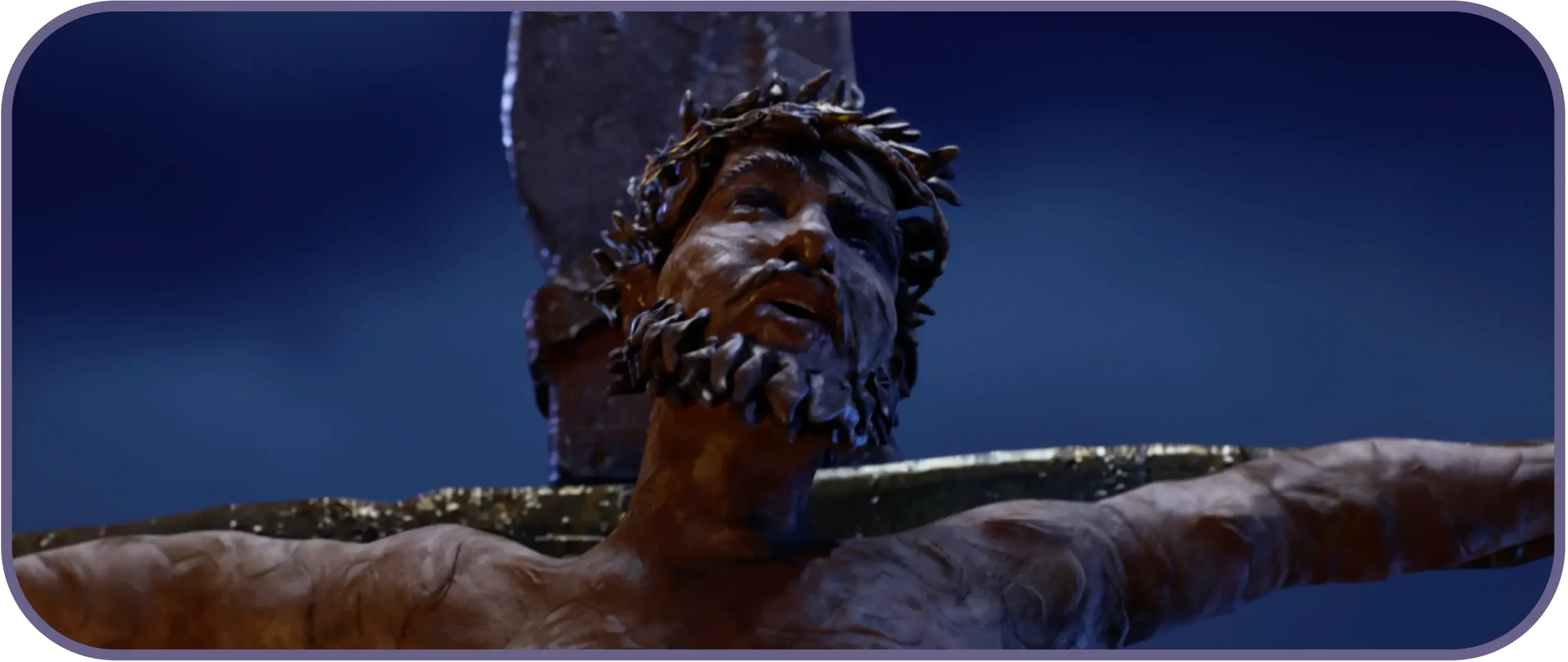
The shadows represent sin, evil, and human brokenness being placed on Jesus.
They visualize what Christianity teaches about his sacrificial death.
What looks like defeat is portrayed as a decisive spiritual victory.
The dark shadows in the scene are not meant to be taken literally, but function as a visual metaphor for sin, evil, and the accumulated weight of human wrongdoing being directed toward Jesus in his death.
This artistic choice reflects the Christian belief that the crucifixion is not merely a physical execution, but a unique act in which Jesus takes upon himself the consequences of human sin.
Rather than depicting this in abstract theological terms, the episode translates it into visual language, showing evil as something active, invasive, and personal, which converges on Jesus at the cross.
Within the New Testament, Jesus himself interprets his death in sacrificial terms, particularly in connection with the Passover meal, where he identifies the bread and wine with his body and blood, signaling the inauguration of a new covenant.
This draws on Old Testament imagery, where covenant relationships were established through sacrifice, and where the Passover lamb symbolized deliverance through substitutionary death.
In this framework, Jesus’ death is not accidental or purely tragic, but purposeful, marking a transition from the old covenant to a new one centered on forgiveness and restoration.
The shadows, then, visually represent what theology later describes as “atonement,” though the New Testament itself presents this through multiple images rather than a single technical explanation.
Importantly, this is not portrayed as God being persuaded to love humanity, but as an expression of a love that already exists, where God, in Christ, takes responsibility for the cost of reconciliation.
Seen this way, the cross becomes not a moment of divine absence, but of intense divine involvement, where suffering is absorbed rather than avoided.
This is an artistic representation of the Christian belief that Jesus died as a sacrifice for human sin.
As Jesus is on the cross, dark shadows are depicted rushing through the sky and dashing into him. Each shadow shouts bad words like “I hate you” or “Take her, kill her” or “I'm prettier than you, get out of here!” This is an artistic representation of Jesus’s claim that his death was a unique act of sacrifice for sin. As Legacy of Adam producer Roger Gihlemoen comments:
What looks like quiet defeat on earth is presented as a decisive moment in the unseen realm, where evil is confronted and broken. . . . Jesus’ death is shown as God taking responsibility for the problem himself. Instead of demanding payment from humanity, God carries the cost. . . . The episode shows this with visual language.
In light of the divine vindication provided by his later resurrection, Jesus’s re-purposing of the Passover meal during his “last supper” with his disciples (see 1 Corinthians 10:16 & 11:23-26; Mark 14:22-24; Matthew 26:26-29; Luke 22:19-20 & John 6:54-56) shows that his crucifixion starts the “new covenant” predicted by the Old Testament (see Isaiah 11:11-16, 35:1-10, 40:1-5; Jeremiah 23:5-8; etc). Just as the act of a properly authorised personage breaking a bottle of Champaign on the side of a ship whilst uttering the words “I name this ship . . .” brings about the naming of a ship, so Jesus’ death in light of a) his interpretation thereof, and b) the fact that his resurrection shows him to be someone with the requisite authority to issue this interpretation, brings about the existence of a new covenant, a covenant of forgiveness for sin through faith in Jesus that is open to both Jews and Gentiles.
As theologian Mark L. Strauss explains, Jesus’s “last supper” was a Passover celebration with a twist:
this is no ordinary Passover but the establishment of a new Passover for the new age of salvation – the kingdom of God. The original Passover represented God’s greatest act of deliverance in the Hebrew scriptures and the creation of Israel as a nation . . . Yahweh . . . delivered his people through the sacrificial blood of the Passover lamb, and brought them out of slavery in Egypt. Giving them his law at Mount Sinai, he established a covenant relationship with them. When Israel was later oppressed and defeated by her enemies, the prophets would predict the day when Yahweh would return to Zion to accomplish a new and greater exodus [Isaiah 11:11-16, 35:1-10, 40:1-5; Jeremiah 23:5-8; etc]. Jesus’ eucharistic words recall and transform the rich symbols of Passover . . . The unleavened bread of the Passover meal represents Jesus’ body, given for his disciples. The implication is that he is the new Passover lamb [1 Corinthians 5:7]. The Passover wine represents the blood of the new covenant. Jesus’ words in Mark 14:24, “This is my blood of the covenant,” echo Exodus 24:8 . . . Jesus speaks explicitly of the new covenant, a clear allusion to Jeremiah 31 . . . Jesus’ words at the Last Supper thus fit well his preaching about the kingdom of God . . . . They also provide important clues as to how he viewed his approaching death. Drawing symbolism from the Passover meal, the covenant at Sinai, and the new exodus and new covenant imagery in the prophets, Jesus inaugurates a new Passover meal celebrating the new covenant and the arrival of the kingdom of God. While the first covenant was instituted with the blood of sacrificial animals, this new covenant will be established through his own blood. It seems likely, therefore, that Jesus viewed his death as a sacrifice of atonement, leading his people in a new exodus from bondage to sin and death.[778]
In short, Jesus’s death and resurrection both bring about, and advertise the existence of, a new form of covenantal relationship between God and humanity.
Exactly how God bridges the gulf between sinful human beings and his own perfect nature so as to permit the “at-one-ment” of this new covenant is the subject matter for theological theories of “atonement.” British theologian Alister E. McGrath explains that:
the New Testament is not . . . concerned with the detailed and intricate mechanics of redemption. The New Testament actually presents us with a series of images of what Christ achieved for us through his death and resurrection. It is dominated by proclamation of the fact that the cross and resurrection have the power to change us, along with a number of superb illustrations of the ways in which we can visualize this potential.[779]
McGrath explores these biblical illustrations in his book Making Sense of the Cross (Leicester: IVP, 1992). Christian philosopher C. Stephen Evans concurs with McGrath that
it is the fact of atonement that Christians are asked to believe, not any particular theory as to how this is achieved by Christ’s death and resurrection. Indeed, Christians have over the centuries held a variety of theories about how this occurred.[780]
Readers wishing to explore these theories should see the recommended resources for this episode.
Certainly, Jesus’ death doesn’t convince God either to love humans or to offer them forgiveness. As theologians Joel B. Green and Mark D. Baker affirm, “Whatever meaning atonement might have, it would be a grave error to imagine that it focused on assuaging God’s anger or winning God’s merciful attention.”[781] Rather, Jesus died for us because God already loved us: “This is love: not that we loved God, but that he loved us and sent his Son as an atoning sacrifice for our sins” (1 John 4:10). The apostle Paul likewise states that “God demonstrates his own love for us in this: While we were still sinners, Christ died for us” (Romans 5:8).
Christian philosopher Richard Shumack highlights the fact that Christian theology understands the atonement within a Trinitarian framework:
Under a trinitarian framework, Jesus is not simply some innocent representative human being punished by an angry God for other people’s sin. Instead, since Jesus is the Second Person of the Trinity, whatever was happening on the cross was all happening, in a sense, “within” God. Care is needed here, and crude parodies of what the Bible describes will not suffice. Nevertheless, it is fair to say that, under a trinitarian understanding, the cross of Christ involves God, alone, sorting out atonement for human sin. Since Jesus is both divine and human, his death on the cross operates as God (appropriately) expressing his anger at human sin and censuring humanity, yet doing so in such a way that he, himself, bears the full destructive force of that expression.
This is, I suggest, sensible in the way that any true forgiveness involves the forgiver bearing pain and anguish. I know, for example, of a woman who discovered her husband had been betraying her for many years. Upon being discovered, he pleaded for forgiveness. Astonishingly, she chose to forgive him and allowed him to be restored to a full loving relationship. This act of forgiveness, however, was profoundly painful. It involved the wife internally wrestling and anguishing over how to avoid relinquishing graciously treating her husband with love and instead justly punishing him for his infidelity. I can imagine the painful, internal trinitarian struggle to atone for human sin working, perhaps, a little similarly.[782]
Christian philosopher Keith Ward has this to say about God’s self-sacrificial suffering of sin displayed on the cross:
Sin, we might well say, causes a change in the divine nature – the realization of anger, even when transformed by compassion, the frustration of divine purpose, and the frustration of joy. These are costs that God [freely] bears whenever sin impairs a possible divine-creaturely relationship. The crucifixion of Jesus, in so far as it is an act of God as well as the self-offering of a human life, is the particular and definitive historical expression of the universal sacrifice of God in bearing the cost of sin. Sin is a harm done to God, inasmuch as it causes God to know, and to share, the suffering and reality of evil. The “ransom” God pays is to accept this cost, to bear with evil, in order that it should be redeemed, transfigured, in God . . . The patience of God, bearing the cost of sin, takes the life and death and resurrection of Jesus as its own self-manifestation, and makes it the means by which the liberating life of God is made available in its essential form to the world.[783]
After all, what is forgiveness, in our experience, but the loving willingness of a wronged individual to suffer and absorb the wrong done to them for the sake of relationship with the person who wronged them? As philosopher C. Stephen Evans comments:
In the death and resurrection of Jesus, God shows us how complete his love for us is . . . He takes on human form and suffers the consequences of sin, expressing both the seriousness with which he views our sin and the exuberant love with which he is willing to forgive our sins.[784]
As Evans advises,
The critical question is not whether you fully understand God’s action in suffering on your behalf. It is whether you are moved by his suffering to “turn around,” to repent. Then the power of God that conquered death in Jesus will be at work in your life as well.[785]
In other words, whether or not you understand how a medicine works, the main thing is to trust the doctor who testifies that it works by taking your medicine.
Mark L. Strauss, Four Portraits, One Jesus: An Introduction to Jesus and the Gospels. Grand Rapids, Michigan: Zondervan, 2007, 504-505.
Alister E. McGrath, Making Sense of the Cross. Leicester: IVP, 1992, 43.
C. Stephen Evans, Why Believe? Reason and Mystery as Pointers to God, revised edition. Leicester: IVP, 1996, 130-131.
Joel B. Green & Mark D. Baker, Recovering The Scandal Of The Cross: Atonement In New Testament And Contemporary Contexts. Carlisle: Paternoster, 2000, 51.
Richard Shumack, The Wisdom of Islam and the Foolishness of Christianity: A Christian Response to Nine Objections to Christianity by Muslim Philosophers. Island View, 2014.
Keith Ward, What The Bible Really Teaches: A Challenge For Fundamentalists. London: SPCK, 2004, 109-110.
C. Stephen Evans, Why Believe? Reason and Mystery as Pointers to God, revised edition. Leicester: IVP, 1996, 131-132.
C. Stephen Evans, Why Believe? Reason and Mystery as Pointers to God, revised edition. Leicester: IVP, 1996, 133.
Jesus quotes Psalm 22 to express both real anguish and deep trust in God.
“It is finished” declares that his mission has been completed.
Together, the statements reveal suffering that leads to fulfillment, not defeat.
When Jesus cries out, “My God, my God, why have you forsaken me?” he is quoting the opening line of Psalm 22, a well-known passage that begins in anguish but ultimately moves toward vindication, trust, and global praise of God.
This means the statement should not be understood as a simple declaration of abandonment, but as a deliberate reference to a larger scriptural context, where the one who feels forsaken is, in fact, not abandoned by God.
Within that Psalm, the sufferer continues to address God as “My God,” affirming relationship even in the midst of distress, and later explicitly declares that God has not hidden His face or ignored the cry for help.
This aligns with Jesus’ own earlier statement in John 16:32, where he insists that even though he will be left alone by others, he is not alone because the Father is with him.
Theologically, this has led many to conclude that the unity between Father and Son is not broken on the cross, even though Jesus fully experiences the depth of human suffering, including the felt absence of comfort and presence.
In this sense, the cry expresses genuine human anguish, while at the same time pointing forward to the resolution already embedded in Psalm 22, where suffering leads to deliverance and restoration.
By contrast, the statement “It is finished” (John 19:30) serves as a declaration that the work Jesus came to accomplish has reached its completion, not that his life ends in defeat, but that his mission has been fulfilled.
This includes the establishment of the new covenant and the completion of the purpose he associated with his death throughout his ministry.
Taken together, these two statements hold both tension and resolution, as one expresses the depth of suffering and the other affirms the completion and meaning of that suffering.
Jesus is quoting from an Old Testament Psalm of David.
Whilst he is on the cross, Jesus shouts out “My God, my God, why have you forsaken me?” and “It is finished!” Jesus is quoting from Psalm 22, a Psalm of David from the Old Testament. As theologian Stephen D. Morrison comments,
Growing up I often heard Matthew 27:46 quoted in presenting the Gospel. The preacher would say something along these lines: “God is too holy to look at sin. When Jesus died on the cross, the Father turned His back on Him. He abandoned Jesus, and forsake Him to die . . .” But did the Father really forsake His Son on the cross? Absolutely not! And this is ultimately how I know that the Father did not forsake Jesus on the cross: Psalms 22 clearly says so! Check out verse 24: “For he has not despised or scorned the suffering of the afflicted one; he has not hidden his face from him but has listened to his cry for help.” Jesus was not forsaken by God! The perfect union of Father, Son, and Spirit remained unbroken! God did not forsake His Son on the cross. As Paul writes, “God was in Christ reconciling the world to Himself.”[786]
Indeed, in John 16:32, Jesus speaks to the disciples about his approaching crucifixion, affirming that he will not be abandoned by God:
Behold, the hour is coming, indeed it has come, when you will be scattered, each to his own home, and will leave me alone. Yet I am not alone, for the Father is with me.
Hence theologian John Gill (1697-1771) argues that Jesus’ quotation of Psalm 22:1
is to be understood, not as if the hypostatical or personal union of the divine and human natures were dissolved, or that the one was now separated from the other: for the fulness of the Godhead still dwelt bodily in him; nor that he ceased to be the object of the Father's love; for so he was in the midst of all his sufferings, yea, his Father loved him because he laid down his life for the sheep; nor that the principle of joy and comfort was lost in him, only the act and sense of it; he was now deprived of the gracious presence of God, of the manifestations of his love to his human soul, and had a sense of divine wrath, not for his own sins, but for the sins of his people, and was for a while destitute of help and comfort. . .[787]
God is still claimed by the Psalmist (i.e., king David) as “My God,” even as he expresses his feelings of temporary abandonment to his oppression of King Saul. As many theologians have observed,
even in his desolation, David prays, “My God, my God,” acknowledging his faith in God and dependence on Him, despite the Lord’s perceived distance and silence. Later, David declares outright his trust in the Lord: “Yet you are enthroned as the Holy One; you are the one Israel praises. In you our ancestors put their trust; they trusted and you delivered them. To you they cried out and were saved; in you they trusted and were not put to shame” (Psalm 22:3–5; see also verses 9–10). David knows that God never forsakes His people (verses 22–24).[788]
As Christian pastor Josh Cramer comments,
in Psalm 22, the Psalmist looks and feels forsaken, but the result is salvation that leads to universal – including all nations and all generations – praise of God. The Psalmist cries out in anguish but the result of the cry of anguish is the reminder that God is faithful. Anguish and praise go back-and-forth in the Psalm: forsakenness to reminder of God’s faithfulness to feelings of being undeserving to reminders of God’s creation to feeling surrounded to cry for God to be near to praise. It’s not an easy or straightforward Psalm that moves from lament to praise. Psalm 22 takes us through the experience of struggle to get to praise. But the Psalmist finally gets to a universal and complete vision of praise. The end does not resolve with the resolution of the Psalmist’s immediate situation but with an eschatological and fulfilled vision, including all nations and generations. The Psalm moves from forsakenness to total shalom.
Verse 24 is key to that vision: “For he has not despised or scorned/the suffering of the afflicted one;/he has not hidden his face from him/but has listened to his cry for help.” Despite the sense of alienation and abandonment that the Psalmist experiences, God has not in fact abandoned him. The “afflicted one” is, in reality, “not despised or scorned” nor is God’s “face” “hidden.” Instead, God “has listened to his cry.” (Just a note: the Hebrew term for “listen” always carries the weight of action with it; one cannot “listen” and not be moved to action. “Listen” might as well be translated “listen and obey.”) So, God is near to the afflicted one who suffers. Though a person might be afflicted and experience suffering, God is near, listening and acting on behalf of the sufferer. . .
Jesus cries out in anguish, “My God my God, why have you forsaken me?” but this cry quotes from Psalm 22, where the initial feeling of forsakenness leads to eschatological salvation. Jesus cries out as a way of expressing both his sense of anguish but also his faith in God’s ultimate victory.[789]
Stephen D. Morrison, ““Jesus Was Forsaken by God” – Disgrace to Grace #3.” https://www.sdmorrison.org/jesus-forsaken-god-disgrace-grace-3/. The idea that “God is too holy to look on sin” is a theologically problematic idea (one that contradicts the doctrine of God’s omniscience) that stems from a misinterpretation of Old Testament language about God being too pure to look upon sin (Habakkuk 1:13), language which means that God is too pure to approve of sin (the Hebrew word raah means both to behold and to approve or respect); see https://biblehub.com/commentaries/benson/habakkuk/1.htm).
“Why does the psalmist ask, “Why have you forsaken me” (Psalm 22:1)?” https://www.gotquestions.org/why-have-you-forsaken-me.html.
Josh Cramer, “Psalm 22 and Jesus' Cry from the Cross.” https://www.resurrectionboise.org/blog/psalm22.
Yes, all available evidence indicates that Jesus died on the cross.
Roman crucifixion was designed to ensure death.
This conclusion is accepted by virtually all historians.
While the crucifixion itself is widely accepted, the question of whether Jesus actually died on the cross is also addressed by examining Roman practices, medical factors, and the convergence of historical testimony.
Roman crucifixion was a highly efficient method of execution, and soldiers were trained and legally responsible to ensure that victims did not survive, with severe penalties for failure.
The process itself, involving scourging, blood loss, shock, and eventual asphyxiation, made survival extremely unlikely, and in recorded history there are no reliable cases of someone surviving a full Roman crucifixion.
In Jesus’ case, the Gospels report that his legs were not broken, a procedure normally used to hasten death, which indicates that the soldiers were already confident he was dead.
To remove any doubt, a soldier pierced his side with a spear, and the description of “blood and water” is consistent with modern medical understanding of fluid accumulation around the heart and lungs following death.
This detail is significant because it reflects an observation that the original witness would not have had the medical knowledge to fabricate, suggesting authenticity rather than invention.
Additionally, multiple groups had opportunity and motivation to verify his death, including Roman executioners, Jewish authorities, and those who prepared his body for burial, all of whom acted on the assumption that he was dead.
The burial practices of the time further reinforce this, as bodies were carefully handled and inspected before being placed in tombs.
From a historical standpoint, early sources unanimously present Jesus as having died, and even hostile or sceptical scholars accept this conclusion.
All the evidence indicates that Jesus died on the cross.
As Charles Foster reports, attempts to deny the historical reality of Jesus’ crucifixion
have been laughed out of court by serious scholars . . . The overwhelming conclusion of the mainstream literature, even that written by virulent opponents of Christianity, is that Jesus did indeed die on the cross.[790]
Hence, for example, American atheist Jerry Coyne admits that: “Jesus was crucified, ending everyone’s hope of glory.”[791]
Although evidence of Jesus’ crucifixion doesn’t in itself absolutely guarantee his death by crucifixion, the overwhelming historical evidence for the former is nevertheless a strong indication of the latter. Jesus’ death by crucifixion passes the criterion of historical verisimilitude, for as Nabeel Qureshi points out: “never in recorded history has anyone survived a full Roman crucifixion.”[792] Roman law placed a death penalty “on any soldier who let a capital prisoner escape in any way, including bungling a crucifixion.”[793] Roman executioners were thus highly motivated and knew what they were doing. Not that their job was particularly complicated. Crucifixion was, in general terms, a cruel, slow death by asphyxiation:
Since the muscles used for inhaling are stronger than the muscles used for exhaling, carbon dioxide would build up and the victim would die an uncomfortable death. Experiments on live volunteers, suspended with the inability to touch the ground, revealed that one could not remain conscious longer than twelve minutes in this position, as long as their arms were at a 45- degree angle or less. Breaking the legs of a crucified victim would prevent them from pushing up against the nail in their feet, an excruciating move, in order to make it easier to breath, albeit temporarily. It is the opinion of my two ER physician friends that, due to the trauma already experienced by a crucified victim, once He had died on a cross from a lack of oxygen, and had remained dead in that position for five minutes, there would be no chance of resuscitating Him.[794]
The fact that the soldiers didn’t bother to break Jesus’ legs in order to expedite death by crucifixion (a practice confirmed by ancient sources including Cicero’s Orations) shows that they were sure he was already dead. Archaeologist Shimon Gibson notes that the earlier scourging suffered by Jesus “would undoubtedly have led to a massive loss of blood . . . Hence, it is not surprising that Jesus did not last very long on the cross, perhaps 3 to 6 hours at the most.”[795]
Nevertheless, to eliminate all doubt, one of the soldiers stabbed Jesus’ corpse with a spear, a coup-de-grace mentioned by the first century Roman author Quintilian. The Gospel according to John provides an eyewitness report of “blood and water” coming out of the spear-wound (John 19:34). Truman Davis M.D. argues that this is “conclusive post-mortem evidence” that Jesus actually died “of heart failure . . .”[796] As Alexander Metherall M.D. explains:
hypovolemic shock would have caused a sustained rapid heart rate that would have contributed to heart failure, resulting in the collection of fluid in the membrane around the heart, called a pericardial effusion, as well as around the lungs, which is called a pleural effusion [sometimes referred to as “water on the lungs”] . . . The spear apparently went through the right lung and into the heart, so when the spear was pulled out, some fluid – the pericardial effusion and the pleural effusion – came out. This would have had the appearance of a clear fluid, like water, followed by a large volume of blood, as the eyewitness John described . . .[797]
John wouldn’t have known these medical details in the first century, and so had no reason for reporting them besides conveying something unusual that he saw (hence his eyewitness report passes the historical “Criterion of Unintentional Signs of History”). The weight of historical and medical evidence thus indicates that Jesus was dead before the wound to his side was inflicted and that the soldier’s spear likely perforated not only Jesus’s right lung, but also his pericardium and heart, which would have ensured his death if he had still been alive. Since it bears the hallmark of an unintentional sign of historicity, John’s eyewitness report of blood and water emerging from Jesus’ spear-wound counts as a demonstrably independent witness to the fact of Jesus’ death by crucifixion, meaning that Jesus’ death by crucifixion passes the criteria of independent testimony in its most stringent form.
It’s worth noting at this juncture that “Tannaitic sources repeatedly emphasize that it is forbidden to treat a person as dead until it is clearly ascertained that he has expired (Semahoth I).”[798] Simon Seabag Montefiore observes: “Jewish dead were not buried in the earth during the first century but laid in a shroud in a rock tomb, which [was] always checked, partly to ensure that the deceased were indeed dead and not merely comatose . . .”[799] Thus, as A. Rendle Short comments: “The Roman soldiers, the priests and His friends who buried Him would all look carefully to make certain that He was dead.”[11] Homicide detective J. Warner Wallace comments:
Three conditions become apparent in the bodies of dead people: temperature loss, rigidity, and lividity . . . dead bodies look, feel, and respond differently from living, breathing humans . . . Is it reasonable to believe that those who removed Jesus from the cross, took possession of His body, carried him to the grave, and spent time treating and wrapping His body for burial would not have noticed any of these conditions common to dead bodies?[780]
Apparently, the people who a) crucified Jesus, or saw him crucified,[781] b) took Jesus’s corpse down from the cross, c) prepared his corpse for burial, and d) entombed his corpse, all thought he was dead. Likewise, the antagonistic Jewish authorities at whose behest Jesus had been executed conceded that Jesus had died when they accused the disciples of stealing his corpse away from his tomb, a conspiracy theory discussed in Matthew 28:12–14 and reflected in Jewish tradition (as gathered into the fifth century AD Toledoth Jesu).
The synoptic gospel accounts of Jesus’ death mention people that the audience would have been able to check facts with. For example, they all mention Simon of Cyrene, who is compelled to carry Jesus’ crossbeam after Jesus (suffering from blood loss, dehydration and shock consequent to his scourging) stumbles under the load (see Mark 15.21; Matthew 27:32; Luke 23:26). Simon’s sons Alexander and Rufus were known within the early church and are mentioned by the pre-Marcan passion account, as if to say “if you don’t believe this, go and check with them” (see Mark 15:21 & Romans 16:13).
The existence of Simon and Alexander has been corroborated by archaeology.[782] In 1941, Israeli archaeologist Eleazar Sukenik discovered a tomb in the Kidron valley in eastern Jerusalem. Pottery dated it to the 1st century AD. The tomb contained eleven ossuaries bearing twelve names in fifteen inscriptions. Some of the names were particularly common in Cyrenaica. An inscription on one of these ossuaries says: “Alexandros (son of) Simon.” The lid of this ossuary bears an inscription with the name Alexandros in Greek, followed by the Hebrew QRNYT. The meaning of this isn’t clear, but one possibility is that the person making the inscription meant to write QRNYH - the Hebrew for “Cyrenian.” Writing in Biblical Archaeological Review Tom Powers comments:
When we consider how uncommon the name Alexander was, and note that the ossuary inscription lists him in the same relationship to Simon as the New Testament does and recall that the burial cave contains the remains of people from Cyrenaica, the chance that the Simon on the ossuary refers to the Simon of Cyrene mentioned in the Gospels seems very likely.[783]
Finally, Jesus’ death by crucifixion would have been so embarrassing to Jesus’ followers (who expected him to destroy the Romans and who mostly ran away when he didn’t) that they wouldn’t have made it up. As theologian Craig A. Evans asks:
Had Jesus not been executed, had Jesus not been crucified, why make up such a preposterous story? No, the death of Jesus is no fiction. It is a grim historical reality. It was known to non-Christians, and it was demoralizing even for Jesus’ followers – at least at initially – and an ongoing embarrassment as the church proclaimed Jesus as Savior and Son of God throughout the Roman Empire. There can be no doubt that Jesus was executed.[784]
Likewise, archaeologist John Romer comments:
the act of Jesus’ crucifixion convinces because of its extremely degrading nature. In the Roman Empire crucifixion was a most shameful death, even in the minds of the early Christian congregations, as Paul’s letters make clear . . . Crucifixion was considered to be one of the most severe Roman punishments, worse than decapitation, burning, or exposure to wild beasts . . . [785]
As Graham Veale writes: “Crucifixion was such a way to die that it is absurd to suppose that any group would pretend that their leader had been crucified!”[786] Historian Michael Grant agrees that “no one would have invented such a degraded end, a fatal objection to Jesus’ Messiahship in Jewish eyes.”[787]
Gary R. Habermas confirms that “Almost no scholar today questions Jesus’ death by crucifixion”[788] since it is “is one of the best attested facts in ancient history.”[789] Likewise, philosopher Francis J. Beckwith reports that “nearly all scholars agree that Jesus died by crucifixion . . .”[790] For example:
In sum:
the historical evidence is very strong that Jesus died by crucifixion. It is attested to by a number of ancient sources, some of which are non-Christian . . . the chances of surviving crucifixion were very bleak; the unanimous professional medical opinion is that Jesus certainly died due to the rigors of crucifixion, and even if Jesus somehow managed to survive crucifixion, it would not have resulted in the disciples’ belief that he had been resurrected.[810]
Charles Foster, The Jesus Inquest. Oxford: Monarch, 2006, 72 & 220.
Jerry Coyne, Faith vs. Fact. London: Penguin, 2016, 123.
Nabeel Qureshi, No God But One: A Former Muslim Investigates the Evidence for Islam and Christianity. HarperChristian Resources, 2016, 167.
Peter Kreeft and Ronald K. Tacelli, Handbook of Christian Apologetics. Downers Grove, IL: IVP, 1994, 183.
Michael Licona, “Can We Be Certain that Jesus Died On A Cross?” In Evidence for God, edited by William A. Dembski and Michael R. Licona. Grand Rapids, Michigan: Baker 2010.
Shimon Gibson, The Final Days of Jesus. Harper Collins, 2009, 123.
Truman Davis, “The Crucifixion of Jesus. The Passion of Christ from a Medical Point of View,” Arizona Medicine 22:3 (March 1965).
Alexander Metherell in Lee Strobel, The Case for Christ. Grand Rapids, MI: Zondervan, 1998, 199.
Shemuel Safrai, The Jewish People in the First Century. Van Goreum Fortress, 1976, 773.
Simon Seabag Montefiore, Yerusalemu: Yerusalemu: The Biography. London: Weidenfeld & Nicolson, 2011, 130.
A. Rendle Short, Why Believe? London: Inter-Varsity Fellowship, 1962, 48–9.
J. Warner Wallace, Cold-Case Christianity: A Homicide Detective Investigates The Claims Of The Gospels. Colorado Springs, CO: David C. Cook, 2013, 42.
Those who saw him crucified include: John, Jesus” mother, Mary Magdalene, Mary the mother of James and Joses, Mary the wife of Clopas and Salome the mother of the sons of Zebedee (see Matthew 27:56; Mark 15:40-41; Luke 23:49 and John 20:1-18).
See Good Answers with Dr. Culley, “Simon of Cyrene.” https://www.youtube.com/watch?v=78SdNTHKC-A&list=PLQhh3qcwVEWjh9aRRWF1kYZIVCPc5iCcw&index=38&t=172s.
Tom Powers, in the July/August 2003 issue of Biblical Archaeology Review, 51.
Craig A. Evans, Jesus and the Remains of His Day: Studies in Jesus and the Evidence of Material Culture. Peabody, Massachusetts: Hendrickson, 2015, 148.
John Romer, Testament: The Bible And History. London: Michael O’Mara, 1988, 178-179.
Graham Veale, New Atheism: A Survival Guide. Fearn: Christian Focus, 2013, 80.
Michael Grant, Jesus: An Historian’s Review Of The Gospels. New York: Charles Scribner’s Sons, 1977, 166.
Gary R. Habermas in Did the Resurrection Happen?, A Conversation with Gary Habermas and Antony Flew, edited by David Baggett. Downers Grove, IL: IVP, 2009, 26.
Gary R. Habermas, The Verdict of History: Conclusive Evidence From Beyond the Bible for the Life of Jesus. Eastbourne: Monarch, 1990, 178.
Yes, there are good historical reasons to think Jesus was buried in a tomb.
The burial by Joseph of Arimathea fits known Jewish and Roman practices.
Many scholars accept the burial as historical.
The claim that Jesus was buried in a tomb by Joseph of Arimathea is supported by multiple lines of historical and cultural evidence, and is widely regarded as plausible by scholars.
Although some critics argue that crucified victims were typically left unburied, archaeological findings, such as the remains of the crucified man Yehohanan, demonstrate that burial after crucifixion did occur in first-century Judea.
Jewish law strongly required burial before sunset, even for executed criminals, and sources like Josephus confirm that Jews were careful to ensure proper burial in such cases.
Roman practice, while sometimes harsh, generally allowed local customs to be followed, especially in regions like Judea during peacetime, making it likely that Jewish burial traditions were respected.
The Gospel accounts align closely with what we know about these customs, and archaeologists such as Jodi Magness affirm that the descriptions of Jesus’ burial are consistent with the historical and cultural context.
The figure of Joseph of Arimathea is also significant, since he is described as a member of the Sanhedrin, a detail that would have been risky to invent given the public nature of that body and its known members.
This lends credibility to the account, as early Christians would be unlikely to fabricate a specific, identifiable individual in such a role.
Additionally, the burial is attested in multiple early sources, including early creedal material in 1 Corinthians 15, which strengthens its historical reliability.
The fact that even critics had to explain the empty tomb tradition suggests that the location of Jesus’ burial was known and publicly accessible.
There is good reason to think that Jesus was interred in a tomb just outside Jerusalem by Joseph of Arimathea.
French atheist Michael Onfray asserts that, as a victim of crucifixion, Jesus “would have been left hanging there, at the mercy of wild beasts. There was no question of bodies being laid to rest in tombs.”[832] While there are indeed historical records of crucifixion victims being left “hanging on a cross to feed the crows,”[833] Onfray’s blanket claim is contradicted by archaeology. The entombed remains of Yehohanan came complete with the nail that had been driven through the heel bone of his left foot during crucifixion.[834] Furthermore, theologian Craig A. Evans points out that “138 iron nails have been recovered from [Jewish] tombs and many of them have imbedded in the rust human bone and calcium. So there we’ve got . . . evidence probably of dozens of crucifixion victims who were properly buried.”[835] For example, archaeologists have recently re-assessed the skeletal materials and nails from the ossuary in Abba Cave in Jerusalem, concluding that the deceased – identified by an inscription in the cave as “Mattathias son of Judah” - was the man known in Greek as Aristobulus II, the last Hasmonean ruler, whom Marcus Antonius had crucified. Three nails, still bearing traces of human calcium, were recovered from his ossuary.
In first century Israel:
The commands of Scripture, taken with traditions regarding piety (as especially exemplified in Tobit), corpse impurity, and the avoidance of the defilement of the land, strongly suggest that under normal circumstances (i.e., peacetime) no corpse would remain unburied - neither Jew nor Gentile, neither innocent nor guilty. All were to be buried.[836]
Indeed, Josephus commented: “Jews are so careful about funeral rights that even malefactors who have been sentenced to crucifixion are taken down and buried before sunset.”[837]
Mark D. Smith, a historian of Rome, observes that:
According to Roman law, criminals condemned to death must be buried. Only in the case of the highest form of treason . . . was denial of burial permitted (but not required). Roman cultural values combined with Roman law to demand that even the destitute and abandoned, even executed criminals, most of whom, then as now, were from the lower classes, would not rot in the streets or the places reserved for executions, but would receive at least the minimal burial or cremation . . . these factors, combined with the traditional Roman respect for the autonomy of the cultural practices of provincials, suggest that standard Roman procedure would be to allow Jews to handle their dead as they wished, including those who were executed.[838]
Hence, contrary to Onfray, reports of Jesus’ burial pass the criterion of historical verisimilitude: “Jews buried all dead, including the executed, and the Romans complied with Jewish customs – at least during peacetime.”[839] Jewish archaeologist Jodi Magness, an expert on burial traditions in Jerusalem in the late Second Temple period, states that “The Gospel accounts describing Jesus’ removal from the cross and burial are consistent with archaeological evidence and with Jewish law.”[840]
The 1 Corinthians 15 creed and the passion source used by the gospel of Mark provide exceptionally early sources of testimony to Jesus’ burial. Early testimony to Jesus’ burial is also provided by the special sources used by Luke and John in their gospels. The sermons recorded in Acts 2:29-31 and 13:36-37 likewise provide early testimony to Jesus’ burial. Finally, Paul alludes to Jesus’ burial when he speaks of believers being metaphorically “buried with” Jesus in Romans 6:4 and as “having been buried with him in baptism” in Colossians 2:13. We can therefore note that the burial passes the criterion of multiple forms.
Although a few critics have suggested that the specific burial place of Jesus may have been unknown, theologian Wolfhart Pannenberg observes that “this is a pure invention of modern scholarship without the slightest evidence.”[841] The gospels contain multiple early reports of multiple individuals (both friend and foe) who knew the specific burial place of Jesus (e.g. Mary the mother of Jesus, the female disciples including Mary Magdalene, the Jewish authorities, the guards, the cemetery groundskeeper, John, Nicodemus and Joseph of Arimathea).
As philosopher and theologian William Lane Craig observes:
Even the most skeptical scholars acknowledge that Joseph was probably the genuine, historical individual who buried Jesus, since it is unlikely that early Christian believers would invent an individual, give him a name and nearby town of origin, and place that fictional character on the historical council of the Sanhedrin, whose members were well known.[842]
J. P. Holding notes that “Arimathea” can be identified with ancient Ramah, which was later named as Ramathaian or Aramathaim (see Josephus Antiquities 13.4.9). Joseph’s coming from Aramathaim would have very naturally led to a pun on the Greek phrase “best disciple” (aristos mathetes). “Metheia” is said to mean “disciple town” and “ari” is a common Greek prefix denoting superiority:
Far from suggesting that Joseph was a fiction, the punning implies that Joseph’s role as a “best disciple” was an early and well-known figure, recognized by the Greek-speakers of the church who, in line with the Jewish tendency to make puns, came up with this clever joke which became implanted in the diverse Gospel tradition.[843]
C. Marvin Pate reports that: “Even the most sceptical biblical scholars agree that Joseph of Arimathea was a historical person, actually a member of the Jewish Sanhedrin . . . it is highly unlikely that [Christians] would invent such an individual who would do the right thing regarding the burial of Jesus.”[844] Indeed, as Michael Grant observes, the absence of Jesus’ circle of male disciples from his burial is “too unfortunate, indeed disgraceful, to have been voluntarily invented by the evangelists at a later date.”[845]
Finally, Jesus’ somewhat publicly falsifiable burial is implicitly conceded by the enemy attestation of the Jewish polemic concerning the empty tomb that lies behind Matthew 27:62-66 & 28:11-15. There would have been no need to explain the emptiness of the tomb had it not been occupied in the first place: “The fact that the enemies of Christianity felt obliged to explain away the empty tomb by the theft hypothesis shows . . . that the tomb was known (confirmation of the burial story) . . .”[846]
Robert J. Hutchinson reports that:
many scholars, and not merely Christian ones, insist that Jesus’ body was almost certainly taken down from the cross and buried, in deference to the Jewish holiday of Passover . . . contemporary historians and archaeologists – such as Shimon Gibson, Jodi Magness, James Dunn, N.T. Wright, Raymond Brown, E.P. Sanders, James Tabor, Michael Grant and Craig Evans – believe that Jesus was indeed given a proper burial.[847]
Again:
Michael Onfray, Atheist Manifesto. Serpent, 128.
orace, Epistles, 1.16.48.
See: Biblical Archaeological Society Staff, “A Tomb in Jerusalem Reveals the History of Crucifixion and Roman Crucifixion Methods” https://www.biblicalarchaeology.org/daily/biblical-topics/crucifixion/a-tomb-in-jerusalem-reveals-the-history-of-crucifixion-and-roman-crucifixion-methods/.
Craig A. Evans, “The burial and empty tomb traditions.”
Craig A. Evans, “Jewish Burial Traditions and the Resurrection of Jesus.” http://craigaevans.com/Burial_Traditions.pdf.
Josephus, Jewish War, quoted by Evans, “Jewish Burial Traditions and the Resurrection of Jesus.” http://craigaevans.com/Burial_Traditions.pdf.
Mark D. Smith, The Final Days of Jesus: The Thrill of Defeat, The Agony of Victory. A Classical Historian Explores Jesus’s Arrest, Trial, and Execution. Cambridge: Lutterworth, 2018, 204 & 206.
Stephen C. Evans, “The Christ of Faith is the Jesus of History,” In Debating Christian Theism, edited by J.P. Moreland, Chad Meister and Khaldoun A. Sweis. Oxford University Press, 2013, 464.
Jodi Magness in Lee Strobel, The Case for Miracles: A Journalist Investigates Evidence for the Supernatural. Grand Rapids, Michigan: Zondervan, 2018, 205.
Wolfhart Pannenberg, “History and the Reality of the Resurrection,” In Gavin D'Costa ed., Resurrection Reconsidered. Oxford: OneWorld, 1996, 69.
William Lane Craig, The Son Rises: The Historical Evidence For The Resurrection Of Jesus. Eugene, OR: Wipf & Stock, 2000, 3.
J. P. Holding, “Was Joseph of Arimathea a Myth?” In Defending the Resurrection. xulon, 2010, 286.
C. Marvin Pate, 40 Questions About The Historical Jesus. Grand Rapids, MI: Kregel, 2015, 258.
Michael Grant, Jesus: An Historian’s Review Of The Gospels. New York: Charles Scribner’s Sons, 1977, 175.
William Lane Craig, “The Empty Tomb of Jesus.”
http://www.reasonablefaith.org/the-historicity-of-the-empty-tomb-of-jesus#ixzz4YZdlDxR6.
Robert J. Hutchinson, Searching For Jesus: New Discoveries In The Quest For Jesus Of Nazareth – And How They Confirm The Gospel Accounts. Nashville, Tennessee: Nelson, 2015, 232-233.
Bultmann, The History of the Synoptic Tradition. Trans. John Marsh; Oxford: Blackwell, 1972, 274.
Raymond Brown, The Death of the Messiah, vol. 2. New York: Doubleday, 1994, 1240.
C. H. Dodd, The Founder of Christianity. The Founder of Christianity.
Gerd Lüdemann in Jesus’ Resurrection: Fact or Figment? Edited by Paul Copan and Ronald K. Tacelli. IVP Academic, 2009, 52.
Simon Seabag Montefiore, Yerusalemu: The Biography. London: Weidenfeld & Nicolson, 2011, 30.
J. A. T. Robinson, The Human Face of God. Philadelphia: Westminster, 1973, 31.
Mark D. Smith, The Final Days of Jesus: The Thrill of Defeat, The Agony of Victory. A Classical Historian Explores Jesus’s Arrest, Trial, and Execution. Cambridge: Lutterworth, 2018, 207.
Geza Vermes, The Resurrection. London: Penguin, 2008, 22.
Good Answers with Dr. Culley. “Simon of Cyrene.” https://www.youtube.com/watch?v=78SdNTHKC-A&list=PLQhh3qcwVEWjh9aRRWF1kYZIVCPc5iCcw&index=38&t=172s
YouTube Playlist, “Atonement.” https://www.youtube.com/playlist?list=PLQhh3qcwVEWimeGJ4DsEDI3QvpKNbIg5f
———. “Jesus died on the cross.” https://www.youtube.com/playlist?list=PLQhh3qcwVEWjXGlCNq08jcoNAXYnyDNoa
———. “Jesus was buried in a tomb.” YouTube playlist. https://www.youtube.com/playlist?list=PLQhh3qcwVEWjOA69as_NWrHsBRBLY_a3Y
Apologetics Roadshow. “The Qur’an DOESN’T Say What Muslims Think It Says!” https://www.youtube.com/watch?app=desktop&v=fMe9tCCs2h8
Dr Gerald Culley, “Simon of Cyrene.” https://www.youtube.com/watch?v=78SdNTHKC-A&list=PLQhh3qcwVEWjh9aRRWF1kYZIVCPc5iCcw&index=36
Craig A. Evans. “The burial and empty tomb traditions.” http://www.youtube.com/watch?v=ZKvy9e5UMKE
Peter S. Williams, “Jesus died on a cross.” YouTube playlist. https://www.youtube.com/playlist?list=PLQhh3qcwVEWjXGlCNq08jcoNAXYnyDNoa
Biblical Archaeological Society Staff, “A Tomb in Jerusalem Reveals the History of Crucifixion and Roman Crucifixion Methods.” www.biblicalarchaeology.org/daily/biblical-topics/crucifixion/a-tomb-in-jerusalem-reveals-the-history-of-crucifixion-and-roman-crucifixion-methods/
Tim Bayne and Greg Restall. “A Participatory Model of the Atonement.” http://consequently.org/papers/pa.pdf
Derek Flood. Blogs on atonement @ https://www.therebelgod.com/search/label/Penal%20Substitution
Gary R. Habermas. “The Empty Tomb of Jesus.” www.4truth.net/fourtruthpbjesus.aspx?pageid=8589952861
Michael R. Licona, ‘Can We Be Certain That Jesus Died on a Cross?’ www.4truth.net/fourtruthpbjesus.aspx?pageid=8589952883
Ben Pugh. “Ransom, substitute, scapegoat, God: is there one doctrine of the atonement?” https://www.churchtimes.co.uk/articles/2018/29-march/features/features/is-there-one-doctrine-of-the-atonement-ransom-substitute-scapegoat-god
Kristen Romey. “Unsealing of Christ’s Reputed Tomb Turns Up New Revelations.” http://news.nationalgeographic.com/2016/10/jesus-christ-tomb-burial-church-holy-sepulchre/
Lee Strobel and Alexander Metherell, “The Medical Evidence: Was Jesus’ Death a Sham?” http://bible-Qur’an.com/medical-evidence-jesus-death-sham-strobel/
Cahleen Shrier and Tally Flint, “The Science of the Crucifixion.” www.apu.edu/articles/15657/
Bert Thompson and Brad Harrub, “An Examination of the Medical Evidence for the Physical Death of Christ.” http://apologeticspress.org/apcontent.aspx?category=13&article=145
Andrew Torrance, book review of Gracious Forgiveness. https://place.asburyseminary.edu/cgi/viewcontent.cgi?article=2990&context=faithandphilosophy
Mark D. Baker and Joel B. Green. Recovering the Scandal of the Cross: Atonement in New Testament and Contemporary Contexts. Second edition. IVP Academic, 2011.
James Beilby and Paul R. Eddy, ed’s. The Nature of the Atonement – Four Views (Spectrum Multiview Book Series). IVP Academic, 2006.
Craig A. Evans. “Getting the Burial Traditions and Evidences Right” in How God Became Jesus: The Real Origins Of Belief In Jesus’ Divine Nature. Michael F. Bird, ed. Zondervan, 2014.
Todd Lawson. The Crucifixion and the Qur’an: A Study in the History of Muslim Thought. Oxford: OneWorld, 2014.
Suheil Madanat. Evidence for the Crucifixion and Resurrection of Jesus Christ Examined through Islamic Law. Langham Monographs, 2023.
Alister E. McGrath. Making Sense of the Cross. Leicester: IVP, 1992.
Richard Shumack. The Wisdom of Islam and the Foolishness of Christianity: A Christian Response to Nine Objections to Christianity by Muslim Philosophers. Island View, 2014.
Mark D. Smith. The Final Days of Jesus: The Thrill of Defeat, The Agony of Victory - A Classical Historian Explores Jesus’s Arrest, Trial, and Execution. Lutterworth, 2018.
Peter S. Williams. Getting at Jesus: A Comprehensive Critique of Neo-Atheist Nonsense About the Jesus of History. Eugene, OR: Wipf and Stock, 2019.